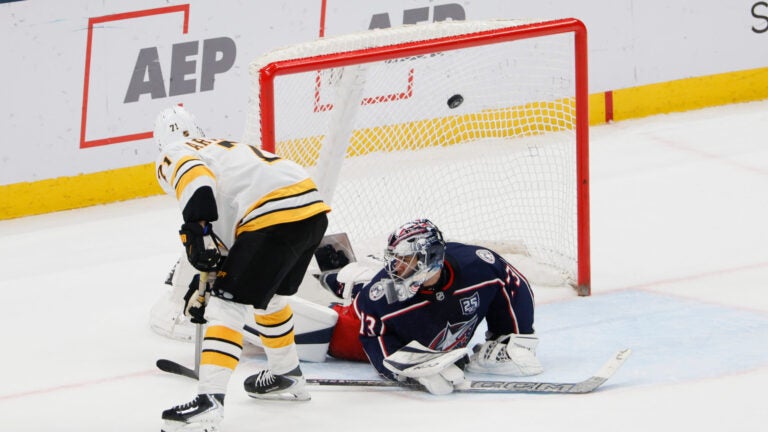
In championship battles, Boston’s favorite foils are folks from St. Louis
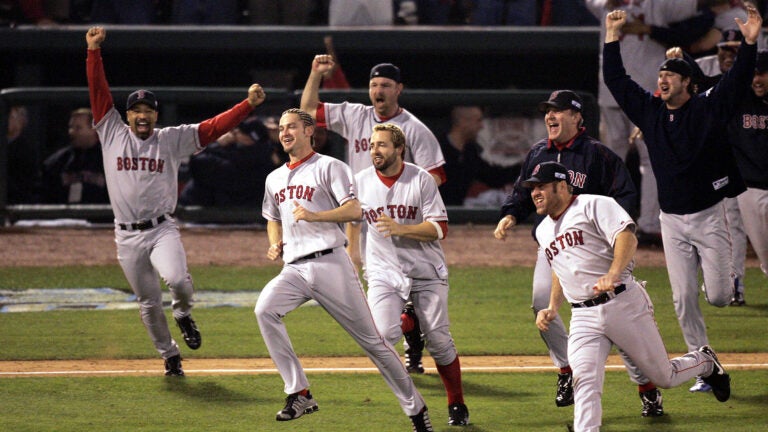
When beginning to ponder the rivalries of Boston’s four highest-profile sports franchises, a deep excursion into a vault of ancient highlight reels (or YouTube, for that matter) is not required. The championship victories and ones that got away are permanently committed to memory and heart, easily summoned whenever context is required or nostalgia desired.
These memories are easily sustained in part because the rivals are both long-running and recurring. When pondering Bruins lore, the Canadiens play the familiar villain. The Celtics’ rivalry with the Lakers connects from superstar to superstar through the generations. The Red Sox have the Yankees, of course, a feud that enjoyed a small but fulfilling revival this weekend.
And the Patriots have . . . well, they had the Jets once upon a time, though their only competition nowadays is their quest to become the dynasty of all dynasties.
I mean, seriously . . . the Jets?
But as a collective, the four franchises have a particular championship rivalry with a specific city, yet it’s one that often goes overlooked.
Check this out: The Patriots, Red Sox, Celtics, and Bruins have all won championships by defeating teams from St. Louis. Seven of Boston’s championships — three for the Celtics, two for the Red Sox, and one each for the Patriots and Bruins — came at the expense of a St. Louis squad.
Boston is the only city to have defeated the same city in four sports with a championship at stake. That’s especially remarkable considering that St. Louis no longer has an NFL or NBA franchise.
With the Cardinals — the Red Sox’ World Series victims in 2004 and ’13 — coming to town for a three-game set at Fenway Park beginning Tuesday, it’s a fitting time to take a look at the cities’ rich but unheralded sports history. One for which Boston fans should be especially grateful lately.
■ Red Sox vs. Cardinals
The Yankees weren’t the only ghost the Red Sox exorcised in 2004. There was appropriateness to be found — and an additional sense of closure, too — in sweeping the Cardinals in the World Series to end an 86-year championship drought.
Whether it was Enos Slaughter’s mad dash home to beat the Red Sox in ’46, or Bob Gibson’s dominance in ’67, the Cardinals were as complicit as any franchise other than the Yankees in making sure the Red Sox’ dreams remained impossible to fulfill.
The Red Sox and Cardinals have met four times in the World Series, tied with the Giants-Athletics and Cubs-Tigers for the most Fall Classic pairings not involving the Yankees. The Red Sox, as you may recall, won the last two.
The 2013 showdown was the most recent and certainly was satisfying, but 2004 forever remains the most relevant. The victory felt almost anticlimactic at the time because it was a sweep coming on the heels of the breathtaking comeback against the Yankees. But those Cardinals were a 105-win team. Beating them was not easy. In that cathartic October, the Red Sox just made it look that way.
■ Celtics vs. Hawks
A basketball junkie’s retroactive daydream: Wouldn’t it have been something if the NBA and ABA champions had met in a something like the basketball equivalent of the Super Bowl in the ’70s?
Imagine if the 1975-76 Celtics of John Havlicek, Dave Cowens, and Jo Jo White had played the ABA champ New York Nets of Julius Erving, John Williamson, and Brian Taylor. Basketball history would be that much sweeter.
This crossed my mind while looking back at the basketball history between Boston and St. Louis, which is richer than fans of recent generations may realize. St. Louis had a comical and yet iconic franchise in the ABA, the St. Louis Spirits, which featured Marvin “Bad News’’ Barnes during his post-Providence pinnacle.
That team never encountered the Celtics, of course, but there is a rich NBA heritage between the two cities. You just have to step into the time machine a bit.
Before moving to Atlanta in 1968, the Hawks belonged to St. Louis. And they were good. Led by Hall of Fame forward Bob Pettit, they collided with the Celtics four times in the Finals between 1957 and ’61, even winning in ’58 when Bill Russell was hobbled by an ankle injury suffered in Game 3. Pettit scored 50 points in the decisive sixth game.
That would be the only blemish for the dynastic Celtics in a decade; they won every other championship from 1957 to ’66.
Their greatest win in that span was the trade that led to it all. On draft day 1956, Red Auerbach sent Ed McCauley and Cliff Hagan to the Hawks for the rights to Russell, the No. 2 overall pick.
Russell would go on to become the greatest winner in professional sports history. The Hawks would go on to Atlanta.
■ Bruins vs. Blues
How’s this for a goofy playoff system? When the NHL expanded for the 1967-68 season, doubling its number of franchises to 12, the Original Six, including the Bruins, formed the Eastern Conference, while the half-dozen new clubs became the Western Conference.
This setup assured that an expansion team would make the Stanley Cup Finals, which led to some rather anticlimactic outcomes. The St. Louis Blues were the beneficiary of this, winning the West in 1968, ’69, and ’70 — yet never winning a game in those three seasons in the Finals.
The Canadiens swept them the first two seasons, then the Bruins overwhelmed them in ’70, outscoring the Blues in the four-game sweep, 21-7.
St. Louis did give Boston an overtime battle in Game 4, though, and that’s a good thing. Otherwise, your favorite sports bar wouldn’t have the familiar image of Bobby Orr flying through the air a moment after scoring the Cup-clinching goal hanging prominently on the wall.
■ Patriots vs. Rams
The Rams, with their electrifying Greatest Show on Turf offense, were a year removed from a championship and a two-touchdown favorite. The Patriots were a year removed from a 5-11 record, had a former sixth-round pick in his second season starting at quarterback, and were perceived as one of the weaker Super Bowl entrants in recent memory.
A dynasty was supposed to be born that night in New Orleans, and one was. It just happened to be a dynasty no one saw coming.