
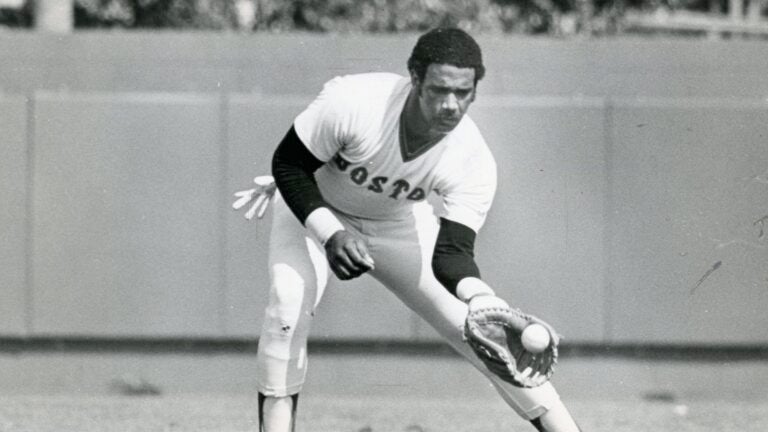
Which player had the best peak, Jim Rice, Fred Lynn, or Dwight Evans?
Welcome to Boston.com’s Sports Q, our daily conversation, initiated by you and moderated by Chad Finn, about a compelling topic in Boston sports. Here’s how it works: You submit questions to Chad through Twitter, Facebook, email, his
Friday chat, and any other outlet you prefer. He’ll pick one each day (except for Saturday) to answer, then we’ll take the discussion to the comments. Chad will stop by several times per day to navigate. But you drive the conversation.
In their prime to start a team, who would you take: Jim Rice, Fred Lynn or Dwight Evans? – Stephen K.
Well, now, here’s a question in my wheelhouse. And I’m not sure there’s a wrong answer. All three – which essentially comprised the Red Sox’ outfield from 1975 to ’80, which was Lynn’s last season in Boston, regrettably – have a decent case as the one you should take.
Lynn’s Rookie of the Year/Most Valuable Player season in ’75 is a part of baseball lore. Rice had 46 homers and 406 total bases in his MVP year, ’78. And Evans, while a relative late bloomer, might have had the longest peak of the three and is on the short list of the best defensive right fielders of all time.
For the sake of actually answering the question, let’s identify each player’s peak as the best three to five-year stretch of his career.
For Rice, it’s 1977-80, though 1976-79 would also yield similar results. In that stretch, his ages 24-27 seasons, he slashed .314/.368/.577 with an average of 37 homers, 117 RBIs, 192 hits, and 106 runs. And that’s with his ’80 season being abbreviated to 124 games because of a broken wrist.
Take the ’80 season out and limit it to 1977-79 and Jim Ed’s numbers are staggering: .320/.376/.596 with an average of 41 homers, 128 RBIs, 386 total bases, and even a dozen triples a season.
He won that ’78 MVP, of course, and finished in the top five two other times.
For Lynn, I’m going make it a five-year stretch since his two best seasons – ’75 and his monstrous ’79, when he hit 39 homers and led the league in batting (.333), on-base percentage (.423) and slugging (.677) – were sandwiched around three good but not quite sensational years.
From 1975-79, his ages 23-27 seasons, Lynn slashed .308/.381/.523 with an average of 22 homers, 90 RBIs, 90 runs, and 37 doubles. He won the MVP in ’75, finished fourth in ’79, and won three Gold Gloves in center field.
Evans? He’s tricky. Per OPS+, he was an above-average offensive player every season from 1974 to ’91, that weird final year in Orioles orange. His best season in terms of OPS+ was the strike-shortened ’81 season, when he finished with 22 homers, tied for the most in the AL.
But he didn’t really peak until he was in his 30s, and even then it was more of a prolonged stretch of general excellence rather than a three- or four-year stretch of dominance. Consider: From 1982-89, an eight-season span, Evans averaged 27 homers, 96 RBIs, and 96 walks while slashing .280/.385/.496. He also won four of his eight Gold Gloves in that window.
Man, Evans was really good for a long time. His best three-year stretch? Amazingly, it was probably his ages 35-37 seasons from 1987-89, when he averaged 25 homers, 111 RBIs, and 94 walks while slashing .294/.397/.507. He was past his prime as a defender at that point and finished no higher than fourth in the MVP voting. But was he ever an offensive force.
So to answer a question that has many satisfying conclusions, I think Rice’s stretch from 1977-79 was the peak among peaks, even if he wasn’t the defensive force Lynn and Evans were. But if you’re starting a team and looking for the most well-rounded player, there are arguments to made for Lynn and Evans. What do you guys think? Let me hear your arguments in the comments.


To comment, please create a screen name in your profile
To comment, please verify your email address
Conversation
This discussion has ended. Please join elsewhere on Boston.com