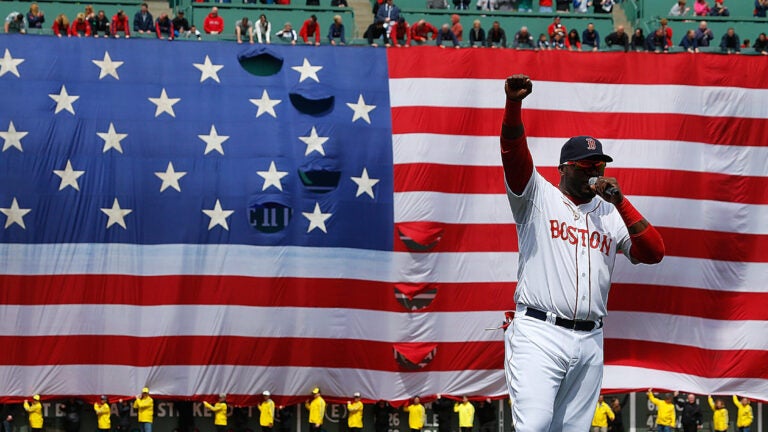
Manny Ramirez was an all-time great hitter, but where exactly does he rank?
The Red Sox great is in rare company.
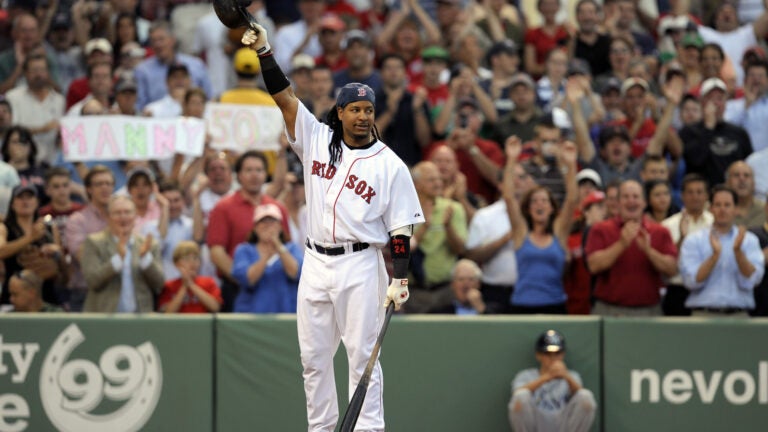
COMMENTARYOne thing you used to hear a lot around here was that Manny Ramirez was the best right-handed hitter in baseball history. Red Sox fans would add the “righthanded” qualifier because they knew that the best hitter who ever lived was lefthanded hitter Ted Williams (or lefties Barry Bonds or Babe Ruth). Which got me wondering — just where does Ramirez rank among the best right-handed hitters of all-time?I decided to look at this through the prism of career batting value, rather than look at peak value or individual best seasons. No defense or baserunning will be applied here. This approach admittedly favors Ramirez. Ramirez was remarkably consistent throughout his career, as he didn’t really have a decline phase as a hitter (he hit 40 percentage points better than league average in his last full season). And obviously, Ramirez’s defense and baserunning were never his strong suits. But I’m not trying to determine whether he was the best righthanded hitting player. No rational person would argue Ramirez was a top-10 player all-time. But as a hitter? Well, let’s see.Since 1901, there have been 99 righthanded hitters (I excluded switch-hitters) who have compiled at least a .350 on-base percentage (OBP) and a .450 slugging percentage (SLG) in a career with at least 5,000 plate appearances. Notable players meeting the OBP and SLG thresholds but not the PA threshold include current players like Mike Trout, Kris Bryant, Buster Posey and Paul Goldschmidt, Negro Leagues players who didn’t play for long enough in MLB like Roy Campanella and Monte Irvin, and turn of the 1900s players like Ed Delahanty. Some of these players may or could have factored in the discussion, but we won’t focus on them here. (Hopefully someday we will receive the miracle of comprehensive Negro Leagues statistics.)I cast a wide net in terms of making my list of 99 players – it included good-not-great players like Kevin Millar and Jason Bay. I also looked at a variety of stats, focusing on nine in particular – six rate-based stats, and three counting stats. There were 33 hitters who featured among the top 10 of these nine stats. The best hitters who weren’t top 10 in any category were Gary Sheffield, Ryan Braun, Mike Piazza and Frank Howard – top-shelf hitters, all, so you know we’re in rarified air.Here’s how our candidates stack up in the three counting statistics. Here, the players are sorted by wRAA, or Weighted Runs Above Average. It’s a counting stat that measures the number of offensive runs a player contributes to their team compared to the average player. Ramirez ranks eighth by this stat, a sign that he was very good for a very long time. Hank Aaron and Jimmie Foxx are sort of in a class by themselves, which is not surprising since they played for 23 and 20 seasons, respectively. Ramirez played for 19. Ramirez also ranks eighth in homers, and 17th in hits (15th in this group of 33). Total hits is where he ranks the lowest, something he owes to his high walk total.
 Here, we’re looking at triple-slash stats, AVG/OBP/SLG. Ramirez is one of just seven right-handed hitters ever to hit the hallowed benchmark of .300/.400/.500, along with Rogers Hornsby, Foxx, Frank Thomas, Edgar Martinez, Hank Greenberg and Harry Heilmann (again, min. 5,000 PA). He ranks fourth in SLG, sixth in OBP, and is tied for 18th with Martinez in batting average.
 Here we have some rate-based advanced statistics. Isolated Power (ISO) is simply SLG minus AVG, and is a way of showing how many extra bases a hitter compiled per at-bat. Ramirez ranks fourth-best in this category, behind just Mark McGwire, Greenberg and Foxx. Weighted On-Base Average (wOBA) is an important catch-all offensive stat that attempts to credit a hitter for the value of each outcome, rather than treating all hits as equal. It is the rate stat version of wRAA. Its one drawback is that it is not adjusted for ballpark effects, so hitters in friendly hitting environments will have a higher wOBA. Ramirez ranks eighth in wOBA. wRC+, our final (and my favorite) stat, does much the same work as wOBA, except it does account for park effects and run environment, so it is a great stat for comparing against different eras. It is scaled so that a 100 wRC+ is league average, so you would say that Ramirez — who ranks 10th here by wRC+ — was 53 percentage points better than league average.So, what’s the final verdict? Conservatively, you’d have to say Ramirez was one of the 10-best right-handed hitters of all-time. He ranks in the top 10 in seven of our nine categories here, and many of the players who rank consistently above him – Rogers Hornsby, Jimmie Foxx, Hank Greenberg, and to a lesser extent, Harry Heilmann and Honus Wagner – played almost exclusively before Jackie Robinson integrated Major League Baseball (Greenberg’s final season was Robinson’s first, 1947). Ramirez wasn’t deficient in any one area, unlike say, Mark McGwire, who had a career .263 batting average. Among post-Integration players, I’d put only Hank Aaron and Willie Mays definitively ahead of Ramirez. Their career bulk outweigh any rate-based arguments. Frank Robinson vs. Ramirez is a good argument of bulk vs. rate, and to me, Ramirez and Robinson fit comfortably in with Frank Thomas, active hitters Albert Pujols and Miguel Cabrera (whose numbers are suffering/may suffer as they age), as well as with Joe DiMaggio, who straddled the Integration line. And of course, today’s players like Mike Trout could factor into the discussion one day as well.Depending on how you judge things, Manny Ramirez was one of the five-best right-handed hitters of all-time, and certainly is in the top 10. That Red Sox fans got to watch him hit every day in his prime was truly a privilege.