How the Red Sox stack up against their AL East rivals
COMMENTARY
When setting expectations for the 2017 Red Sox, the team Boston is most often compared to is Cleveland. And it’s not only because the Indians finished a game ahead of the Sox last season, swept them from the playoffs, then went on to win the pennant. Thoughts are already turning to the American League at large because Boston might not get much of a threat within the AL East.
According to Fangraphs, the Red Sox are projected to score more than any other team in the division, while also allowing fewer runs than any other club. That forecast makes sense when looking at the facets of each roster position by position. Here’s a breakdown of how the Red Sox stack up against their rivals in the AL East, and why Boston should be playing in the Divisional Round (at minimum) come October.
STARTING PITCHING
Top to bottom the best rotation in the East might reside in Tampa Bay. Chris Archer had a disappointing 2016, but he is capable of being an ace, and if his staff mates join the righty in delivering on their potential the Rays could roll out a rotation of five hurlers with sub-4 earned run averages.
The Blue Jays’ rotation is intriguing, too. Marcus Stroman was a chic Cy Young pick before last season, then Aaron Sanchez pitched like an award candidate before his innings piled up. If J.A. Happ and Marco Estrada can exceed expectations again, so could the club as a whole. The Yankees could find themselves at the other end of the spectrum. Masahiro Tanaka is solid atop the rotation, but things could be ugly beyond Michael Pineda as their No. 2, undermining some of New York’s other strengths. Baltimore figures to have similar concerns. In fact, Fangraphs’ projections don’t show an Oriole starter with an ERA below Kevin Gausman’s 4.00, and in counting on veterans like Wade Miley and Ubaldo Jimenez their collective ceiling doesn’t look too high.
Overall, a case could be made that if Price was healthy the season would begin with the three best starters in the division all pitching in Boston, considering Rick Porcello is the reigning Cy Young winner, Chris Sale has finished no worse than fifth in voting for that award over the last four seasons, and Price has three times finished no worse than its runner-up. So if Eduardo Rodriguez makes a leap, and either Drew Pomeranz or Steven Wright is some semblance of the All-Star he was in 2016, Boston’s group of starters has a chance to be the deepest in the division. If injuries force them to go much deeper there should be trouble, but presuming reasonable health the Sox’ starters are a major asset.
RANK: Red Sox, Rays, Blue Jays, Yankees, Orioles
BULLPEN
Relievers can be unpredictable from year to year, but every team in the division should have supreme confidence in its closer. Aroldis Chapman rejoined the Yankees, joining the Orioles’ Zach Britton, Red Sox’ Craig Kimbrel, Blue Jays’ Roberto Osuna, and Rays’ Alex Colome as lock-down power arms in the ninth inning.
The questions come in getting to the closers, and that’s the weakest area on Boston’s roster in light of the Tyler Thornburg and Carson Smith injuries. If Joe Kelly, Matt Barnes and Heath Hembree flounder early, or if Kimbrel’s career-high rate of 5.1 walks per nine innings last year was a harbinger of persisting problems, the Sox’ bullpen could become a fatal flaw.
For the Yankees, it could be their greatest strength. Dellin Betances wasn’t as dominant as usual last season, but he remains a weapon among a veteran-laden group leading to Chapman. The Orioles are also stacked, with Darren O’Day, Mychal Givens, and Brad Brach all projected for more than a strikeout per inning. Neither the Rays nor the Blue Jays have that sort of power coming out of the ’pen, though both units have the depth to be decent.
RANK: Orioles, Yankees, Blue Jays, Red Sox, Rays
INFIELD AND CATCHER
Highlighted by the outstanding Manny Machado and the fear-inducing Chris Davis, the Orioles have a power threat at all five of these positions, especially if 25-year-old second baseman Jonathan Schoop can build on a 25-homer season. Buck Showalter’s team has thrived on the long ball for a while now, and this year will be no different — led by his infield.
The Blue Jays have Josh Donaldson to match Machado, but Toronto is slightly behind Baltimore across the infield, with everyday players like Russell Martin and Troy Tulowitzki starting to decline and Devon Travis needing to show he can endure a full season.
The Yankees have reason to be excited about the burgeoning bats of Gary Sanchez and Greg Bird, who project to hit a bunch of home runs, though elsewhere in the infield they’re really no better than replacement level. That’s better than the Rays, who don’t have a lot beyond Evan Longoria and his 2016 resurgence, but not enough to rate ahead of any other team in the East.
Boston has questions: Dustin Pedroia is a high-mileage 33-year-old; Mitch Moreland is a defensive asset, but had offensive troubles last year; Pablo Sandoval is a wild card; and the catcher spot is unlikely to contribute anything offensively. If everything clicks, and defense is factored in, the Sox should have the best infield in the division. At worst, it’s probably third.
RANK: Orioles, Red Sox, Blue Jays, Yankees, Rays
OUTFIELD AND DH
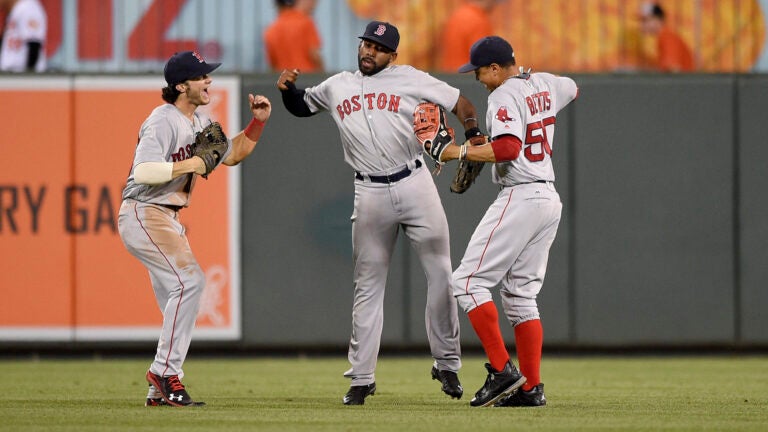
The Red Sox’ group features power, on-base ability, speed, and plus-defense — and that’s true even if Andrew Benintendi experiences some growing pains as the everyday left fielder. No unit in the division, or maybe across all of baseball, does so much collectively as well as Boston’s does.
Within the East, the second-best offense is up for debate. Adam Jones and Mark Trumbo give the Orioles a pair of big bats, but the corners figure to rotate with regularity. The Blue Jays also have a platoon situation in left field, and Kevin Pillar’s excellent defense in center, but there are boom-or-bust questions about what sort of difference aging sluggers Jose Bautista and Kendrys Morales can make in the middle of the order, especially in light of Edwin Encarnacion’s exit to Cleveland.
The Yankees have big names, as usual. Jacoby Ellsbury is still in center field, Brett Gardner is in left, and Matt Holliday has been brought in to DH. Five years ago, that would’ve made for a formidable lineup; today, not so much. The Rays might have the game’s most impactful defensive outfielder in Kevin Kiermaier, but he’s flanked by a couple of players who were supposed to be better than they are (Steven Souza Jr. and Colby Rasmus), and DH Corey Dickerson is no better than average.
Barring a major regression from Jackie Bradley Jr., or a return to disengagement from Hanley Ramirez, no division rival should come anywhere close to the Red Sox’ production at these positions.
RANK: Red Sox, Blue Jays, Orioles, Rays, Yankees
OVERALL
So how do the teams compare as a whole when their parts are summed? Assigning five points to our top-ranked team in a category, four for the second-ranked, and so forth until assigning the worst team one point, the Red Sox come through as a relatively clear favorite.
Boston gets 16 of a possible 20 points, followed by Baltimore (14) and Toronto (13). Those three incumbent playoff teams leave the Yankees (9) and Rays (8) lagging behind.