
Reviewing the Red Sox: David Price had a Pedro-type season — just not the one you wanted
The lefthander's frustrating first season in Boston is very similar to the former ace's final year here.
COMMENTARY
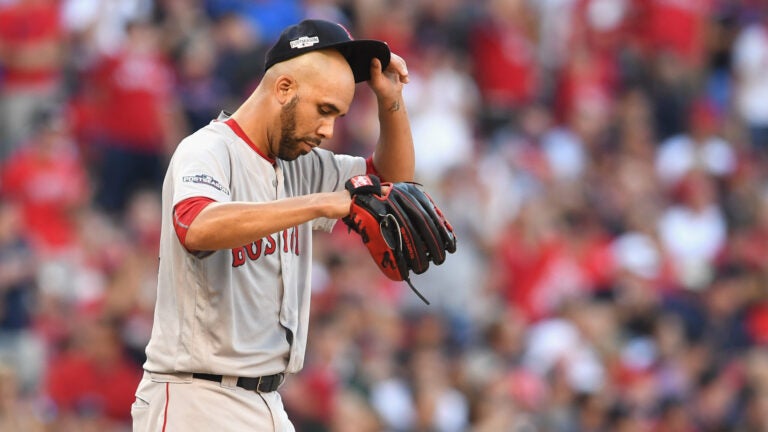
Other than perhaps paycheck envy, I do not know what your problem is with David Price.
No, I do not. After all, Price had a season reminiscent of one of Pedro Martinez’s most memorable seasons with the Red Sox. That’s right. Reminiscent of PEDRO. That Pedro. Not Pedro Borbon. Not Pedro Guerrero. Not the other Pedro Martinez.
The great Pedro Martinez, arguably the greatest pitcher of all time. The one who was at the height of his immense powers during his seven seasons here. The Pedro who makes you smile every time you see him back at Fenway. The Pedro who is the only redeeming personality on TBS’s postseason baseball broadcasts. That one.
I don’t know what more you guys could want, really. David Price is Pedro-like. Yes, he is. You’re so picky. Stop being so picky.
Now, this is the point where I wish I could convert to really small type — like, the barely readable kind that you see on those drug commercials during re-runs of The Middle, the ones that leave you bewildered and your kids asking questions that are unanswerable on 50 different levels. Right, the commercials with people in separate bathtubs for no apparent reason or have mascots that look like human intestines and stuff.
Because here is where we try to sneak the disclaimer by you: David Price’s season was extremely similar to one of Pedro’s seasons in Boston. Unfortunately, it was the 2004 season.
That, of course, is a year that is forever rewarding for Red Sox fans. It was also Pedro’s last in Boston. The season brought the end of the generations of torment, but it coincided with end of his Red Sox career and the beginning of his descent to baseball mortality. It’s a trade-off we’ll take 1,918 times out of 1,918, obviously. But it was no fun to watch his mojo fade in coincidence with his radar-gun readings.
Pedro’s 2004 season was not terrible. Nor was Price’s season this year. But neither was exceptional. They were, however, remarkably similar.
Pedro, at age 32, went 16-9 with a 3.90 ERA. He struck out 227 in 217 innings, with 26 homers allowed, a 124 ERA+, 1.17 WHIP, and 3.58 FIP.
Price, at age 30, went 17-9 with a 3.99 ERA. He struck out 228 in 230 innings, with 30 homers allowed, a 114 ERA +, 1.20 WHIP, and 3.60 FIP.
In both cases, exceptional was the expectation. It was not a prolonged bummer to watch Pedro slip, because the team payoff that October was a dream come true. It was, however, a frequent drag to watch Price struggle this year, because the Red Sox’ postseason stay was short, while his stay in Boston is just beginning. I don’t think we’ve already seen the best of him. But it isn’t out of the question, either.
At least Pedro left us with a memorable final scene, his point skyward as he walked off the mound at the end of his gem against the Cardinals in Game 3 of the 2004 World Series. Price’s story in Boston is just beginning, but so far it does not seem to be headed to a place we should anticipate with any eagerness.
That Price was pretty good, and occasionally great, but all too often exasperating in his first season with the Red Sox might have been the biggest frustration of this mostly successful season — especially since he was complicit in the disappointing ending, failing to get out of the fourth inning in a Game 2 loss in the ALDS.
Price’s inconsistency in his first year here wasn’t the only disappointment of the Red Sox season. I reviewed the five best things to happen to the 2016 Red Sox last week. Now, here are four other frustrations:
Xander Bogaerts’s second half: So much for that “who’s better, Betts or Bogaerts?” debate, at least for now. While Betts put together an MVP-caliber season at age 23, Bogaerts, his fellow super-talented, mature-beyond-his-years 23-year-old, kept pace with his buddy for a half-season … then promptly forgot again how to hit (or ignore) a slider away. It’s the same issue that ailed him in 2014, his first full big league season, when he hit .240 as a disappointing follow-up to his sterling October the previous season. Bogaerts fixed that hole with a breakthrough ’15 season, slashing .320/.355/.421 with 196 hits. He actually improved upon his ’15 numbers in several categories this year, including homers (21), runs (113), and OPS (.802). With limited context, it looks like a superb season. But in reality, it was a monstrous first half (.329/.388/.475) bonded to a fairly alarming second half (.253/.317/.412). Bogaerts is a terrific and admirable young player, and it looked like he was just pulling out of his malaise when the season ended. But it’s hard not to imagine what his numbers would have looked like had he been as successful in the second half as he was in the first.
Craig Kimbrel’s inconsistency: If you looked at Kimbrel’s rate stats and had to guess the relief pitcher to which they belonged, you might suspect you were looking at Zach Britton’s numbers, or maybe Andrew Miller’s production. In his first season with the Red Sox, Kimbrel allowed just 4.8 hits per nine innings, while striking out 14.1 batters per nine. Those stats strongly suggest dominance, and when he was on, he was unhittable. But we also know those stats aren’t telling us the full story. Kimbrel walked 30 batters in 53 innings, the most walks of his career since his first full season, when he walked 32 in 77 innings for the 2011 Braves. I don’t care how dominant you look or how impressive your stuff is; a closer who habitually loses the strike zone is a closer who can’t be completely trusted. He also struggled, puzzlingly and annoyingly, in non-save situations. I’d say his inability to close out the division clincher in New York is the perfect symbol of his season, but that’s only because he didn’t get a chance to walk four Indians in the ninth inning of a playoff loss.
The Drew Pomeranz trade, but not in the way you think: He was mediocre after the Red Sox acquired him in July, not to mention complicit in helping Coco Crisp gain his long-play justice on the franchise that benched him during the 2007 playoffs. I know I’m in the minority here, but I still like this trade. The Red Sox acquired a cost-controlled, pedigreed (he was a No. 5 overall pick) lefthander who has had recent success in multiple roles. They gave up Anderson Espinoza, an 18-year old pitching prospect of various levels of expectation who won’t be a prospect much longer if he has another season with a 4.49 ERA in Single A. My frustration isn’t with the trade, but with the consensus reaction around here to the trade. The value of a pitcher of Pomeranz’s relative achievement is underestimated, as you’ll see when the Red Sox barely blink before picking up Clay Buchholz’s $13.5 million option. And the value of a pitching prospect in Single A — if such a thing even exists, given the hazards every young arm faces en route to the big leagues — is vastly overestimated. It’s possible, if not probable, that Espinoza, promising though he has seemed, will never be as good as the slightly above-average Pomeranz is now. Sure, perhaps the Red Sox could have traded Espinoza as part of a bigger deal. It’s also possible that the Red Sox figured out Espinoza isn’t as promising as the outside prospect reports might suggest and realized other teams’ scouts were going to catch on soon. There’s a reason the Red Sox passed on the chance to reverse this deal after Padres GM A.J. Preller was exposed as a dishonest garden weasel yet again: They think they made a good trade. Maybe we should too.
A flop you remember, and one you forgot about: It’s funny in a not-that-humorous kind of way, but the Red Sox are in the same situation now with Pablo Sandoval as they were two years ago when they made the ill-fated decision to sign him: The position is a black hole. Sandoval was good once. What the hell, let’s see if he can be again. Two years ago, the Red Sox ignored the fact that Sandoval had declined as a hitter each year as his waistline expanded, and figured if he could just be average he would be a huge upgrade of the likes of Will Middlebrooks at third base. Now, after one miserable season in Boston and another lost to injury, the Red Sox look at the position again — which featured the Middlebrooks-like Travis Shaw, the willing-but-miscast Brock Holt, the tattered husk of Aaron Hill, and a not-ready-for-prime-time Yoan Moncada — and hope Sandoval can be useful again next year. I expect him to be about as useful as he was this year, albeit with more than 7 plate appearances. Hurry up and learn to hit the curveball, Yoan. As for that other flop: I guess Rusney Castillo isn’t going to be the next Ron Gant after all. He had more plate appearances with the Sox this year than Sandoval — eight, to be exact — and damned if my vague recollections of them feel like they happened five years ago.
Other considerations: John Farrell’s various perplexing tactical decisions (we’ve covered that turf enough, right?), Jackie Bradley’s second-half plunge, Travis Shaw’s post-May plunge, Junichi Tazawa’s burnout, Christian Vazquez’s feeble bat, the way it all ended.
Stay tuned for Part 3: The bewildering.




To comment, please create a screen name in your profile
To comment, please verify your email address
Conversation
This discussion has ended. Please join elsewhere on Boston.com