
Here’s what went wrong for the Red Sox against the Indians in the playoffs
Breaking down what happened in the American League Division Series.
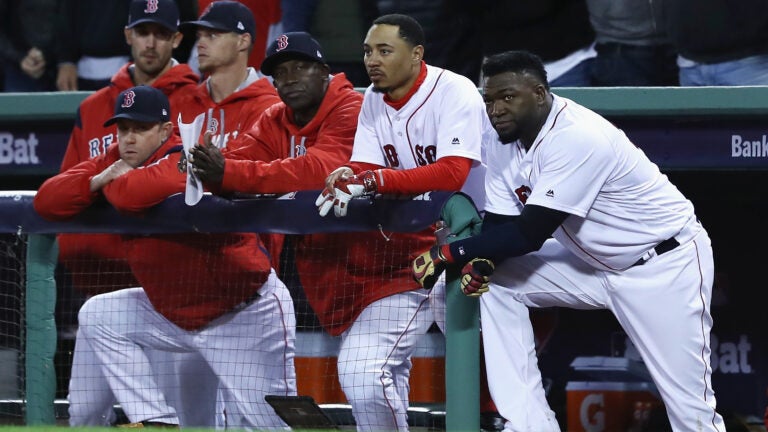
COMMENTARYThis wasn’t how it was supposed to end. Not the Red Sox’ season, and certainly not David Ortiz’s career. The Red Sox were the best team in the American League in the second half of the regular season, going 50-32 (.610) after July 2. They had the most potent offense in baseball by a considerable distance, and their Division Series opponent, the Cleveland Indians, had lost two of their top three starting pitchers to injury in September. It might have been underestimating Cleveland to say that the Sox should have won the series easily, but they should have won it. Instead, they didn’t even win a single game, sending Ortiz, one of the greatest postseason performers in major league history, into retirement without adding another big October moment to his legacy.To be fair, the series wasn’t as lopsided as the Indians’ sweep makes it seem. Games 1 and 3 were both one-run games that saw Boston make the final out with the tying run on base. It wouldn’t have taken much for either game to have gone the other way. In Game 1, for example, rookie pinch runner Marco Hernandez, running for Ortiz after his only hit of the series — a one-out double in the top of the eighth inning — failed to advance to third on a ball in the dirt. Had he done so, he might have scored the tying run on Hanley Ramirez’s subsequent groundout, a point Ortiz made clear to Hernandez in the dugout after he was stranded at third base by Xander Bogaerts’ subsequent strikeout. In the eighth inning of Game 3, Mookie Betts and Bogaerts both hit ringing line drives directly at infielders with respective exit velocities of 112.5 and 99 miles per hour, turning what looked like RBI hits off the bat into outs.Still, the Red Sox hit just .214/.278/.378 in the series. For all of the frustration over David Price’s performance in Game 2, you can’t win if you don’t score, and the Red Sox didn’t in that game, scattering three singles, three walks and a hit by pitch. They didn’t even get a runner past second base until there were two outs in the eighth inning. For the series, Ortiz went 1-for-9 with that Game 1 double, a pair of walks and a sac fly. Baseball is a zero-sum game, making it difficult to tell if such a performance is the fault of the Red Sox’ hitters or the Indians’ pitchers. But perhaps we should have paid more attention to how the Sox finished the regular season.The Red Sox finished the regular season by losing five of their last six games. That didn’t seem terribly troubling at the time, as they clinched the division early in that span and had just come off an 11-game winning streak. However, after averaging 5.5 runs per game through the first 156 games of the season, they scored just 2.8 runs per game over those final two series against the Yankees and Blue Jays. Again, sample size tells us that was a fluke at worst, a random dip in performance during the only time all season the team was playing meaningless games (and, no, home-field advantage in the Division Series is not meaningful). However, that performance carried over into the Division Series. Altogether, the Red Sox scored 2.7 runs per game in their final nine games this season, Division Series included, going 1-8 in those games. Meanwhile, Ortiz hit a mere .138/.257/.276 (4-for-29) over that stretch.It may have been bad luck — beyond the two line-drives mentioned above, the Red Sox stung the ball all series with little to show for it — but it’s also important to acknowledge that there was another team on the field. Thanks to Terry Francona’s aggressive use of his bullpen, Cleveland had one of its three best pitchers on the mound for 14 of the 27 innings in the series. Former Cy Young Award winner, and current Cy Young contender, Corey Kluber dominated for seven innings in Game 2, and relief aces Andrew Miller and Cody Allen combined for another seven innings split between Games 1 and 3. Cleveland also forced the action on the bases. I noted in my series preview that the Indians were the best baserunning team in the American League this year, and there was ample evidence of that in this series. Cleveland baserunners advanced two bases on a single six times in the series. Catcher Roberto Perez tagged up from first and went to second on a deep fly ball to left field in Game 1 then scored from second on a single in a game the Indians won by one run. Brandon Guyer went first to third on the ball that got through Dustin Pedroia’s legs in Game 2 then scored on a sacrifice fly. Mike Napoli, of all people, executed a delayed steal on a ball in the dirt earlier in Game 2. In total, Cleveland took the extra base 10 times in the series while only running into an out on the bases twice. Those baserunning plays led directly to seven of the Indians’ 15 runs in the series.You’ll note that other than a passing mention of Price, I haven’t mentioned the Red Sox’ starting pitchers at all. Certainly Rick Porcello and Price turned in disappointing performances, but Clay Buchholz actually pitched pretty well in Game 3 before getting an early, but appropriate for an elimination game, hook. I’m simply not convinced that any of the three were the reason the Red Sox lost their respective games. Price could have just as easily lost to Kluber and company 1-0 as 6-0 in Game 2, and the Indians’ hustle on the bases and the shortcomings of the Red Sox’ lineup — be it due to a collective slump or simple bad luck — were what sank Boston in the other two games. It’s also worth noting that, as poorly the rotation performed as a unit — 12 runs allowed in 11 2/3 innings, with just two of those runs scoring after the starter in question had been removed from the game — the bullpen was similarly outstanding. Boston’s relief pitchers, including repurposed starter Drew Pomeranz, allowed just three runs, two earned, in 13 1/3 innings (1.35 ERA) while striking out 17 men against just three walks. Even if you include the unearned run and two inherited runners who scored on their watch, the ‘pen’s runs allowed per nine innings would be 3.38. Indeed, if there was a silver lining to this series, it was that Joe Kelly continued his emergence as a potentially elite set-up man, appearing in all three games and working 3 2/3 perfect innings.In the end, however, the why is less important than the simple fact that the Red Sox’ season, and Ortiz’s career, did end prematurely. That can’t be fixed through explanation. However, Ortiz’s disappointing performance can be forgiven given his looming retirement and the many great moments he provided for Boston fans in past Octobers, playing a key role on three Red Sox championships, a phrase which still sounds impossible to fans who came of age prior to the 2004 season. As for the rest of the 2016 Red Sox, most of them will be back next year in the hope of making it deeper into the postseason. Ortiz may be gone, but this team is just getting started.



To comment, please create a screen name in your profile
To comment, please verify your email address
Conversation
This discussion has ended. Please join elsewhere on Boston.com