
Red Sox paying for David Price’s struggles while Jon Lester proves worth for Cubs
COMMENTARY
The ace has become a punchline.
The Red Sox were dutifully embarrassed Friday afternoon in Cleveland, but it took a few hours for the comeuppance to really settle in.
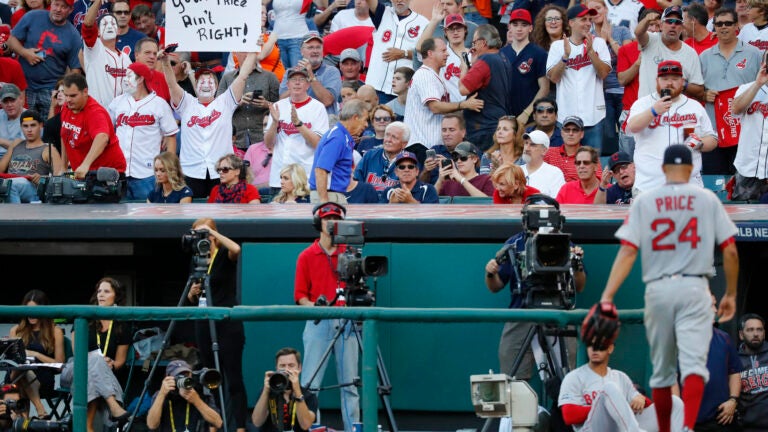
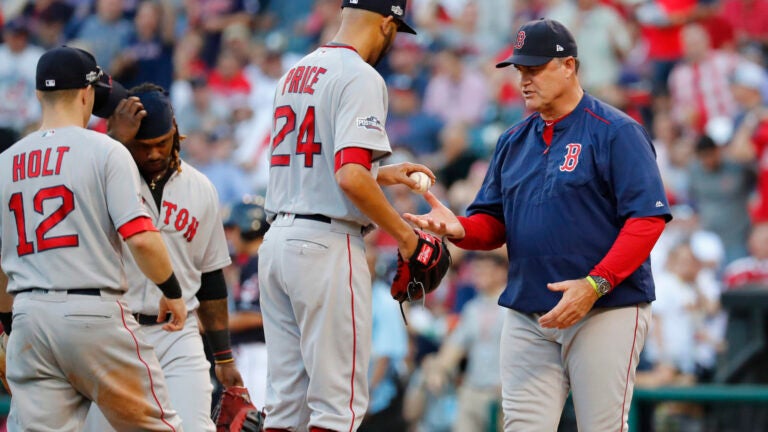
Not all that long after Boston’s $217 million man, David Price, left the mound giving up six hits and five runs over a measly 3 1/3 innings in Game 2 of the American League Division Series, it was Jon Lester, pitching for the Chicago Cubs on Friday night, who may have amplified the laughter in the Indians’ clubhouse, where manager Terry Francona must be getting a real kick out of being up 2-0 on the team that unceremoniously fired him five years ago.
As if that series deficit wasn’t enough to demoralize the Red Sox as they slink back to Boston in time for Sunday’s Game 3 at Fenway Park, it was their old, low-balled friend Lester who put the finishing touches on the worst night possible, masterfully handling the San Francisco Giants in a 1-0 gem at Wrigley Field.
Lester went eight innings, allowing only five hits in Game 1 of his team’s National League Division Series. It was the sort of performance the Cubs came to hope for from Lester, who is now 7-6 with a 2.63 postseason ERA, one of the primary reasons why Theo Epstein felt satisfied giving his former draft pick $155 million over six seasons.
It was Lester’s first postseason win since 2013, when he won the World Series with the Red Sox. He might have another one in him this month with the Cubs.
Price, of course, is still waiting for his first postseason win as a starter (oh, ask him, and he’ll be sure to defensively remind you that he has two as a reliever), a victory that seems it might always elude him. In a 1-0 hole on Friday, the Red Sox needed the David Price they handsomely paid for during the offseason, handing the pitcher more money than they had ever given any other player with the expressed confidence that his October troubles were merely a matter of circumstance.
As it turns out, nope.
Price was as bad as any Red Sox fan could have possibly feared against the Indians. He insisted the ball he threw to Lonnie Chisenhall, who hit a three-run home run off the so-called ace to help lift the Indians to a 6-0 win, was a decent pitch. He’s trying to calm the nerves of a fan base that has been here before, on the brink, only to be proven wrong.
But it’s impossible to buy into his bravado.
“Made some pitches, didn’t have good things happen. That’s part of it,” Price told reporters after taking his eighth career playoff loss. “Our confidence isn’t altered. This is a very confident group, even though we’re down 0-2 right now. This team has been there before. We’re all right.”
Kevin Millar saying it is one thing. Dustin Pedroia saying it is another.
David Price boldly proclaiming that he knows he’ll pitch again this month, when and if the series shifts back to Cleveland for Game 5 sounds like an empty promise, sort of like Price’s first season with the Red Sox as a whole.
Nobody believes in his purported confidence.
“I know my number’s going to get called again to pitch a game in 2016, and I’ll be ready,” Price said. “I want it, for sure, and I know these guys will give it to me.”
There’s a phony aura that follows Price much of the time, perhaps a natural reaction to adjusting to a new team with the apparent burden of his historic contract. But after Friday night, the hope would be that it would fade away just for a brief period.
Price can get angry and stubborn. In fact, his best stretch of pitching late this season happened to be when he was at his most ornery. But his competitive spirit can’t seem to acknowledge such blatant disappointment. It almost appears as if Price has a hard time dealing with the reality that he needs to be the Red Sox’ most important pitcher. He is the stopper, a role that he took on Friday and handled it with the same tangled confusion that is his playoff record.
In the end, it leaves the Red Sox looking foolish.
Four years, $70 million. The numbers will haunt Boston as long as Lester is sticking it to them in Chicago.
Had the Red Sox initially offered something in the neighborhood of what Lester was worth, they might not be in this situation to begin with. Instead, he signed a deal with the Cubs worth $155 million over six years in December 2014. Earlier that year, team owner John Henry had discussed his weariness of signing players over 30 to long-term deals. In December 2015, the Red Sox handed now-31-year-old Price a deal worth $217 million over seven years.
The short-term risks of these decisions played out on the playoff stage on Friday. Price was terrible. Lester was magnificent.
The Cubs very well might win the World Series. The Red Sox will likely deliver a depressing end to David Ortiz’s career on Sunday afternoon. Swept by Francona.
What the Cubs saw from Lester Friday was everything the Red Sox didn’t from Price. Talent aside, location and pitch selection disregarded, Lester brings the confidence and resolve to the mound that Price can only try to make you believe he possesses. It’s now clear that he has none.
The Red Sox didn’t want to pay for the genuine machine, only to realize their mistake and end up paying top dollar for a generic knockoff. Now, they’ll be going home early.
Price may want to pitch again in this series. But is there any guarantee the Red Sox even want him to after what they watched Friday?
It’s not like the Red Sox shouldn’t have known. But their mistake goes back much further than believing Price would be a good fit here.
The joke’s on all of us.



To comment, please create a screen name in your profile
To comment, please verify your email address
Conversation
This discussion has ended. Please join elsewhere on Boston.com