
Breaking down the American League MVP race: Mookie Betts battling Mike Trout and even his own teammates
COMMENTARY
As the Red Sox’s September surge sucks the suspense out of the AL East race–now 13-5 on the month, the Sox lead the second-place Blue Jays by four games with 11 left to play–the focus around the local nine has shifted from the pennant race to the awards races, for which Boston has several compelling entries. Rick Porcello’s tremendous second half–and similarly impressive run support–has made him an unexpected Cy Young favorite. Meanwhile, among the team’s numerous candidates for Most Valuable Player, two have garnered significant support from the Boston faithful: retiring great David Ortiz and emerging superstar Mookie Betts.
Consider this a reality check. As great and historically significant as his performance this season has been, David Ortiz is not going to win the American League’s Most Valuable Player award. No major leaguer has ever won an MVP award for a season in which he has appeared in more than 65 games as a designated hitter (that upper limit having been set by the Angels’ Don Baylor in 1979). Ortiz, who has played just five innings in the field this season, won’t win the award not because no DH ever has, but for the same reasons that no DH ever has: his complete lack of defensive contributions and the corresponding lack of contributions on the bases.
Wins above replacement aren’t the final word on anyone’s MVP candidacy, but they illustrate the futility of a designated hitter candidacy quite simply. Since the arrival of the DH in the American League in 1973, the record for wins above replacement (Baseball-Reference.com version, hereafter bWAR) by a player who appeared as a DH in at least half of his games was Edgar Martinez’s 7.0 in 1995. Already this season there are three fielders in the American League who have surpassed that total, and there is still a week and a half remaining (WAR is a cumulative statistic). Ortiz’s career high is 6.4 bWAR in 2007. His total this year is his highest since then, but, even after his strong showing Tuesday night, it is still just 4.9 wins above replacement.
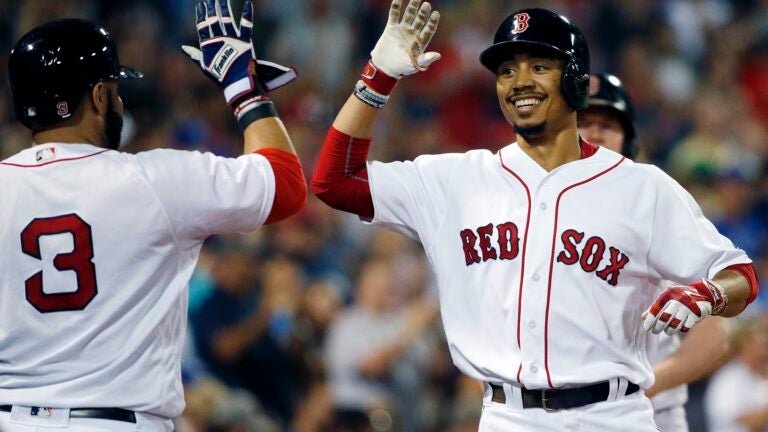
If Red Sox fans want to pin MVP hopes on one of the locals, they’re far better off focusing on Betts, who is one of the three American Leaguers to exceed 7.0 bWAR thus far this season. Betts’ rate of production at the plate falls short of Ortiz’s, but his contributions in the field and on the bases, not to mention the fact that he has played in eight more games and come to the plate 107 more times than Ortiz, have made him almost literally twice the contributor that Ortiz has been this season. Betts leads the American League in hits (201), runs (115) and total bases (344), has stolen 24 bases at an 86 percent success rate, and grades out as one of the best defenders in the league according to the advanced fielding metrics.
Betts has inarguably been one of the handful of best players in the AL this year, and one of the two best per bWAR. However, the best player in the league by that measure has, once again, been Mike Trout. Here’s a side-by-side comparison through Tuesday night’s games:
| Trout | Betts | |
| AVG | .318 | .317 |
| OBP | .438 | .358 |
| SLG | .555 | .542 |
| OPS+ | 175 | 131 |
| wOBA | .418 | .379 |
| bWAR | 10.0 | 8.9 |
| fWAR | 8.7 | 7.3 |
| WARP | 8 | 6.5 |
OPS+ is on-base percentage plus slugging percentage adjusted for ballpark and scaled against a league average of 100; wOBA does a similar thing but placing appropriate added emphasis on on-base percentage and placing the result on the batting average scale; bWAR, fWAR and WARP are the wins above replacement statistics of Baseball-Reference, FanGraphs and Baseball Prospectus, respectively, all three are cumulative measures that take into account hitting, running and fielding.
Betts leads Trout in numerous raw cumulative categories (hits, runs, doubles, home runs, RBI, total bases), but has had the significant advantages of both a far more hitter-friendly home ballpark and a far more productive lineup in which to hit. The latter has helped Betts come to the plate 54 more times than Trout in the same number of games thanks to the Red Sox’s order turning over more often than the Angels. The former is best illustrated by a comparison of the two player’s road splits:
| AVG | OBP | SLG | OPS | |
| Trout | .306 | .419 | .570 | .989 |
| Betts | .294 | .352 | .484 | .836 |
Despite the difference in their ballparks, Trout has out-produced Betts at the plate on a per-plate-appearance basis on the season as a whole. That gap only widens when ballparks are taken into account, as indicated by OPS+ and wOBA above. Trout also bests him in all three versions of WAR, which are cumulative and factor in baserunning and defense. As someone who believes that the best player in the league is the most valuable player in the league (and believes that definition is indeed contained in the official instructions to the voters which define the “actual value of a player to his team” as “strength of offense and defense”), I believe that Trout, for the fifth season in a row, is the most deserving candidate for AL MVP. That does not, however, mean that I think he will win the award.
Indeed, recent history strongly suggests the voters will pass Trout over yet again. Though deserving in every one of his full major league seasons, Trout has only won the AL MVP once, that coming in 2014, the only year of his career that the Angels have made the playoffs. With the Halos already eliminated this year, it’s very possible that Trout could be robbed of the award yet again. Similar logic could undermine Jose Altuve’s candidacy should the Astros also miss the postseason, which they seem likely to do, falling well short of preseason expectations.
That could boil the MVP race down to three players, all from AL East teams: Betts, Orioles third baseman Manny Machado, and defending AL MVP Josh Donaldson of the Toronto Blue Jays. Of those three, Betts is both the most deserving candidate and the representative of the best team. However, the latter could hurt him. Ortiz won’t win the award, but he will get some votes, possibly even a first-place vote from a local writer (two writers from every city represented by an American League team vote for the award with the specific voters from each market changing from year to year; I do not have an MVP vote this year). Meanwhile, Dustin Pedroia, Jackie Bradley Jr. and Porcello have all been at least as valuable as Ortiz this season, suggesting the possibility of even more Red Sox votes being siphoned away from Betts. Alternately, some voters could reason that Betts had too much support from his teammates, which could push them toward Machado, who stands out more clearly on the Baltimore roster.
None of that is justifiable, of course. Voting for an individual award should be based on the performance of the individual alone, separate from that of his teammates and, thus, of his team. Still, unsubstantiated by the numbers though it may be, an MVP award for Betts is a distinct possibility. I’ll stop short of calling him the favorite just yet, however. With the first-place vote likely to be split and Trout likely to finish no worse than second on most ballots, as was the case in 2012, ’13 and ’15, Trout may yet take home the hardware almost by default. Also, with a week and a half left to play in the season, there’s still time for any one of the above-mentioned candidates to alter their candidacy with a season-closing streak or slump.



To comment, please create a screen name in your profile
To comment, please verify your email address
Conversation
This discussion has ended. Please join elsewhere on Boston.com