
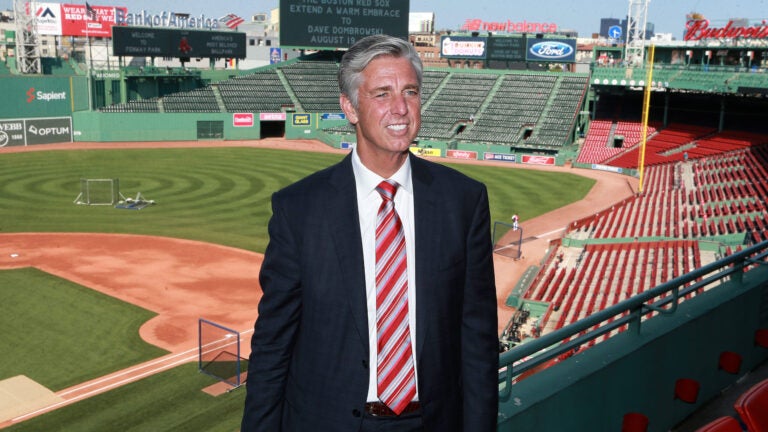
Dave Dombrowski will have a lot to process when it comes to judging John Farrell
One makes bold decisions based on common sense. The other is the Red Sox manager.
COMMENTARY
The majority of sports fans – especially in our parochial corner of the country – are reactionary. I’m not being judgmental when I say that; it’s a perfectly normal, visceral way to respond to the ebbs and flows of following a sports team, a way to briefly escape from the daily weight of our serious lives. Sports matter, but they don’t really matter at all. Sometimes it’s just fun to yelp about stuff.
I get that. My problem comes when the process of how a decision is made – and the thought-process that went into it at the time — is ignored and our reaction is based entirely upon results. Revisionist history has little to do with history and everything to do with the reviser’s desperation to look like he’s right at all times. The shameless dishonesty of it all aggravates me almost as much as the notion that David Price is “soft,’’ whatever that is supposed to mean. I don’t care to hear the explanations.
There is one specific flame-broiled take that was bubbling up in the sludge, at least before the Red Sox swept the Diamondbacks to salvage a 4-2 homestand, and it’s one that annoys me more than most: How much is Dave Dombrowski to blame for the Red Sox struggles? The answer, at least when the process is considered, should be rather obvious: Not a whole hell of a lot, and certainly not as much as John Farrell, who sometimes turns game management into bizarro performance art. And not as much as the various players – Price chief among them, even as he picked up his 10th win Friday night – who have significantly underperformed.
Dombrowski took over for Ben Cherington last August 18. When he began renovating the roster in his own design in December, he signed Price to be the ace, traded four quality prospects (but not their best prospects) to the Padres for accomplished closer Craig Kimbrel, traded mediocre Wade Miley for hard-throwing reliever Carson Smith, and signed respected righthanded hitting platoon outfielder Chris Young.
Dombrowski worked swiftly to acquire the players he targeted, and the approach was applauded by a consensus. He put the same aggressive, confident tactics into action before the August 1 non-waiver trading deadline, trading for All-Star lefty Drew Pomeranz, reliever Brad Ziegler, and veteran infielder Aaron Hill. All of the players filled a need, presumably, and he got them well before the hourglass ran out on deadline day. He also had the good sense to give Andrew Benintendi an opportunity despite barely a full season in pro ball. That seems to be working out OK.
In terms of process, Dombrowski deserves high marks. But there does seem to be some reluctance among Red Sox fans to give them to him because the results haven’t always met expectations – and in Price’s mystifying case, have wound up a great distance south of the expectations. Meanwhile, none of the aforementioned acquisitions, save for maybe Ziegler, have met expectations, let alone exceeded them. Hill has been decent, nothing more. Kimbrel has had his hiccups, especially when the game isn’t on the line. Smith and Young got hurt. Pomeranz has been the modern day Kent Mercker. (Not a compliment.)
Dombrowski made all the moves he was supposed to make. He got talented and often long-established players. He built a theoretically strong ballclub, and he did it while keeping the major league roster’s young core intact (Mookie Betts now has more homers than David Ortiz) and without gutting the farm system. For the most part, it’s been a job very well done. He made the moves he was supposed to make, and he made them, boldly.
Which happens to be the exact reason Dombrowski deserves much more leeway than Farrell should the Red Sox fall short of the postseason. (Right now they are 64-52, two games back of the Blue Jays in the division and positioned as the second wild card, 1 ½ games back of the Orioles. Hardly a bad spot.)
When Dombrowski’s moves don’t work out, at least the reasoning behind them is usually sound. When Farrell’s moves don’t work out, too often they’ve already left you bewildered before the bad result inevitably comes around.
It’s been nine days now, and I still cannot understand why Steven Wright – who looks like the guy standing in front of you in line at Dunkin’s every morning who can never resist adding a coffee roll to his order – was used as a pinch-runner against the Dodgers.
Farrell sometimes does things that are so inexplicable that when they go wrong it almost feels like justice. That wasn’t supposed to work, and it didn’t, and thus all is right in the baseball universe. Hell, he still owes the baseball gods for letting him get away with batting Brandon Workman in a tie game in the ’13 World Series.
He’s been here four seasons now, and I still don’t know if Farrell is truly a poor manager, a mediocre one, or one who is actually super-valuable at the elements of the job (communication, culture, player development) that don’t involve tricky double-switches and quick tactical thinking.
He does weird things, but he does some things right, too. (The kids have developed on his watch, for one.) But I do know this much for sure Farrell had better get the Red Sox to October this year, and for more than just one postseason game. If he doesn’t, the next step in his boss’s string of bold but sound processes would have to be to find a manager who can. It would be the only logical result.
An historical look at Fenway Park
[bdc-gallery id=”115689″]





To comment, please create a screen name in your profile
To comment, please verify your email address
Conversation
This discussion has ended. Please join elsewhere on Boston.com