
Drew Pomeranz trade a worthwhile gamble for the Red Sox
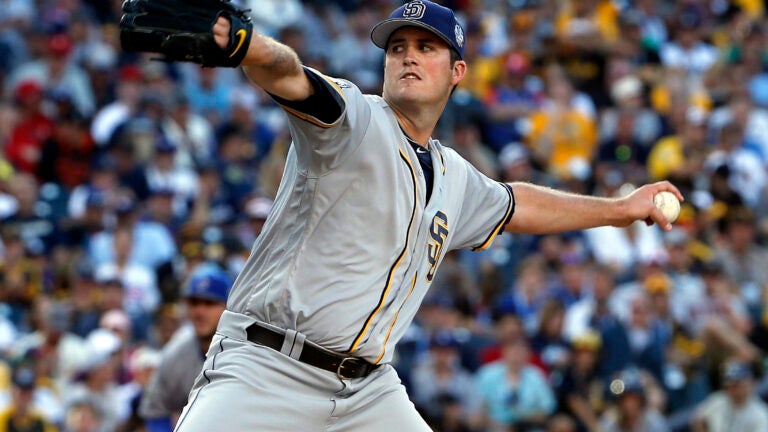
The 27 year-old southpaw was in the midst of an All-Star season in San Diego.
COMMENTARY
There are three players central to the Drew Pomeranz-for-Anderson Espinoza trade. The two principals, of course, and David Ortiz. It is because of Ortiz, and the final season he is producing, that the Red Sox are being so aggressive on the trade market, filling needs and filling them well in advance of the deadline, so as to help bring the Red Sox to October in Ortiz’s final season. This latest move brings a promising pitcher fulfilling his potential into the fold.
First, the faithful departed. Espinoza might someday pitch in All-Star Games. As Chad Finn mentioned earlier today, Espinoza has drawn favorable comments from Pedro Martinez. But this season, he wasn’t even old or accomplished enough to pitch in the Futures Game. He is in A ball, at least two and probably three minor league levels away from the majors. He was running a 4.38 ERA. He had thrown 11 wild pitches this season, or one every seven innings. He was recognized for his potential greatness, yes, but if you have to pick a top prospect to trade, you pick the 18-year-old pitcher with a 4.38 ERA in A ball every day of the week and twice before the trade deadline.
For the record, Espinoza wasn’t the only 18-year-old pitcher the Red Sox have in Greenville this year. Fellow 18-year-old Roniel Raudes also has pitched well there, earning South Atlantic League All-Star honors, and tossing better strikeout and walk numbers, with far fewer wild pitches and a slightly better ERA than the more heralded Espinoza. He’s currently ranked 20th in the system by SoxProspects.com, but he’ll probably ascend the list at least a little soon. Is he as good as Espinoza? Obviously he doesn’t have the same hype, but the point is, there’s always another pitching prospect.
It is unlikely that there will ever be another David Ortiz. The big man is putting together a final season for the ages, and the Red Sox are doing what they can to put themselves in position to have a memorable October. They have acted quickly, and in doing so are getting extra time from the players they have acquired. They will end up with more than two weeks extra time from Aaron Hill and Brad Ziegler, and they will get an extra three starts from Pomeranz than had they waited until the July 31st non-waiver trade deadline, as is more customary.
Drew Pomeranz doesn’t draw comparisons to Martinez, but he was an All-Star this year, and the fifth overall pick of the 2010 draft. Still, on the surface, Pomeranz has a skeptical background. For one, he’s been traded a few times before. People are quick to point that out. Here’s the thing – he shouldn’t have been. When he landed in Colorado from Cleveland, the Rockies didn’t stick by him for very long.
Colorado jerked Pomeranz around but good, as he appeared in just 34 games for them across three seasons. He made his major league debut in September 2011 with the Rockies after just two starts in their farm system, five starts at Double-A and just 20 as a professional. While he came into the pros as a highly touted college pitcher, that’s still a bit fast. Despite that, his peripheral stats were good enough in his audition (2.59 FIP) to earn him a spot in the 2012 rotation. But he only got five starts before being banished to the minors for two months – hardly the way to treat a top prospect. When he came back up, he wasn’t much better, and the Rockies decided they had seen enough. He made four more starts for them, compromised in part by a shoulder injury.
In the winter of 2013, Pomeranz was sent to the A’s for Brett Anderson. Anderson didn’t work out well for Colorado, but Pomeranz was good in Oakland. Across 73 games in 2014 and 2015, he compiled a 3.08 ERA and 3.69 FIP, marks that were 20 and five percent better than league average, respectively. The A’s, who had a middling rotation in 2015 and could use all the help they could get, then inexplicably traded him to the Padres for a bag of balls. In San Diego, Pomeranz has blossomed. He has added a cutter, which has allowed him to work further away from lefties and further in to righties. The new weapon has been very effective, as Jeff Sullivan recently detailed at FanGraphs.
The new pitch obviously takes him to a new level, but again, Pomeranz has been good for awhile. Since 2014, he has a 2.84 ERA and a 3.48 FIP across 257 innings pitched. Of the 132 pitchers who have tossed at least 250 innings since the start of 2014, Pomeranz’s ERA ranks eighth overall (better than Jon Lester, Adam Wainwright and Chris Sale) and his FIP ranks 34 th , in a dead heat with Masahiro Tanaka and better than Danny Salazar, Cole Hamels and Sonny Gray. This is a pretty damn good pitcher, and he’s at his best right now.
The worst things you can say about Pomeranz is that he’s never tossed more than 150 innings in a season before, and he didn’t pitch well in Colorado. Only one of those things is a concern going forward, though you could just as easily say that it means he has plenty of bullets left. Only time will tell. But the risk of Pomeranz wearing down a little as the season progress is far more palatable than a second half filled with Sean O’Sullivan starts. O’Sullivan is a journeyman who wasn’t good enough for the Phillies to retain at the end of 2015. His projected ERA for the remainder of 2016 is 5.31, according to FanGraphs. Pomeranz’s is 3.52. That’s a sizable difference, enough to make an impact down the stretch.
Pomeranz is also not a rental. The Red Sox will have him for all of 2017 and 2018 as well. And, not that it matters much for the Red Sox, but as an added bonus, he’s also cheap – he only makes $1.35 million this year, and given his lack of career bulk, probably won’t make a mint in arbitration.
Pomeranz doesn’t come with a clean track record, to be sure. This isn’t a no brainer like the trades for Pedro Martinez or Curt Schilling were, but few trades are. Furthermore, it’s instructive to look at who else was available. Rich Hill is old, and has already missed time due to injury this season. Sonny Gray has missed time due to injury and has also been bad this season. Julio Teheran was going to be even more expensive, and he has frequently been mediocre when the opponent is not the Phillies or Marlins – he has a career 2.75 ERA against those two teams, and a 3.75 ERA against everyone else.
In acquiring Drew Pomeranz, the Red Sox get measurably better not just in 2016, but in 2017 and 2018 as well. They get to stop playing rotation roulette with one spot in the rotation, and if Eduardo Rodriguez can impress in his latest chance to stick, then the team might even finally get rid of Clay Buchholz. In acquiring Pomeranz, the team parted with a player who wasn’t going to show up in the majors before 2018, and they didn’t trade Yoan Moncada or Andrew Benintendi, both of whom rate better and stand a good chance to start for the big league club next season. This is a deal you make when you’re trying to win a championship, and that is doubly true when the season in question happens to be the swan song for one of your team’s all-time greats.




To comment, please create a screen name in your profile
To comment, please verify your email address
Conversation
This discussion has ended. Please join elsewhere on Boston.com