
It’s 1998 all over again for the Red Sox rotation
COMMENTARY
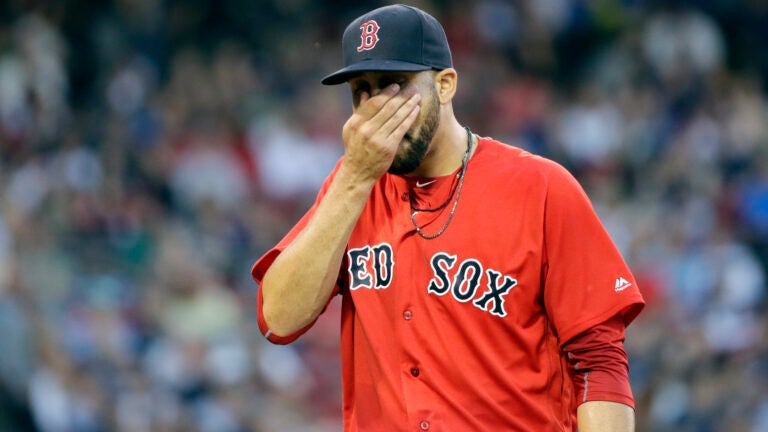
The Red Sox rotation has been an issue. It’s an issue this year. It was an issue last year. This year, the team’s incredible offense has dulled some of the sting from what hasn’t been a great unit, but things are still not great. As such, this season is shaping up to be similar to those years just prior to them breaking through in 2003 and 2004 with some of the strongest and well-rounded teams in club history. Good, but not quite good enough. Specifically, this rotation reminds me a lot of the team’s 1998 rotation.
I realize that 1998 was a while ago, so let me walk you through it. Stay with me here. At the top of the rotation, we have two ace pitchers not quite at the peak of their powers. In 1998, it was Pedro Martinez. In 2016, it’s David Price. In ’98, Martinez was on the cusp of his two best seasons (and two of the best seasons from any pitcher ever). Price might be coming off of his two best seasons. In 2014 and 2015, he was a six-WAR player, and while he doesn’t quite look like that guy this season, he still has that ability in him, as he showed this week in San Francisco.
The two teams also had two solid knuckleballers. In 1998, it was Tim Wakefield, in 2016 it’s Steven Wright. If you’re looking for a place to poke holes in the comparison between the years, it would be here, as Wakefield in ’98 wasn’t nearly as good as Wright. Still, Wright’s got to prove it for the whole season. If you look back at Wakefield’s splits, you’ll notice that he gave up more homers in the second half than he did the first. As it gets warmer, Wright’s knuckler might get more inviting. But in a general sense, we’re coming to appreciate Wright the way we did Wakefield, as a guy who goes out and gives you everything, and as a guy you trust to command his knuckler when the chips are down.
The same cannot be said of the next guy in each rotation. For each team, this was a veteran who wasn’t/isn’t quite living up to his billing. In 1998, it was Bret Saberhagen. In 2016, it’s Rick Porcello. Both have an ERA that hovered/is hovering near 4.00, both suffer(ed) from an acute case of gopheritis, and while you really want to root for these guys, you don’t really trust either one.
Then there’s the former hot shot who had nothing left in the tank. In 1998, it was Steve Avery, who was suffering through his second year of not being able to pitch. He would walk seven more batters than he struck out that season, but Avery had a pretty storied career with the Braves, where he piled up 20+ WAR in his seven seasons there. Buchholz actually isn’t that accomplished, as he’s put up just 13.5 WAR in his 10 seasons with the Red Sox (yes, we’re going on a decade of this). Buchholz hasn’t walked more men than he’s struck out this year (yet) but he’s allowed 12 homers in 62 innings, for a 1.74 HR/9 that is eighth-worst in baseball. Yey! Also, Buchholz isn’t technically in the rotation right now, but the team’s lack of action on James Shields, the fact that they’re leaving the fifth starters role open and the fact that they didn’t just cut Buchholz leads me to believe he’ll be back in the rotation before long. Double yey!
The pivotal role in this comparison will be played by Eduardo Rodriguez. In 1998, the four above-mentioned starters – Martinez, Wakefield, Saberhagen and Avery – all threw at least 117 innings, but no one else on the staff threw 50 as a starter. Derek Lowe was the closest at 48 innings pitched, and then came Pete Schourek (41.1), John “Way Back” Wasdin (39.2) and Brian Rose (37.2). The best of them was Schourek, as he posted a 4.35 ERA.
This year’s team as currently constituted looks similar. The four main starters – Price, Wright, Porcello and Buchholz – have all tossed at least 56 innings in the rotation, and then you have a drop-off to the group of others. Joe Kelly has tossed 22.1 innings as a starter so far, and he’s followed by Henry Owens (12.1), Rodriguez (11.2) and Sean O’Sullivan (10.1). Rodriguez should emerge out of this pack, but nothing is written just yet. He hasn’t had the smoothest first two starts this season, and if he can’t straighten himself out (or isn’t fully healthy) then the team will have to adjust again.
These two squads don’t just feel like they’re similar, some overall stats bear it out too. Most notably, the rotation FIP (Fielding Independent Pitching) of 4.54 this season is just about identical to 1998, when it was 4.51. The ERAs aren’t that far off either; 4.66 this season, 4.36 in ’98. Both teams are allowing more home runs than they should. This year, they’re posting a 1.30 HR/9, whereas in 1998 it was 1.20. Only twice in the intervening 17 seasons did they have a HR/9 that high – 2006 (1.23) and 2012 (1.31). Overall, they end up similar. In 1998, their rotation’s 11.3 WAR ranked 18th out of 30 teams. This season, the rotation’s current 2.6 WAR ranks 21st.
In 1998, the Red Sox just didn’t have enough starting pitching to get the job done. Even with Pete Schourek pitching a miraculous 5.1 innings of shutout ball in Game 4 of the American League Division Series, the team didn’t have enough to make it back to Martinez in Game 5. Wakefield blew up in Game 2, and while Saberhagen pitched well in Game 3, it wasn’t enough. This year’s team is looking a lot like the ’98 team. For now, Wright looks like a strong number two behind Price, but what happens if Wright regresses when the weather gets humid? And behind them, the story gets thin real quick. It might just be the defining story of the season.
9 times Pedro Martinez blew us away
[bdc-gallery id=”141655″]




To comment, please create a screen name in your profile
To comment, please verify your email address
Conversation
This discussion has ended. Please join elsewhere on Boston.com