
Jackie Bradley Jr. and the statistical mythology of the hitting streak
COMMENTARY
It isn’t the longest…yet.
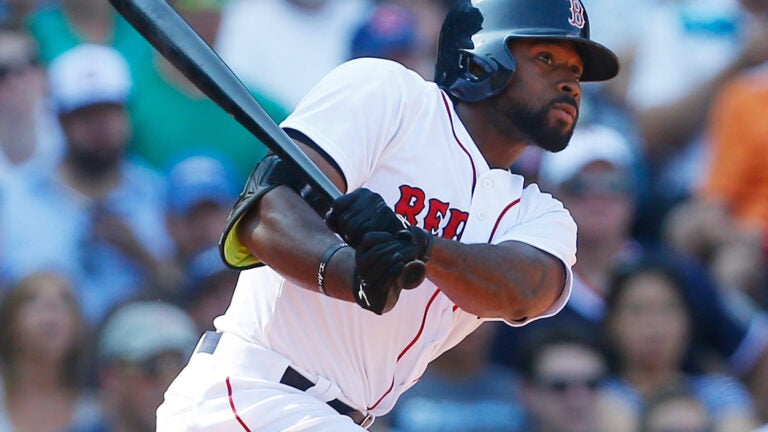
But is Jackie Bradley Jr.’s current hitting streak the greatest of its kind in Red Sox history?
With a hit on Tuesday night against the Colorado Rockies at Fenway Park, Bradley would extend his streak to 28 games, tying him with Wade Boggs for the fourth-longest in franchise annals. In 1985, the Hall of Famer Boggs, who will have his No. 26 retired at Fenway later this week, hit .402 over his four weeks of good fortune, hitting one home run with a 1.007 OPS.
Johnny Damon’s 29-game hitting streak in 2005 would be next on the list for Bradley to surmount. Damon hit .348 over the course of his streak, with three home runs and a .916 OPS. Nomar Garciaparra hit in 30 straight during his 1997 rookie season, batting .383, with nine home runs and a 1.059 OPS.
Of course, it’s Joe DiMaggio’s own brother, Dom, who owns the Red Sox record, hitting in 34 straight games in 1949, eight seasons after Joe set the mark of Americana with 56. Dom DiMaggio hit .352 during his, with three home runs and a .934 OPS.
Bradley has a higher streak batting average than Boggs (.408), the highest OPS of any of the aforementioned (1.272), and is one home shy of Garciaparra with eight since it all began on April 24.
If we were to ask late paleontologist and evolutionary biologist Stephen Jay Gould, however, the inclination is that he’d tend to still lean toward Dom DiMaggio’s feat as the greatest in Boston history.
It is the former Harvard professor’s 1988 essay, “The Streak of Streaks” in The New York Review of Books that pays homage to Joe DiMaggio’s 56-game hitting streak by classifying it as “both the greatest factual achievement in the history of baseball and a principal icon of American mythology.” Gould’s baseball essays (published posthumously in 2004’s “Triumph and Tragedy in Mudville: A Lifelong Passion for Baseball”) married the scientist’s affection for the game with his life’s work, and his view on DiMaggio’s streak is much loftier than anything else in baseball that might have been attained by chance of a coin.
“Single moments of unexpected supremacy—Johnny Vander Meer’s back-to-back no-hitters of 1938, Don Larsen’s perfect game in the 1956 World Series—can occur at any time to almost anybody, and have an irreducibly capricious character.” Gould wrote. “Achievements of a full season—Maris’s sixty-one homers, Ted Williams’s batting average of .406, also posted in 1941 and not equaled since—have a certain overall majesty, but they don’t demand unfailing consistency every single day; you can slump for a while, so long as your average holds. But a streak must be absolutely exceptionless; you are not allowed a single day of subpar play, or even bad luck. You bat only four or five times in an average game. Sometimes two or three of these efforts yield walks, and you get only one or two shots at a hit. Moreover, as tension mounts and notice increases, your life becomes unbearable. Reporters dog your every step; fans are even more intrusive than usual (one stole DiMaggio’s favorite bat right in the middle of his streak). You cannot make a single mistake.”
In the essay, Gould notes that a colleague, Ed Purcell, Nobel laureate in physics, did a comprehensive study of all baseball streak and slump records and found that nothing ever happened above and beyond the frequency predicted by coin-tossing models. Even the 1988 Orioles, who started that particular season with an 0-21 record, fell victim to the laws of probability, according to Gould.
Except, Gould wrote, DiMaggio’s fifty-six–game hitting streak shouldn’t have occurred. Ever.
“Purcell calculated that to make it likely (probability greater than 50 percent) that a run of even fifty games will occur once in the history of baseball up to now (and fifty-six is a lot more than fifty in this kind of league), baseball’s rosters would have to include either four lifetime .400 batters or fifty-two lifetime .350 batters over careers of one thousand games. In actuality, only three men have lifetime batting averages in excess of .350, and no one is anywhere near .400 (Ty Cobb at .367, Rogers Hornsby at .358, and Shoeless Joe Jackson at .356). DiMaggio’s streak is the most extraordinary thing that ever happened in American sports. He sits on the shoulders of two bearers—mythology and science. For Joe DiMaggio accomplished what no other ballplayer has done. He beat the hardest taskmaster of all, a woman who makes Nolan Ryan’s fastball look like a cantaloupe in slow motion—Lady Luck.”
Even by extending his streak on Tuesday, Bradley would be only halfway to DiMaggio’s infamous mark, a goal so lofty that it’s not worthwhile to suggest its possibility. Based on Gould’s above remarks about 56 differing vastly from 50, it’s not even time to consider Bradley’s streak more impressive than Dom DiMaggio’s, despite the loftier numbers he’s managed to put together.
There’s another side of the, um, coin, of course. In 2008, Samuel Arbesman, a graduate student at Cornell and Steven Strogatz, a professor of applied mathematics at the school, wrote an op-ed in the New York Times detailing their coin-flipping experiments for every player in the history of the game. In repeating the process 10,000 times, they discovered the possibility of extremely long streaks (as long as 109 games) throughout baseball history.
“Here’s how it works,” they wrote. “Think of baseball players’ performances at bat as being like coin tosses. Hitting streaks are like runs of many heads in a row. Suppose a hypothetical player named Joe Coin had a 50-50 chance of getting at least one hit per game, and suppose that he played 154 games during the 1941 season. We could learn something about Coin’s chances of having a 56-game hitting streak in 1941 by flipping a real coin 154 times, recording the series of heads and tails, and observing what his longest streak of heads happened to be.”
What they concluded was that more than half the time, or in 5,295 baseball universes, the record for the longest hitting streak exceeded 53 games, and two-thirds of the time, the best streak was between 50 and 64 games.
“In other words, streaks of 56 games or longer are not at all an unusual occurrence. Forty-two percent of the simulated baseball histories have a streak of DiMaggio’s length or longer. You shouldn’t be too surprised that someone, at some time in the history of the game, accomplished what DiMaggio did.”
It would be fascinating to get Gould’s reaction to the steroid-fueled home run chases of Barry Bonds, Mark McGwire, and Sammy Sosa (Gould died in 2002), particularly in how the records crushed the former occupants’ numbers, and how he might judge their validity (his explanation for the disappearance of the .400 hitter would seemingly fit somehow in his discussion, but with the enveloping caveat of the enhanced playing field). But numbers don’t necessarily tell the story for Gould when it comes to DiMaggio (who hit .408 with 15 home runs and a 1.181 OPS over his 56 games), whose record he treats with a mythology that, he admitted, makes a strange bedfellow for statistical analysis.
Gould even dismisses the argument that hype helped lead to extending DiMaggio’s streak by proclaiming, “long streaks always are, and must be, a matter of extraordinary luck imposed upon great skill.”
He wrote, “DiMaggio’s remarkable achievement—its uniqueness, in the unvarnished literal sense of that word—lies in whatever he did to extend his success well beyond the reasonable expectations of random models that have governed every other streak or slump in the history of baseball.”
It’s why it wouldn’t surprise Gould that neither Roger Clemens nor Pedro Martinez ever tossed a no-hitter, something Clay Buchholz managed to do nine years ago. Random.
The explanation for DiMaggio’s 56 isn’t as simple.
“DiMaggio’s hitting streak is the finest of legitimate legends because it embodies the essence of the battle that truly defines our lives,” Gould wrote. “DiMaggio activated the greatest and most unattainable dream of all humanity, the hope and chimera of all sages and shamans: he cheated death, at least for a while.”
Luck. Skill. Probability. They all play a part in what Jackie Bradley, Jr. has on the line right now.
Who are the Red Sox’ all-time statistical leaders?
[bdc-gallery id=”661869″]



To comment, please create a screen name in your profile
To comment, please verify your email address
Conversation
This discussion has ended. Please join elsewhere on Boston.com