
Running up the score: Can ’16 Red Sox offense remain among most prolific in franchise lore?
The Red Sox have scored 229 runs through their first 38 games, but they have a long way to go to match potent lineups of the past.
COMMENTARY
The Red Sox are on pace to score 976 runs this season. Know what I say to that?
Nine-hundred-and-seventy-six? That’s it? Huh. Seems like it should be more.
You know why. Led by sluggers David Ortiz and – we all saw this coming – Jackie Bradley Jr., the relentless Red Sox have scored 229 runs through 38 games, an average of 6.02 per.
If you’d told me they had scored 229 runs over the past 10 days, I might believe you. As would the pitching staffs of the A’s and Astros, I suspect.
The Red Sox are coming off a seven-game homestand in which they scored 73 runs – an outright ridiculous average of 10.4 per game. We’d suggest those are video game numbers, but video games have guidelines built into their technology to prevent such unrealistic outcomes.
This torrid start – this torrid season, really, save for an occasional collective hiccup against the likes of Jose Quintana – already has Red Sox fans wondering whether we’re watching an all-timer of an offensive season in progress.
I have some skepticism whether that will happen – more on that after the good stuff – but that current 976-run pace would rate as the second-highest run total in Red Sox history should it play out so prolifically through the full 162.
For the fun of it, here is some historical context on the most productive offenses in Red Sox history. It’s this company that our current cast of mashers is trying to join.

The 1950 Red Sox lineup scored 1,027 runs with a lineup that included Ted Williams, Bobby Doerr and Walt Dropo.
1950 Red Sox: What a machine. They scored 1,027 runs, the only Red Sox club to surpass the 1,000-run mark in a season — and they did it over the shorter 154-game schedule, averaging 6.7 runs per game. They slashed .302/.385/.464 as a team and posted an .848 OPS collectively, which is essentially what legends Jim Rice (.851), Fred Lynn (.845), and Carl Yastrzemski (.842) each submitted over the course of their respective careers. They walked (719) more than they struck out (580). Five regulars had an on-base percentage over .423. A machine.
What’s funny is that they did it with a so-so season from Ted Williams – so-so being a .317/.452/.647 slash line and 28 homers in 334 at-bats over 89 games. (What a standard that man set.) Williams broke his elbow crashing into the Comiskey Park wall during the All-Star Game in July and didn’t return until September. But his lineup mates picked up the slack. Vern Stephens and Walt Dropo each drove in 144 runs. Johnny Pesky had the lowest OPS-plus in the lineup; and he still slashed .312/.437/.388 with 104 walks and 31 strikeouts.
So how did they finish in just third place at 94-60, four games behind the Yankees? That team ERA of 4.88 probably had something to do with it. And to think, Clay Buchholz wasn’t even on that staff.

July 2003: David Ortiz beat the Yankees with a wall-ball double that scored Jeremy Giambi.
2003 Red Sox: I remember this as the greatest Red Sox offense of my lifetime – more so than any of the ‘70s Monster-mashing lineups, more so than even the ’04 champions, which featured small alterations to the ’03 cast. And my recollection is buttressed by plenty of statistical support.
The ’03 Sox scored 961 runs, second in franchise history only to the aforementioned 1950 bombers. They walloped 238 home runs, still a club standard. They scored 190 runs in June alone. Manny Ramirez and David Ortiz – who became a regular in May – perfected their modern-day Ruth-Gehrig act that summer, combining for 68 homers and 205 RBIs over the full season.
But it wasn’t just them; it was everyone. Jason Varitek and Kevin Millar split 50 homers evenly. Trot Nixon delivered a career-year, slugging 28 homers with a .975 OPS. Bill Mueller won the batting title, slashing .326/.398/.540 … and he usually hit ninth in the order. Even Todd Walker, who was streaky at the plate and in the field, knocked in 85 runs from the No. 2 spot.
The memory of two particular days – consecutive days, actually — reinforces the recollections of their offensive potency. On July 4 and 5, the Red Sox totaled 20 runs in victories over the Yankees, back at a time when the rivalry was approaching its boiling point and even midsummer showdowns were can’t-miss. On July 4, the Red Sox won, 10-2, lighting up David Wells and the New York bullpen for seven homers – two each from Ortiz, Varitek and Mueller and one from Ramirez. The next day, a 10-3 thumping of dastardly Roger Clemens, Ortiz hit two more while Nixon added another. I’ll let you supply your own fireworks analogy here, but man, was that ever a good time.

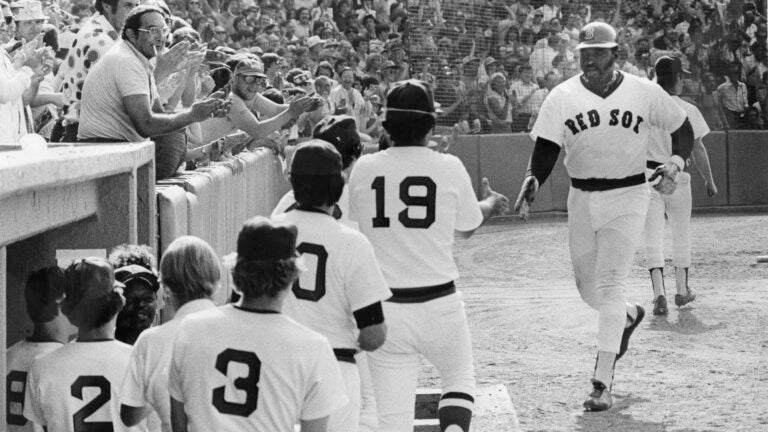
The ’77 Red Sox hit 33 homers over a 10-game stretch, 16 in a three-game set with the Yankees — and, as the scoreboard confirmed, 20 in a stretch of five games during the same period.
1977 Red Sox: Fans of a certain age – my age – might remember this crew as the most prolific lineup the Red Sox have ever had. It is not – their total of 859 runs is tied for just the 16th-highest total in franchise history – but the perception is easily understood. They hit a lot of home runs, and they hit a lot of home runs very far. “We’ve got this standard routine in the dugout now,’’ Jim Rice told a Sports Illustrated writer that summer. “When a guy comes in after a homer, someone will ask him, ‘Hey, man, you get it all?’ The answer’s always, ‘Nope.’”
The ’77 Sox held the club record for home runs in a season (213) until the ’03 Sox smashed it by 25. Three players hit at least 30 homers – Jim Rice (39), George Scott (33), and Butch Hobson (30, despite usually batting in the No. 8 spot in the lineup) – while Yaz added 28 and Carlton Fisk 26. They had a team OPS of .810, despite giving 500 plate appearances to Denny Doyle and his .596 OPS.
Like the ’03 Sox, they had an unforgettable power surge during a series against the Yankees. In a three-game set from June 16-18, the Red Sox outscored the Yankees, 30-9. How many home runs did they hit during the sweep? Five? Eight? Ten? A dozen? Nope. Incredibly, they hit 16. Yaz had four, Scott and Bernie Carbo three each, Fisk two, and Lynn, Rice, Rick Burleson, and – yep – Doyle each contributed one. They’d never admit it, but they probably got all of a few of them, too.
***
I suppose the question of the moment is where these 2016 Red Sox – who are on a 192-homer pace right now – will ultimately rate among the franchise’s great offenses. I have to admit, I’m skeptical that it will rate among the most prolific. You’re counting on the sustainability of a lot – Jackie Bradley’s imitation of 1979 Fred Lynn, the continued health and massive production of David Ortiz (and Hanley Ramirez … and Dustin Pedroia), no prolonged slumps from the likes of Travis Shaw. I’d say 900 runs – which would rate eighth-most in franchise history – is a reasonable if slightly optimistic expectation.
But make a note of this: The Red Sox’ next series with the Yankees is July 15-17. If they can drop a midsummer homer barrage on the Bombers then like they did in ’77 and ’03, we won’t just remember them well. We’ll remember them among the best lineups the Red Sox have ever had, whether the current pace proves sustainable or not.




To comment, please create a screen name in your profile
To comment, please verify your email address
Conversation
This discussion has ended. Please join elsewhere on Boston.com