
Jackie Bradley Jr. and the anatomy of a diving catch
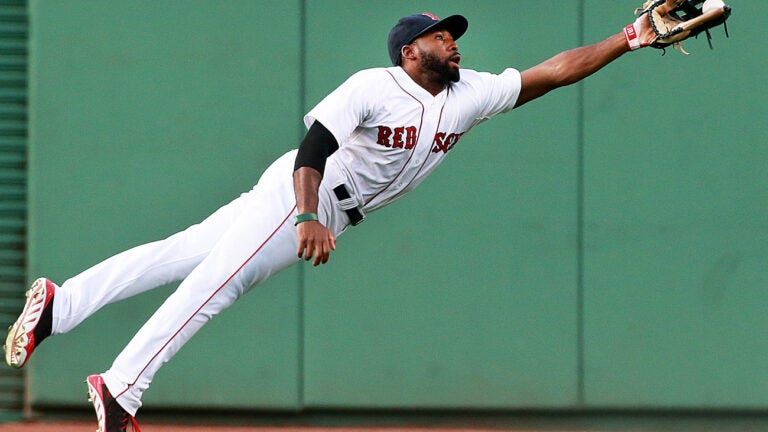
The fascination began by watching the stars do it first. Willie Mays did it in the 1954 World Series. Jim Edmonds did it in the ‘90s, Torii Hunter did it in the 2002 All-Star Game. Jackie Bradley Jr. grew up seeing major leaguers execute dramatic diving catches in the outfield.
This season he has been putting on a show of his own.
Bradley makes defensive show-stoppers look effortless. Balls that seem impossible to catch are run down seemingly with ease. Each time he throws his body on to the field, slams against a wall, or hurdles a barrier to steal a home run, he leaves spectators shaking their heads wondering, “How did he do that?’’
Who better to explain it than the expert himself?
A Natural Ability
What may seem to be an acrobatic feat is something that has come naturally to Bradley. As he rose through the ranks from Prince George High School in Virginia to the University of South Carolina, he always felt at ease in the field.
“I think it’s been a knack that I’ve always had,’’ he told Boston.com. “Even when working on it, I’ve always been able to do it pretty well. Repetition after repetition, you get more comfortable and just do it.’’
[fragment number=0]
There are plenty of facets of Bradley’s game that he works on each day. This season, for example, he has improved his batting average from .198 last year to .286. His defense, however, has been the highlight of his game. He has a .986 fielding percentage this season, including 1.000 in left and centerfield with just 1 error in 45 games.
“I don’t go out there and just practice diving,’’ he said. “I think it’s an instinctual thing.’’
Undeterred by Injury
Bradley doesn’t play it safe in the outfield. With his style of defense comes the risk of injuries. During his junior year of college, he tore a tendon and suffered ligament damage in his left wrist.
“I tore it diving, actually,’’ he recalled. “My glove got caught on the grass and bent back. My wrist and body landed on my wrist. It popped the sixth metacarpal out of the sheath, that tendon, and I had to get that repaired. … It was a painful experience.’’
The injury occurred in center field just months before the 2011 draft. Bradley was concerned it would affect his stock. The Red Sox selected him in the first round (40th pick) that June.
Instead of getting bogged down by the mental aspect of the injury, Bradley took a different approach. He put it out of his mind and continued to attack defense the only way he knew how. He thought proceeding with caution could end up causing more harm than good.
“Honestly, you’ve got to keep playing the game,’’ he said. “Most likely, guys get hurt when they’re not going that hard. That’s why you train hard; [it’s] the reason for your body being able to withstand things you put it through, hopefully. You want to go out there and play the game without any regrets.’’
Mental Preparation in the Outfield
While Bradley makes his plays in a matter of seconds, there is a thorough thought process involved in every at bat.
Leading up to a series, Bradley studies scouting reports on all the hitters. Before they even step up to the plate, he has become well-versed in their tendencies, how they match up against each pitcher, and their offensive performances as of late.
This knowledge allows Bradley to envision the direction of the ball in advance.
“I actually like to imagine where he could possibly hit the ball,’’ said Bradley. “I like to take myself into a place like, I’m going to see him hit the ball this way, I’m going to go to my right, I’m going to go to my left, go behind me. I like to just visualize what I think is going to happen.’’
Communication with his teammate also plays a role into his positioning. He takes cues from other players as to where he should be.
“For some reason, me and Jackie kind of have a telekinesis type thing,’’ said outfielder Mookie Betts. “I just kind of look at him and we move to where we are supposed to be. I don’t really know how it works. I guess knowing him and being friends with him, we build a relationship off the field and it rolls over on to the field. You just see it, we move well together.’’
Determining Go Time
The timing on each dive varies from play to play. A combination of instinct, distance and game situations factor into when Bradley makes his move.
“I don’t think there’s a certain time I say, ‘Ok, I’m going to go now,’’’ said Bradley. “You want to do it when the ball is as close to you as possible, knowing it’s just out of your reach if you were to try to run normally. Sometimes you have to leave your feet to give a better effort on the ball.’’
Bradley is also cognizant of the score. A dramatic play can save a tight game, but it can also blow the chance to win if it goes awry.
“If it’s a really close game, normally you don’t want to try to dive unless you absolutely know you have it,’’ he said. “You don’t want to make a mistake, give a runner extra bases and put the pitcher and the team in a hole. [You should dive] when you have a comfortable lead or you absolutely know you can get it or teammates are behind you to back you up.’’
Not Every Dive Feels the Same
The impact of a dive varies from ballpark to ballpark. Bradley has to be ready to absorb different severities of contact depending on where the game is held.
“Playing on grass here (at Fenway Park) will be a lot different than diving on turf in Toronto,’’ he said. “That’s a lot harder and it’s not very giving on the body.’’
The trajectory of the dive also plays into the impact. Bradley doesn’t always leap in the same direction on each play. Over the years he has found a dive he prefers over others, although it can’t be his go-to every time.
“(The way the ground feels) depends on how you hit it — whether you’re hitting it going out or you’re coming straight down,’’ he explained. “I like to have my dives going out so that way it’s more of a slide, you ease into it. Granted, you don’t really know how the ground’s going to play sometimes, but for the most part I don’t think it’s too painful. You’ve got too much adrenaline.’’
Proud Moments and Regrettable Re-Dos
There are bound to be a mix of ah-ha’s and oh-no’s when making plays in such dramatic fashion.
Bradley’s favorite catch came years ago when he was playing Legion baseball. Even as a young, aspiring athlete he was going after balls with fearless abandon.
“I robbed a homer, went completely over the fence but caught myself on the other side so my feet were still dangling in the air and I shimmied my way back over with the ball in my glove,’’ he recounted.
Once reaching the majors, he remembers a special moment from last season when the Red Sox faced the Chicago White Sox.
“I’d say the second-best was probably last year when I robbed Tyler Flowers of probably a double in the right-centerfield gap,’’ he said.
[fragment number=1]
If Bradley could tackle one hit again, he would make right on a Kevin Kiermaier at bat during a game against the Tampa Bay Rays at Fenway Park.
“(I would re-do) Kiermaier’s inside-the-park homer last year,’’ he said. “It was against the left-center field wall. I missed it by, I want to say an inch. It went right over, came back, smashed me right in between my eyes, nose started bleeding, I think my eyes swelled up a little bit. I had a flight that night, but I was alright, I stayed in the game.’’
[fragment number=2]
Keep on Diving, Keep on Grinding
The ups and downs aren’t limited to the outfield. For Bradley, he has taken hits on his road to the majors. He played 127 games for the Red Sox last season but spent the majority of this season on the Triple-A Pawtucket Red Sox.
He is becoming more comfortable with consistency, getting to know his new faces from last season, and adjusting to the MLB schedule.
“I’ve learned that I can do anything I set my mind to,’’ said Bradley, adding, “I don’t stress over much. I get plenty of sleep at night. I focus on what I can control and go out there and play hard every day.’’
Bradley approaches defense and his career with a confident mindset. He believes mistakes are part of the game and proceeding hesitantly would prevent him from making those spectacular plays, the ones he watched on television years ago.
“His standards are higher than everybody else’s,’’ said Betts. “The catches (we make) that we think are good, that’s all routine for him. You learn to appreciate how good he is and there’s pretty much a show with it out there.’’





To comment, please create a screen name in your profile
To comment, please verify your email address
Conversation
This discussion has ended. Please join elsewhere on Boston.com