
What it feels like to be aged out of your Baseball Hall of Fame vote
COMMENTARY
I recently lost the right to vote, but only in baseball, so it didn’t hurt too much.
The National Baseball Hall of Fame and Museum, to give that institution its full name, recently announced it had changed its eligibility rules for the voters who elect players to the Hall. From now on, members of the Baseball Writers’ Association of America who were previously voters but who have not “been active in the game’’ for 10 years or longer can no longer vote.
The next vote will be in December. My last year as a full-time sportswriter was 2005. So it looks as if I’m out, unless writing this piece qualifies as baseball activity, which I’m pretty sure it doesn’t.
I’m a little sad to lose the privilege and responsibility of voting, but I’m not upset. It’s not my Hall of Fame. The committee which runs it is entitled to do so as it sees fit. Besides, having a Hall vote was a privilege which brought me seriously mixed feelings.
The idea that I was a small part of creating baseball history was a heady one, to be sure. Better yet were the memories generated by the arrival of the annual ballot. I suppose many voters made their decisions based on cold statistical analysis. For myself, I used recollection as much as RBI, let alone WAR.
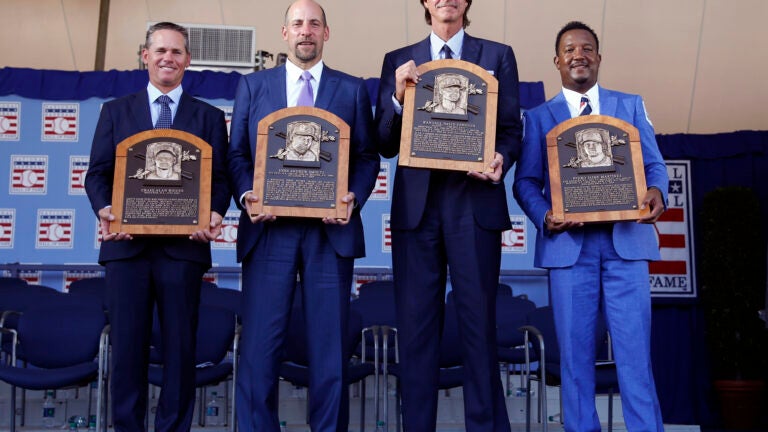
On my last ballot, the first name I checked was that of Pedro Martinez. It wasn’t just that Pedro was one of the two best pitchers I have even seen (Sandy Koufax is the other) but because he was one of the best stories I ever covered, too. Being around Pedro was never dull, and there aren’t many higher compliments a journalist can pay a subject.
The year before that, the first vote I cast was for another surefire first ballot Hall pitcher. This time, my motives were even more personal. I owed the guy.
In July of 1999, the Red Sox’ last game before the All-Star break was in Atlanta. Former colleague Tony Massarotti and I were covering the series for the Herald. The last flight back to Boston was at 6:30 p.m. and we had to be on it. The professional consequences of missing one day of the paper’s Fenway Park All-Star Game coverage would be dire.
We needn’t have worried. Greg Maddux threw a four-hit complete game win against the Sox in just about two hours. That’s what I remembered when I cast my vote for Maddux, and why I said, “thanks, pal’’ when I did.
There are also social benefits to a Hall vote. There’s no better means of making new acquaintances or getting back in touch with old friends and family. Every baseball fan has an opinion and wants you to hear it.
The first year I was eligible to vote, in 2000, one of my younger brothers, an attorney, sent me a cogently reasoned brief arguing that ‘60s and ‘70’s slugger Dick/Richie Allen, the hero of our teenaged Phillies fan year, should be elected to the Hall. In truth, Allen has an excellent case. However, his eligibility for election by the BBWAA voters had run out some years earlier. My brother knew that. He was just letting me know he’d be watching my vote with a careful, not to mention skeptical, eye.
But despite those pleasures, with every vote, I couldn’t help thinking “why me?’’ The Hall gave the vote to BBWAA members because it felt that as journalists, we were objective observers. As an objective journalist, it’s easy to see that the electorate for baseball’s highest honor is both overly exclusive and absurdly small.
A person becomes eligible to vote for the Hall by being a member of the BBWAA for 10 consecutive years. There’s no doubt that anyone meeting that standard does indeed know a great deal about baseball, because they’ve watched a lot of games. But sportswriters are a tiny subset of the much larger group of men and women who know a great deal about baseball because they too have watched a great many games. Some of them have played in more games than I’ve watched.
Mike Schmidt, the baseball hero of my youth, is in the Hall of Fame. He doesn’t have a vote. Players, active or retired, do not. Vin Scully’s only been calling Dodgers games for 60 years or so. He doesn’t have a vote, either. The veteran scouts who study and evaluate players for a living have no vote. Go to any major league ballpark, walk around the cheaper seats, and you’ll find folks, usually old men, who’ve made following baseball the most important activity of their lives. They know more about the sport than I care to learn, but they have no say in the Hall selection process.
I’ve always felt this is wrong. I’m proud that I am still a (retired) BBWAA member. It’s a fine organization of people who dearly love baseball. There are a few Hall votes every year which defy logic, but that’d be true no matter who made up the electorate. The overwhelming majority of BBWAA voters take that responsibility with the utmost gravity and do their best for the candidates and the sport.
But selecting or rejecting men for immortality in their profession is real power, and power and journalism are not a good mix. We aren’t the whole sport of baseball, and shouldn’t be put in a situation where we act as if we are.
Baseball being baseball, we shouldn’t be surprised that faced with a crisis, the Hall of Fame decided its best course of action was not to expand its electorate, but to shrink it. Jack O’Connell, the longtime and invaluable Secretary of the BBWAA, estimates that 130 of the current 650 voters will be term-limited out by the new rule.
The crisis for the Hall is a simple, deadly one – the era of performance-enhancing drugs. Many of the greatest players from roughly 1985 to 2005, the era I did cover baseball, are known, suspected, or rumored to have used PEDs. A player must be named on 75 percent of all votes cast (you can vote for up to 10 each year) to win election to the Hall. As has been made plain by the voting on such players thus far, far more than 25 percent of those 650 eligible voters believe deeply that no PED user should be granted the honor of a plaque in Cooperstown. A roughly equivalent number believe just as deeply that their job is to judge performance, not how it was obtained. The result is the equivalent of a kidney stone for the Hall of Fame.
Unlike its rules for voters, the Hall ballot is very inclusive. Players who’ve been out of the game for five years or more get listed, and some of them are nobody’s idea of an immortal. But a player remains on the ballot for 10 (used to be 15) years if they are named on at least five percent or more of the ballots.
The PED Era has caused a ballot backup. Guys like Roger Clemens and Barry Bonds don’t get enough votes to be elected, but get more than enough to remain on the ballot. Deserving players on the ballot who aren’t part of that era, the newer candidates, fail to hit the 75 percent mark because the PED players soak up votes that otherwise would be theirs. The nadir was reached when the election for the class of 2013 resulted in no class of 2013.
Baseball being baseball, the Hall of Fame made no mention of this issue when it changed the rule. In a press release that has been its only public statement on the change to date, Jane Forbes Clark, Chairman of the Board of the Hall of Fame, said only that the new rule would result in the “most active electorate possible.’’ A spokesperson for the Hall declined comment for this story.
Clark’s words brought to mind the delightful possibility of the BBWAA triathlon to be held prior to each vote. What else does the MLB Network have to show in December? But I know her diplomatic language actually meant, “we’d like voters who have actually been at a damn ballgame sometime during the Obama Administration.’’
Fair enough. Although I believe a 15-year cutoff would have been more just, if that’s the Hall’s real reason for the change. I can’t kick. I haven’t been in a big league ballpark since I left the Herald. I’ll be damned if I’ll pay the freight at Fenway Park, and although my BBWAA membership allows me entry to any and all press boxes, to go hang out where my former peers are hard at work seems way too creepy.
But I remain enough of a journalist not to believe Clark’s statement for one second. The new rule is an effort to ameliorate if not end the PED era standoff. It’s a problem the institution cannot tolerate. A museum which erases 20 years of its subject’s history belongs in the Soviet Union, not upstate New York. In the opinion of this victim, the Hall’s purge of its voter rolls is being conducted in the hope that minus all of us old farts, the remaining BBWAA members will elect some of the PED Era’s most obvious candidates and ease the backup. This is a vain hope.
The PED Era logjam is a problem of the Hall’s own making. The museum’s governing body didn’t have the guts to either disqualify candidates like Bonds and Clemens (oh, the lawsuits they’d have) as they did Pete Rose and Shoeless Joe Jackson or to explicitly tell we voters candidates on the ballot should be judged solely on the merits of their on-field performances. Leave your dirty work to others and you’re liable to wind up stuck cleaning up the resulting mess.
My guess, a guess I admit is based on unreasonable hope, is that after a few more seasons, the Hall will try out a Plan B. If fewer voters don’t solve their dilemma, they’ll try more voters. The electorate will be expanded to include the likes of broadcasters, current and former players, coaches and managers and maybe, just maybe a few stringently vetted fans.
When that door gets opened just a crack, it’s only a matter of time before marketing takes over. The Hall of Fame vote sponsored by Gillette, Bud Light or whatever will become a regular part of America’s holiday season. It’ll be a promotional boon for baseball, although I shudder to think of the resulting increase in fatal barroom arguments.
So I’m philosophical about the Hall of Fame kicking me out its front door. I don’t think of it as losing a vote, but as helping to give Pete Rose a reason to keep on living.
The best Red Sox are NOT in the Hall of Fame?
[bdc-gallery id=”111556″]



To comment, please create a screen name in your profile
To comment, please verify your email address
Conversation
This discussion has ended. Please join elsewhere on Boston.com