
Mookie Betts’s luck starting to turn, fueling hot streak
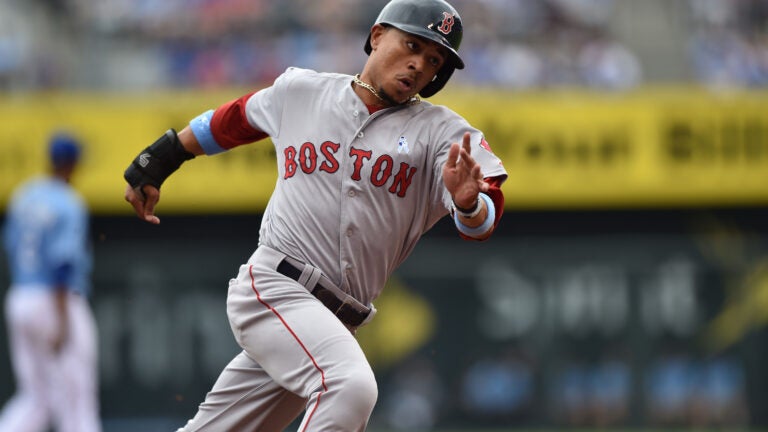
Dynamic young outfielder Mookie Betts saw no lack of fawning after putting up a spring training line that would fit better in a tee-ball league than in the majors.
But base-running heroics aside, the outfielder did little to justify the spring training hype through the first two-plus months of the season – until June 11, that is.
Since that date, Betts has hit safely in nine straight games while slashing a preposterous .556/.568/1.028. In doing so, he’s brought his season line up from a pre-streak .234/.294/.364 to a much more respectable .277/.329/.453.
Betts isn’t about to maintain an OPS of near 1.600 for the remainder of the season, but there’s reason to think that season line will continue to rise, because the biggest factor behind the newly minted American League Player of the Week’s big stick is the same one, more or less, behind his disappointing start: luck.
More specifically, Betts had been tremendously unlucky in how his batted balls fell in the months prior to his winning streak, and has been inversely lucky during, with both of these aptly demonstrated by trends in his batted average on balls in play, or BABIP.
BABIP is a bread-and-butter sabrmetric stat born out of the tried-and-tested assertion that once a ball is put in play (non-robbed homers don’t count as balls in play), the only things that determine whether it will become a hit or an out are defense and random chance.
There’s a bit more to the equation than that, but across baseball, roughly 30 percent of balls in play fall for hits, for a league-average BABIP of approximately .300. As with any stat, some players fall well above that mark and others well below, but most will, over the course of a season, come within a few dozen points of that mark.
Story continues after photo gallery
15 reasons Boston loves Mookie Betts
[bdc-gallery id=”655770″]
Through his 0-for-3 performance the day before he began his hitting streak, Betts had posted a BABIP of .249; since, he’s posted a BABIP of .548.
In all, Betts has posted a BABIP of .289 for the season, which suggests he has yet more improving to do. That’s because while BABIPs tend to average out to .300 or so leaguewide, individual players’ skillsets can lead to their consistently posting marks above or below the average marks.
The two biggest factors in a player’s posting a significantly above- or below-average BABIP are speed and batted ball profile. In the former factor, quicker players are more likely to leg out the occasional weak grounder than plodders. In the latter, line drives fall for hits at a higher clip than fly balls and grounders in that order, and so batters who hit more liners will see higher BABIPs.
Betts’ 40-time isn’t readily available, but his 72 percent steal success rate shows he’s got the speed to fuel an above-average BABIP. His liner rate, too, suggests his early struggles were more reflective of luck than skill: while his 19.5 percent mark through June 10 was below league average, it wasn’t far enough below to justify such a low BABIP.
Through last season and this one, Betts has hit liners 20.7 percent of the time, which along with his speed suggests he should be capable of consistently hitting at a better-than-average BABIP. Given this, his .327 BABIP last season could be a reasonable mark – and as his stats continue to regress to where his skillset suggests they should be, Betts’ numbers should continue to rise.



To comment, please create a screen name in your profile
To comment, please verify your email address
Conversation
This discussion has ended. Please join elsewhere on Boston.com