
Get the latest Boston sports news
Receive updates on your favorite Boston teams, straight from our newsroom to your inbox.
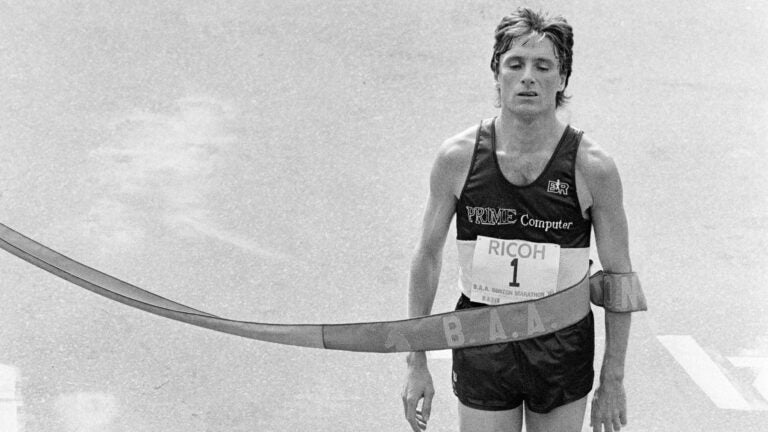
Geoff Smith ran the Boston Marathon to win. He did. Twice.
Smith didn’t run Boston for the money. After all, there wasn’t any prize money awarded to the winner when he won back-to-back Boston Marathons in 1984 and 1985. He ran to compete, to test his limits, and for victory.
Born in Liverpool in 1953, Smith’s one-of-a-kind running career began in an unlikely place: The Liverpool Fire Department. From a fire brigade running team, he went on to twice represent Great Britain in the Olympics, run a sub-four-minute mile, be named an All-American at Providence College, finish second in the New York City Marathon, and then reel off consecutive Boston wins.
“I went from just doing it for fun to then suddenly getting competitive. The first cross-country race among the fire departments to win a place on the team to go to Paris. I guess that would be it,” Smith said when asked to name his greatest race. “I remember that I fell with about a mile to go and I got up and won the race. So that was fun.
“Obviously, winning Boston was a great, great feeling.”
These days, Smith, who lives in Mattapoisett and still frequently visits his hometown in England, is more of a sage than competitor, offering guidance to runners who reach out.
“People will phone me up or they’ll email me and I’ll sit down and I’ll talk to them or I’ll write out what they need to do,” Smith said of his current connection to those running Boston or elsewhere. “I just got an email from a friend that said, ‘thank you for your sage advice.’”
On the 40th anniversary of the first of his back-to-back Boston wins, Smith chatted with Boston.com about his unusual route to running success, reflected on his triumphs and world record near-miss in Boston, and shared his key to victory for any runner looking to break the tape first on Boylston Street.
This interview has been edited for length and clarity.
Boston.com: Growing up in Liverpool, how did running become a part of your life?
Geoff Smith: I was always a soccer player growing up. I ran every day as a young kid around the block, you know, but never competitively. I ran while playing football, and I played on a bunch of different teams.
I got into running through the Fire Department. I joined the fire department at a young age, and they had soccer teams, running teams, tug of war teams, and cricket teams. You name it, they had it. So I was always active. From going to races with the fire department team, I got interested and became pretty good. Then I made the national fire brigade team and went over to France and ran in an international race for the fire department. I won in France in about 1976.
From that point onwards, I was a runner. I joined the running club, and wanted to be the best in the running club. Then I wanted to be the best in the city, then the best in the county and the best in the country, then the best in the world. It just continually grew and grew and grew.
BDC: I would imagine that mentality of wanting to be the best really helped you, but what were your physical strengths as a runner?
GS: I just enjoyed going out. I like physical activity. That was my super strength, I think. I liked the idea of pushing my body to the limits, you know, no matter what sport I was in.
BDC: What was it like coming from the fire department running team all the way to the Olympics?
GS: I was competing, and I was working 50-60 hours a week, doing night shifts. It was a very active job, and I’m fitting in running. Was there an easier way or a better way to train? I don’t know. That’s what I did, so I made the best of the circumstances I was in.
Coming off night shifts, grabbing some sleep and going out training or going training and then going to work, I was trying to find the best training plans or the best training routines to fit my schedule. I didn’t know what each day was going to hold for me: It could be an easy day, it could be a day from Hell.
If I was on a night shift and then I’m racing the next day, I didn’t know what type of night I was going to have. Was I going to be out all night? Was I going to be at a fire all night? Or was I going to have an easy night and just be on the station?
I had good days and I had bad days. But, generally, you know, when you stand on the line, no matter how tired you are, something always materialises. You have a reasonably good race or you have a great race.
BDC: Before you ran and won Boston in 1984, you finished second in the New York Marathon. How did that learning experience set you up for success in Boston?
GS: New York was my very first marathon race, and I really didn’t hydrate adequately. I trained very well for it, but I didn’t drink adequately. And then I sort of zoned out towards the end. But Boston was a totally different event.
BDC: What was your mindset coming into Boston?
GS: The Boston race was my Olympic trials. The British Olympic team was going to be selected on time: So I could either go to London and run against the rest of the Brits or I could stay and run Boston.
I’d done four years of college at Providence and I still needed to go back for a month. I said, I’m not gonna destroy my degree by going back to England. Besides, I couldn’t afford to anyway.
I knew that if I ran Boston and I won Boston with a reasonably good time to go along with my time from New York of 2:09, 2:08 (the British record at the time); and provided nobody at London ran faster than my New York time then I would make the team. So my goal at Boston was to win the race in a good sound time.
I went in with a totally different mentality. I didn’t hammer myself. I ran with a little bit more control. In hindsight, I left a lot on the table in Boston in ‘84 because I wanted to be ready for the Olympics.
BDC: That’s a lot of pressure! Was there a point in the race where you had any doubts?
GS: No. My training had gone extremely well. I’d done 20 miles at a really good clip. I’d done a couple of 25-mile runs. I knew I was ready to run. And I knew I could maintain the pace.
BDC: You lived somewhat nearby in Providence. Had you come to Boston to run any of the route in your training?
GS: No. The only time I saw the course was the day before when I went in on the Saturday to get my number. We drove from Hopkinton to Boston on the course, and that was the only time I saw the course. But where I trained in Providence was hilly. So I trained on hills all the time.
BDC: After winning Boston in ‘84 but feeling like you could have done even better, what was your approach when you won again in ‘85?
GS: I took a gamble to break the world record. Boston still wasn’t a prize money race so I took a major gamble in not going to London or any of the other events for money. But I believed I could break the world record here.
So I went out with the intent of breaking the world record. And, I think through the half marathon, I was on a 2:04 pace, 2:05 pace. Even approaching 19 miles, I was still like 20 or 30 seconds ahead of the world record. But that’s when I cramped up, right before you get to Boston College. On the hill, I stopped and I walked. I don’t get credit for how hot it was that particular day, especially because we started at noon back then. It was a hard day.
The good thing was that all those behind me were suffering just as bad. I was able to walk the cramp out, get myself jogging again, and I think I ran 2:14 or 2:15.
BDC: You won the Boston Marathon, yet hadn’t achieved your goal. What was your mindset?
GS: I was very disappointed. That wasn’t a great, great feeling at the end.
BDC: And over the years, have you been able to better appreciate what you were able to accomplish?
GS: No. I knew on that day if I’d been anywhere else, I would have broke the world record. If I’d gone to London, I would have won London. If I had gone to any of the other European marathons, I would have won, you know? Anywhere without the hills, without Heartbreak. But you do what you do, and you can’t change it.
Chris: Well, what advice do you have for someone running Boston for the first time?
GS: For Boston, more so than many other races, you want to go out slow. Don’t get caught up because it’s downhill at the start. Enjoy the first couple of miles, get your rhythm going. Remember, you’ve got to get through miles 14 to 20. But once you’re at 20, it’s not so bad. It’s flat to downhill. And remember to smile for the picture at the end.
BDC: To follow up on that, if you were gonna give some advice to somebody who was attempting to win Boston, would you tell them anything slightly different?
GS: If you’re going there to win, you’ve got to be in the race. There’s no point in going out and saying, ‘Well, I think this time is going to win it,’ because you don’t know what time is going to win it.
You don’t know how everybody else is feeling. So you’ve got to be there to compete. You’ve got to sit with the lead bunch, go out and if there’s a move, cover the move. Don’t sit there and say, ‘Oh s*** I’ve missed the move,’ because once you’ve missed it you’re playing catch up and when you’re playing catch up you’re running out of energy. You’re expending more energy than you really need to playing catch up.
Today, it seems to me that there’s two ways to run the race: You’re either going out to win the race or you’re going out to get a good time. If you’re going out to get a good time, you’re not there to win the race.
If I’m there, I want to win the race, I stood on the line with the belief that I’m there to win. Nothing else, there to win. But I talk to a lot of people now and they say they’re there to get a good time.
BDC: Well, you did win twice. Are there any memories from your other years running Boston that stand out to you?
GS: The best memory I have from Boston is chasing Toshihiko Seko in ‘87.
I was running in a pack of 20 people, but I wasn’t at the front of the group. I was in the middle and I missed the jump. Seko took off and opened up 20, 30, 40 yards.
By the time I saw the move it was too late. But I still came out and chased and Steve Jones came out and chased. So it was just me and Steve Jones chasing Seko. We worked together. We were always good buddies and we pushed ourselves. We looked at each other and gave ourselves a look saying, ‘let’s go for it,’ you know?
But even working together, we couldn’t close the gap. We were pushing and it just wasn’t closing. So, running that in ‘87 with Steve Jones was fun. So that was a good year too.
Receive updates on your favorite Boston teams, straight from our newsroom to your inbox.



To comment, please create a screen name in your profile
To comment, please verify your email address
Conversation
This discussion has ended. Please join elsewhere on Boston.com