
Newsletter Signup
Stay up to date on all the latest news from Boston.com
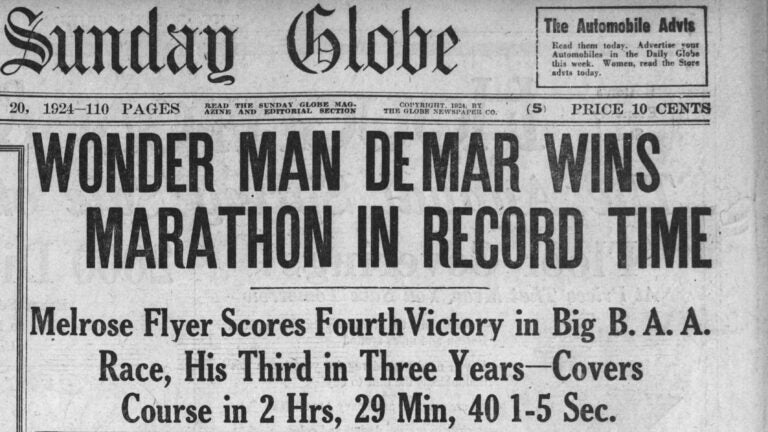
Among the thousands of inspiring individual performances in the history of the Boston Marathon, the very first to run exactly 26 miles and 385 yards—the now-standard distance of a marathon—remains one of its most impressive.
Run in 1924 by “Mr. DeMarathon” himself, Clarence DeMar, it established the template for Boston greatness followed by so many in the ensuing years. Both in his preparation and race-day tactics, there was more than a familiar tinge of modernity in DeMar’s approach.
And while his win was less surprising in the circumstances—DeMar had won each of the preceding two Boston Marathons to accompany his first victory in 1911—his dominance on that chilly day in April left distance running enthusiasts short of superlatives.
“DeMar is a superman,” Boston Globe reporter John J. Hallahan declared in his recap. The 35-year-old DeMar was also called a “wonder man,” a “thoroughbred,” a “freak,” and “the greatest of all men who have sought honors as a distance running plodder.”
While no Boston champion had won the event more than twice, DeMar, like an earlier-era Tom Brady, raised the bar to extraordinary heights. He not only doubled the previous record number of wins, but set a marathon world record with his time of 2:29:40.
And as the 1924 edition was the first to conform with the newly established Olympic marathon standard distance (26.2 miles), it set up “the little Melrose ace” for success on the world stage later that summer.
Born in Ohio in 1888, DeMar first burst onto the scene in 1910 when he surprised experts by finishing second in his initial attempt at a Boston Marathon. Having moved to Massachusetts with the rest of his family at the age of 10, enduring “a hard and somewhat squelched life,” DeMar only took up running while a student at the University of Vermont in the winter of 1908. It was initially simply a choice made out of New England necessity.
“I always ran, partly to save time and partly to keep warm,” he later said in his autobiography of his running origins while in Vermont.
His running style was unconventional and occasionally criticized (described by an Associated Press account as a “peculiar gait“), though it became a source of pride for DeMar.
“I was never a graceful runner,” he said, “but then I never thought an athletic event should be a beauty show.”
In 1911, he went one better than his previous attempt and won the Boston Marathon. This came despite the recommendation from doctors that he not race after they claimed to have detected a heart murmur.
The medical advice (coupled with increased demands from his day job as a printer) led to a years-long gap in his marathoning following the initial triumph in Boston, broken only by a third place finish in 1917. The break from running increased after U.S. entry into World War I (DeMar served in France before returning to live in Melrose after the conflict).
In 1922, DeMar returned to the starting line for the Boston Marathon. Once again stunning experts (who by now had written him off as too old to contend), the 33-year-old broke the tape as a winner for the second time. When he repeated the feat in 1923, DeMar became the first person to win a third title in Boston.
Going for the three-peat (and fourth overall) at the age of 35 was seen as a long-shot. Odds grew even longer that winter when, in a very relatable New England moment, DeMar “jumped over a snowdrift in such a way that my back and hip became lame.”

The winter injury curtailed his training for a time, but he was eventually able to recover. The problem was that his preparation appeared to be behind schedule. In the Baltimore Marathon earlier in 1924, he was easily defeated by rival Frank Zuna (the 1921 Boston winner). Zuna, utilizing the logic of the day, ran multiple marathons in the six weeks prior to Boston.
DeMar kept his focus on being prepared only for the exact race day, however, in a nod towards modern training approaches. He also avoided running full marathon distances before the actual race day.
One aspect of his regimen that admittedly feels out of place a century later was his diet.
“As to food, [DeMar] says he eats about everything he wants except on the day of the race,” noted a Globe account from 1924. “Then he eats breakfasts at 6:45 on wheat, milk, and sugar, two soft-boiled eggs, three or four rolls and butter and a cup of malted milk. At 9:30 he eats three fresh eggs on toast.”
With Boston’s course officially lengthened to meet Olympic standards (changing the distance from 25 miles to 26.2), it threatened to disrupt longstanding timing developed by experienced runners like DeMar.
At noon, the starter’s gun officially sent the 170-runner field on its way to the cheers of “one of the largest crowds on record,” according to the Globe recap.
Conditions were typical of April in Boston, with periodic sun but a “chilly northwest wind for most of the distance that blew diagonally across the course and neither helped nor hindered the runners.”
DeMar was conspicuously absent from the leading pack in the first few miles as his rival, Zuna, charged ahead.
Yet with the increased mileage, patience proved crucial. Slowly, as the elite field began to take shape on the approach to Natick, DeMar “crept up within striking distance of the lead.”
Internally, he had no doubts.
“I ran with great confidence and felt that I had a grasp of the distance and my competitors’ abilities from the first,” DeMar later wrote.
Having conserved his strength and let others set the pace, he took the lead near Wellesley and did not relinquish it for the rest of the day.
A key factor was his tactical commitment to attack on the hills.
“DeMar knew the course and on reaching the turn from Washington St onto Commonwealth Ave,” noted the Globe’s Hallahan, “the three-time winner was rushing along at a terrific pace.”

The turn, now known informally among marathoners as “the firehouse turn” in Newton, remains a vitally important setting in the annual race. DeMar was one of the first to fully exploit its possibilities.
“It was here that DeMar began to show what a really great runner he is,” Hallahan wrote. “He ran like a runaway horse. He never let up, and a steady pace carried him away, while [Finnish runner Louis] Takkanen stopped to walk on the hill at Brae-Burn Country Club. There was no stopping DeMar.”
With his rivals left in the dust (Zuna eventually dropped out of the race in the hills, possibly worn out by having run three marathons in two months), DeMar flew on to the finish. He crossed with not just the best time ever recorded by an American, but a new world record. Chicago runner Charles Mellor finished a distant second by a margin of more than five minutes.
“No race that I have ever won has pleased me as much as the victory of today,” DeMar said after his 1924 win. “I was strong all the way.”
There was one additional factor: With his performance in Boston, DeMar had formally secured a spot on the U.S. Olympic team in the Paris Summer Games.
“I wanted another chance to run an Olympic marathon,” he confessed. Having first run in the 1912 Stockholm Olympics, DeMar had finished a disappointing 12th. He blamed the “outside influence” of what he saw as a micromanaging U.S. coaching staff.
“All that I wish is that I be left alone,” he said of his intended Olympic training regimen. It proved fruitful. Despite the oppressive July heat in Paris, DeMar hung on to claim a bronze medal. He would be the last American to stand on the Olympic marathon podium until Frank Shorter won gold almost half a century later.
DeMar went on to win an astounding three more Boston Marathons, bringing his total to seven (a feat that has not been matched by any open division runner since). His final Boston win came in 1930 at the age of 41.
After his death in 1958 following a bout with cancer, his heart was studied by Boston doctors James H. Currens and Paul Dudley White. Their findings, published in the New England Journal of Medicine, became front-page news in 1961. With his heart in “perfect condition,” one of DeMar’s lasting legacies was that he helped dispel the notion that distance running over the long term had negative effects on the body.
Stay up to date on all the latest news from Boston.com





To comment, please create a screen name in your profile
To comment, please verify your email address
Conversation
This discussion has ended. Please join elsewhere on Boston.com