
Get the latest Boston sports news
Receive updates on your favorite Boston teams, straight from our newsroom to your inbox.
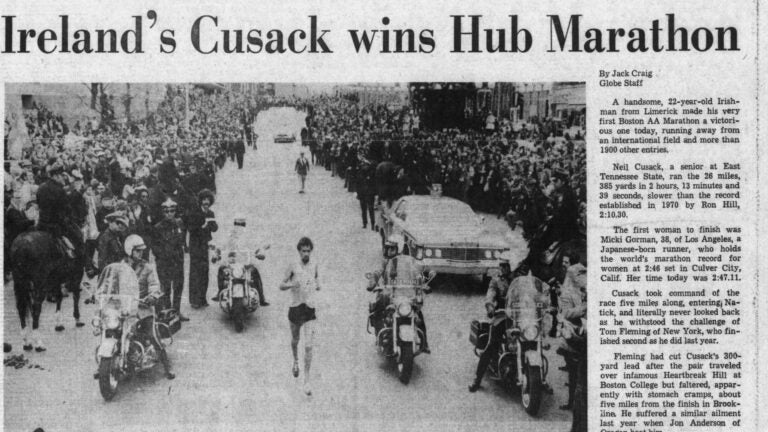
In the history of the Boston Marathon, there has only been one Irish winner.
It happened in 1974, and it came from a runner who had initially been recruited to East Tennessee State’s cross-country team as an afterthought.
Neil Cusack, hailing from the Irish city of Limerick, emerged from what was then a record-setting field of more than 1,900 runners to win with the third fastest time in the Boston Marathon to that point (2:13:39).
Now a half-century later, Cusack will be back in Boston as the official race-starter for the 2024 edition.
In a recent phone call from his home in Ireland—conducted from the kitchen while, as he noted, his wife was baking bread—the 72-year-old recalled with crystal clarity the events of that momentous day 50 years earlier.
“It seems like yesterday, to be quite honest,” said Cusack.
Prior to the race, he’d been viewed as a notable runner, but was not necessarily expected to contend.
Cusack had completed four years at East Tennessee, having been perceived initially as—in his own words from 1974—”the weak part of the deal.” Yet despite being a relative recruiting afterthought (coaches had been more interested in fellow countrymen E.J. and Eddie Leddy), Cusack was still given a “half-scholarship.”
He quickly proved to be an asset for East Tennessee, becoming an NCAA champion (and earning a full scholarship). Boston Globe columnist Jerry Nason, noting Cusack’s entry into the ’74 marathon, described him as “wild-running Irishman.”
Still, Cusack faced stiff competition, including the 1973 runner-up Tom Fleming. The two were staying in close proximity to each other prior to the race, to the extent that Cusack heard his rival talking beforehand.
“Tom Fleming was staying down the hallway,” Cusack explained.
“I just happened to hear Tom inside the room with a lot of other guys, saying that he reckoned he was going to win tomorrow,” Cusack remembered of Fleming, a two-time New York City Marathon champion in his own right (who died in 2017).
“I said to myself, ‘Yeah, I think there’s someone that could make that wish not come true,'” he said, alluding to his self-belief.
Though he had never run the Boston Marathon before, Cusack was confident.
“To be quite honest, you don’t win races like that unless you think you’re going to win,” he said.
Despite his lack of local experience, Cusack noted that he had a vague idea of a race plan.
“It worked out perfectly,” he added.
“My plan going into Boston was to sit back for six miles and listen to the birds singing, you know what I mean?” Cusack recalled. He later jokingly summarized his bird-listening approach to Nason, simply saying, “I played it by ear.”
“I just stayed 100 yards off the pace,” Cusack continued. “I said at six miles, I’d go up to the leaders and move, and I did exactly that.”
After taking the lead near Natick, Cusack (in the words of Boston Globe reporter Jack Craig) “literally never looked back.”
“I was a minute ahead at Wellesley, which is the halfway point,” he said. The only challenge would be if he could sustain his pace over the famously hilly stretch of the race in Newton.
The other potential issue took shape in the form of the powerful Fleming, who began to make his move in the latter stage of the race. With no experience running “Heartbreak Hill,” Cusack could have fallen into the same trap as so many other runners unaccustomed to the unusual elevation changes of the Boston Marathon.
But even as Fleming shaved time off of Cusack’s lead during the hills, the Irishman didn’t crack. Unbeknownst to Fleming and other Boston veterans, Cusack had plenty of experience running hills.
“I was always strong on hill-running because down at East Tennessee we used to train on the hills on a daily basis, myself and Eddie Leddy,” said Cusack. “We used to push each other hard, so hills weren’t a problem for me.
“Once I got over Heartbreak Hill and was down to the last miles, I felt fairly good,” he added. “When I turned and saw Boylston Street, it was just like manna from heaven.”
By that point, Fleming had fallen off the pace, having pushed himself to the brink trying to close the gap over the hills. Unlike Cusack, who ran (in the words of Craig) with “clockwork steadiness” until the end, Fleming stopped completely to drink a cup of water near Coolidge Corner with his hands on his knees. His chance to catch the Irishman disappeared into the distance.
To mark his Irish heritage, Cusack decided the night before the race that he would add a custom design to his attire.
“I sewed an Irish crest off an old vest onto one of these sort of string vests,” he said. Having no experience in Boston, he was oblivious to its large Irish population.
“Little did I realize there were about 80,000 Irish people in Boston,” joked Cusack. “So of course I remember afterward they asked, ‘What are you going to do now?’ I said, ‘I’m going to have a few beers.’ I got $10 and $20 bills in the post for the following three weeks from people saying, ‘Have a beer on us, we’re proud of you!’ It was amazing.”
After the win (and some celebratory drinks), the true extent of the achievement began to reveal itself to Cusack. Traveling back to Tennessee with the “big trophy wrapped up in the newspaper in the middle of my bag,” his presence was announced over the intercom on both of the return flights as “the winner of yesterday’s Boston Marathon.”
And since 1974, Cusack said that his Boston win has become the thing people most identify him for. Even for someone who competed in multiple Olympic Games and won other marathons (notably including the 1981 Dublin edition), it’s Boston that comes up the most.
Recalling an anecdote from 2023 when he encountered two Americans in Ireland, Cusack joked about how he still catches people by surprise.
“These two guys were up at the bar with Boston Marathon t-shirts on them. So I went up and said, ‘Hey lads, I like your t-shirts. You ran the Boston Marathon?’
“They said they did and were talking times,” said Cusack. “I told them I’d run it a few times, and they looked at me and said, ‘How’d you do?’ I said, ‘I won it, actually.'”
Receive updates on your favorite Boston teams, straight from our newsroom to your inbox.



To comment, please create a screen name in your profile
To comment, please verify your email address
Conversation
This discussion has ended. Please join elsewhere on Boston.com