
Why are so few top Americans running this year’s Boston Marathon?
The US Olympic marathon trials are on Saturday in Orlando. Every four years, many of the nation's best runners forgo the oldest marathon for the shot at a medal.
When the Boston Athletic Association announced its elite professional fields for the 2024 Boston Marathon in recent weeks, there was plenty of star power on offer.
Defending champion Hellen Obiri leads a loaded start list featuring a record 11 women with sub-2:20 personal bests; Kenya’s Evans Chebet will chase the first three-peat in 15 years in the men’s professional field, with the fourth-fastest man in history, Ethiopia’s Sisay Lemma, among his company.
The best of the international best will toe the line in Hopkinton like they do every year. But where are the Americans?
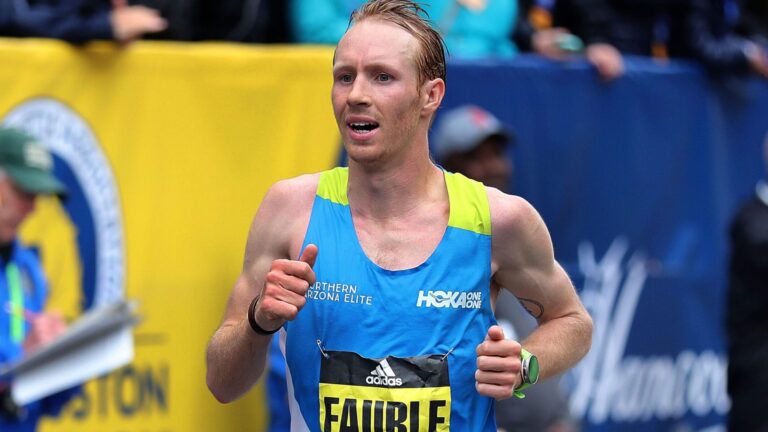
When April comes, you won’t see Scott Fauble, three times the top American in Boston. Nor will you see Conner Mantz, who made his Boston debut last year before a brilliant 2:07:47 in Chicago this past fall — the fastest run by an American man for a decade — or his training partner, Clayton Young, who was just 13 seconds back in Chicago. Providence grad Emily Sisson, the women’s American record holder, won’t be there, and neither will be her predecessor for that honor, Keira D’Amato.
Instead, they each have other business to attend to, in a place with much less marathoning history than Boston: Orlando.
Just about every top American marathoner has their sights set on Saturday, when the Olympic marathon trials come to South Florida with a summer trip to Paris on the line for the nation’s best.
It seems like an Olympic year sneaks up on us on a quadrennial basis, but for the race organizers of the top marathons in the United States, it’s always lingering, threatening to take their biggest names away.
There are exceptions, but for the vast majority of elites, racing comes on a biannual schedule: a spring marathon and a fall marathon. Boston in April, Chicago in October; London in April, New York in November; Tokyo in March, Berlin in September. A few months in between races are almost always needed first for recovery.
So when are those marathon trials? Typically in February, to give qualifying athletes the necessary time to prepare for the Olympics in July or August — but throwing a big wrench into the plans of race organizers in the process.
“I’m not running Boston,” Fauble confirmed on a recent episode of the CITIUS Mag podcast. “I’m not going to run Boston or another marathon between the trials and the Olympics unless I have to, to make the Olympics. If I’m on the outside looking in, I’m not going to go do that.”
Thus the field for April’s 128th running is particularly short on American male stars.
There are still some very good US athletes — namely the BAA’s own Matt McDonald, the second American last spring, and CJ Albertson, both of whom are scheduled for the Orlando-Boston double. (Albertson, it should be noted, ran 2:11 marathons on back-to-back weekends in December, so he’s something of an outlier.)
The effects of the trials on Boston are less stark on the women’s side, with the professional field boasting former champion Desiree Linden and last year’s top American, Emma Bates. But even their inclusions need a bit of context.
Linden is one of the greatest American marathoners ever but at 40, isn’t a favorite for an Olympic spot at this stage, though she is planning to race the trials. The 2018 Boston champion has missed the race just once in the last decade (in 2016 — an Olympic year).
Bates, meanwhile, looked like a top contender for an Olympic spot until she was forced to withdraw from the trials — a fall injury set her training back too far to be ready for Orlando, but left her on a timeline that made sense for Boston.
For race organizers, this is a uniquely American problem. If you look at the fields for Boston, you’ll see plenty of stars from abroad. Top marathoning nations like Kenya and Ethiopia don’t have a quadrennial trials race, opting instead for a more vague (and often convoluted and controversial) selection process without a one-day, all-or-nothing qualifier, leaving their athletes free to race in the spring as they choose.
But for the best Americans, they have no choice to prioritize an unusual race with no pacers, in a strange location, at an untraditional time of year. Olympians are remembered more than the third American in Boston, after all.
There’s always chaos at the trials, since anything can happen over 26.2 miles. Sisson and D’Amato are the favorites as the two fastest American women in history; Aliphine Tuliamuk is the lone returning Olympian from 2020 and would have been joined by Molly Seidel, but the Tokyo bronze medalist withdrew from the trials because of injury.
With only two American men, trials favorites Young and Mantz, having run under the 2:08:10 Olympic standard (compared to 13 women), there’s far more uncertainty on the men’s side, including how the selection process will even work. Galen Rupp won the trials in 2020 and took bronze at the 2016 Olympics, but has been limited by injuries in recent years. Fauble should be in the mix, and there’s always a chance Albertson will do something unexpected with an Olympic spot on the line.
So once every four years, when it comes to attracting American stars, Boston takes a brief backseat, a rarity for the world’s oldest marathon. Berlin is faster, but it’s not Boston; London and New York boast bigger fields, but they’re not Boston.
Only the Olympic stage can match Boston’s prestige. For now, those five rings still resonate.


To comment, please create a screen name in your profile
To comment, please verify your email address
Conversation
This discussion has ended. Please join elsewhere on Boston.com