
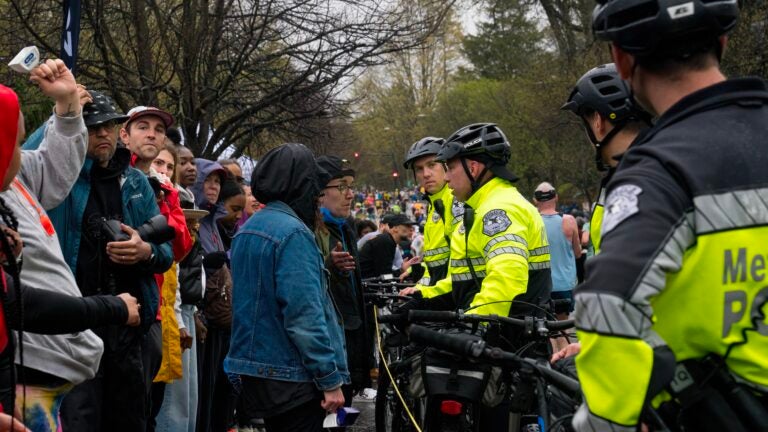
Get the latest Boston sports news
Receive updates on your favorite Boston teams, straight from our newsroom to your inbox.
Right on Hereford… Left on Boylston
Every runner who has competed in the Boston Marathon — or dreams of one day time-qualifying or raising enough funds for a charity spot — likely knows these words. Half mantra, half roadmap. These are the words you think of as you wind your way through the final turns toward the finish line off what many consider to be the pinnacle of amateur distance running.
But what about right on Washington … left on Dale?
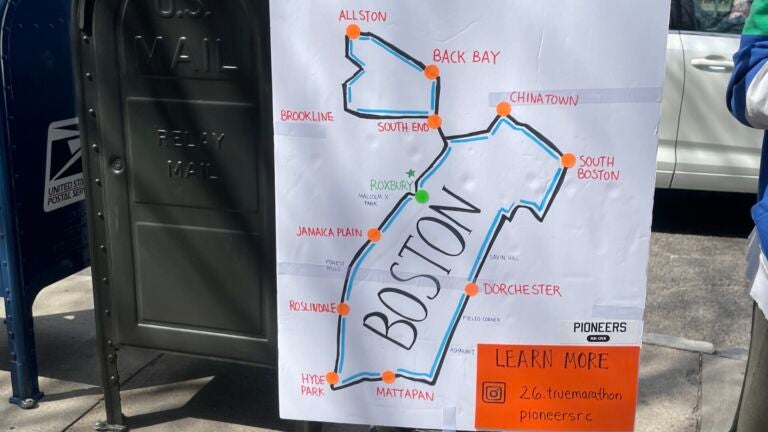
These are the final turns of the 26.True Marathon put on by Pioneers Run Crew. The untimed, unsanctioned marathon passes through more than a dozen of Boston’s neighborhoods and aims to include runners and communities historically excluded from the Boston Athletic Association’s marquee event.
“We realized the city of Boston doesn’t truly have a marathon, even though it has one by name,” Pioneers co-captain Barak Soreff told runners and volunteers before the start on Saturday April 15. “We figured it was time that the city deserved one.”
Just a few days before nearly 30,000 competitors started the 127th Boston Marathon in suburban Hopkinton on April 17, nearly 100 participants began and ended the third 26.True marathon in Roxbury. The tagline “Our City, Our Way” was emblazoned on the 26.True finisher’s medals handed out at the Melnea A. Cass Recreational Complex.
“I don’t know if all of you have run through the different neighborhoods of the city before, but they are so special.” Pioneers co-captain Aliese Lash said during her pre-run remarks to the crowd, many wearing gear from local run crews such as Pioneers and Trailblazhers. “So I just encourage you to take in the sights, the sounds, the smells, the people, the culture, the diversity of the neighborhoods that you’re running through.”
From the absence of official timing and the lower cost to enter to the drastically different course map, 26.True intentionally sets itself apart from the BAA marathon by placing an emphasis on inclusivity. The distance, of course, remains the same.
“This is a celebration of the city of Boston and all of its neighborhoods,” Soreff said. “This city is more than just a right on Hereford and a left on Boylston Street.”

The 26.True course takes participants through Dorchester, the most diverse neighborhood in Boston. The sight of dozens of runners cruising along Dot Ave is a sign of how much Pioneers Run Crew has already had an impact in Sidney Baptista’s neighborhood since he founded the group in 2017.
“I was growing tired of having to leave my house and go miles away just to run a couple of miles, and I also started to see that there were very few people of color in these spaces,” Baptista told Runners World in 2020. “The reason why people don’t run in communities of color is because there’s such a stigma that if Black people are running, they’re either running from danger or running from the cops, or they’re running to attack someone. We just need to normalize Black people doing everyday things, including running.”
A pacer with Nike Run Club before founding Pioneers, Baptista could feel the potential of running and the limits of the running community in Boston. The growth of the crew and attendance at its Wednesday nights showed that there were diverse runners eager to log miles together and in their own neighborhoods.
“When I pulled up, it was just such a welcoming space. Everyone was mad friendly,” Lash said of her first run with the crew in July 2017. “Most people were not like your typical runners. Most people were wearing basketball shorts and cute Air Jordans; and the girls had on their little Victoria’s Secret pink athleisure outfits running around the streets. They had music going, everyone was saying ‘What’s up?’ to each other. It was just so different than any space I had been in before. And I was like, ‘OK, I could mess with this.’”
Nearly six years later, Lash is a captain of the crew, has hardly missed a Wednesday run, and is one of the architects of 26.True and a leader in the larger running community in Boston and beyond.
“I think a lot about the intersections between physical health and mental health and public health,” said Lash, a clinical social worker. “I care a lot about public health. And I say this all the time, but I really believe that Black and brown people in Boston, we need running more than anyone else.”
The desire of Pioneers to create a more inclusive running community can easily place the crew at odds with its city’s most famous run: The Boston Marathon, an event famed for its exclusivity.
“It’s not inclusive to people who live in Boston,” Lash said of the Boston Marathon. “It’s not inclusive to Black and brown runners, it’s not inclusive to people who have low socioeconomic status, it’s not inclusive to people who have low levels of fitness. It’s this elitist event that is designed for and by upper middle class white men who love tradition and love doing things the way that they’ve always done them.”
After the Boston Marathon was cancelled for the first time in its 124-year history in 2020 because of the COVID-19 pandemic, the BAA announced that registered runners could complete a virtual marathon and receive a finisher’s medal.
“We had a bunch of friends from the team, from Pioneers who were planning to run Boston and then all of a sudden they had to pivot at the last minute,” Lash recalled. “We had been dreaming of creating a route that went through the neighborhoods of Boston. And we’re like, this is the moment. This is our chance.”
According to Lash, about 35 people ran their virtual 2020 Boston Marathon with Pioneers — and that was just the beginning.
“It was magical,” she said. “And then shortly afterwards people started hitting us up and are like, ‘So you’re doing this again next year, right?’”
They did — and 26.True was born.
In 2023, the third year of 26.True, Pioneers were expecting 85 participants, with approximately a quarter of that group being first-time marathoners. Helping to pull off the latest incarnation of the unsanctioned event, 26.True had volunteers, bike marshalls, cheer zones, and more than a dozen sponsors and partners, ranging from athletic brands like Puma, who provided finisher’s jackets and sneakers to all participants, to Fresh Food Generation, a Dorchester-based, Caribbean-inspired caterer and restaurant, whose food truck provided meals at the finish.
“To us, planning 26.True was like planning a huge party. Like that’s literally the mindset we go into organizing this event because it’s a space to bring all of our people together, but then also invite people into the fold to be able to experience our city,” Lash said.

Although 26.True organizers volunteer hours and hours to ensure the gear and the vibes of the event are immaculate, they know the real draws for participants are the neighborhoods of Boston.
“This is where we live, this is where we work, this is where we run, and there’s so many people who have a better appreciation for Boston after running this,” said Pioneers co-captain Barak Soreff, the crew’s resident route planner.
Starting and finishing at the Melnea A. Cass Recreational Complex in Roxbury, the route takes participants through Roslindale, Hyde Park, Mattapan, Dorchester, South Boston, Chinatown, Back Bay, South End, Allston, and Brookline.
“There’s more to Boston than The Departed. There’s more than Copley Square, Faneuil Hall, Fenway Park, and South Boston,” said Soreff
It’s no accident that 26.True extends into Brookline, a town outside of Boston. The slight detour before runners head back to Roxbury is a nod at the Boston’s Marathon’s own suburban course map.
“There’s only two miles of the actual Boston Marathon that’s in the city,” Soreff said after completing his run of the course on Saturday. “So we made two of the miles of this route outside of Boston: Two miles go through Brookline.”
With an emphasis on inclusivity, 26.True has lower barriers to entry, both financially and athletically than the Boston Marathon. Moreover, the organizers intentionally try to foster an environment that celebrates every participant equally, without regard to pace or finishing place.
“We held the finish line tape for everybody to run through when they hit the finish line, which is just like an experience that most people never ever get unless you’re like an elite athlete,” Lash said.
“We try to find simple, but meaningful ways to help people to feel seen and to feel like they belong here and that it’s not about winning, it’s not about being a super strong, super fast, super fit runner, but how we all belong here as runners.”
It isn’t only the participants who Lash and the Pioneers want to feel included, it’s the spectators who live in the communities far from Boylston Street, who may not often see running as something for them or that is even possible in their communities.
“Another big reason why the route starts sort of on the southern half of the city is because we believe so strongly that representation matters,” Lash said. “I’m so excited for the folks in the community, the little kids, the neighbors to be able to see this group of people running because there’s so many pockets that the course goes through that people do not run.
“We want people to see us out there.”
We’re running Brian Alexander Gonzalez’ home turf on Hyde Park Ave. One of the 2023 26.True participants completing their first marathon, Gonzalez’ springy cadence and smile to match are retracing his daily running route in the early miles of the race, passing family landmarks along the way.
“I just looked at the route,” Gonzalez said after turning onto River Road not long after the 5-mile marker. “I saw we were gonna run down Hyde Park Ave, and I lived two streets off of it. I was like, all right, well, that’s the first fifth of my run, so it’s gonna be exciting once I run through there.”

Along the way, he passed La Perla, his uncle’s restaurant where his mother’s siblings work together. Both his parents came to Boston from El Salvador, like many fleeing the civil war in their home country. They had met each other in their hometown of San Vicente, but didn’t actually get to know each other and fall in love until both had moved here.
Not long after passing his family’s restaurant, Gonzalez spotted his 80-year-old grandfather getting into a car, shouting out a greeting as he bounded by with a small cluster of runners.
“He didn’t, like, break his neck to see who was talking to him. My aunt was in the driver’s seat; she kind of gave me a little wave,” he said about the sort of quick moment that only happens when you’re running in the place you live. “They see me run all the time because I run by up and down Hyde Park Ave. now all the time. So I pass the restaurant daily and like a lot of our family lives in this neighborhood.”
It was during one of his local solo runs where he first saw a Pioneers Run Crew stencil outside of a building on River Road. It was a signpost that directed him — after some social media research — toward this community and ultimately this event. After seeing another stencil not long after in Allston, he knew he needed to find out more.
“I’m like, where are these people? They’re everywhere,” Gonzalez recalled thinking of Pioneers. “I found them on Instagram. I reached out, asked how to join. And then it was super easy from there. They just said, ‘We run every Wednesday here, just pull up and that’s it.’
“Now I’m running a marathon.”
Leading up to the third 26.True and the 127th Boston Marathon, Alison Desir, the author of Running While Black: Finding Freedom In A Sport That Wasn’t Built For Us, posted an infographic to Instagram, based on US Census data, showing racial demographics along the latter event’s route. In contrast to the relative diversity of the Boston neighborhoods included on the 26.True course, the towns along the Boston Athletic Association’s marathon route are overwhelmingly white.
“It’s not really representative of the people that live here,” Pioneers co-captain Barak Soreff said of towns along the marathon course. “And I think it just irks us.
“If you want to see Boston, we’ll show you Boston.”
Mile by mile, groups like Pioneers want to bring running to the places ignored by the city’s most prominent marathon with the hope of bringing the experience of running to the people who might otherwise not be exposed to it.
“Boston is an interesting place because it’s so segregated,” said Lash. “It has a lot of history, a lot of pain and separation between different classes, different races. And I think that the Boston Marathon in itself really perpetuates that and it continues to sort of create these sort of, I don’t even want to call it like a barricade, it’s like a divot that’s like really, really, really deep, that interferes with people’s ability to access something so beautiful, something so transformative as running.”

In September 2021, the Boston Athletic Association announced the formation of the Boston Running Collaborative and invited leaders from the running and non-profit communities to join the organization in making Boston running more inclusive.
“The Boston Running Collaborative builds on our commitment to racial justice and our vision of a world where all people can access and benefit from running and an active lifestyle,” said then-BAA President and CEO Tom Grilk in the initial press release. “We must be intentional to bring greater representation and diversity to the sport and we recognize our role as conveners of the collaborative to support that.”
Lash was among those invited to join the group. The Boston Marathon may be the BAA’s crown jewel event, but it’s not the one that Lash thought of when determining whether or not to participate in this initiative.
“I always tell them in those meetings that my favorite event that the BAA hosts is the Road to Wellness, which is a 5K that’s here in my neighborhood. It’s free, it goes through the city, it’s mostly Black and brown neighbors. They have a whole training program leading up to the 5K. It’s like a couch to 5K,” Lash said. “That event is beautiful.
“Anybody who comes to the event could just feel that it’s so community forward, which to me is the exact opposite of what the Boston Marathon is. And I’m glad the BAA does that because if they didn’t, I would probably not be involved with what they’re creating.”
When thinking about creating the sort of inclusive events that she feels have historically been absent from Boston’s running calendar, Lash often finds herself reflecting on the legacy of Ted Corbitt. Known as “the father of long-distance running” Corbitt was born in 1919 and was the first Black marathoner named to the US Olympic Team. He was a co-founder of the New York Road Runners — who put on the New York Marathon — and ran the Boston Marathon 22 times during a groundbreaking career that included a lifetime total of 223 marathons and ultramarathons.
“Our team Pioneers was inspired by Ted Corbett, Lash said. “I channel my inner Ted sometimes when I think about what we’re creating, what we’re organizing. I think, what would Ted do? What would Ted do in this situation?”
Less than 48 hours after pulling off another joyful, communal 26.True, Pioneers and Trailbazhers set up a cheer station at mile 21 of the Boston Marathon route on Comm Ave. There are no big-picture misgivings about the event getting in the way of supporting the runners taking all those small steps toward their goal.
“Friends, family, culture and bringing the noise for everyone bringing the heat on the marathon course! This is not your average cheer zone…welcome to Club 21’, proclaimed the cheer zone announcement on Instagram.” Get familiar! BYOV- Bring Your Own Vibes! We’re excited to celebrate our runners and all runners! You’ll hear us before you see us!”
With 26.True growing and so many community leaders calling for a more inclusive Boston where running in Boston isn’t considered less than running Boston, does the BAA hear or see them yet? If not, how much bigger can 26.True get?
“As much as I love that we own 26.True, because we’re able to make it our own and we’re able to bring the elements of running that are important to our team to this event, I know that this is much bigger than us,” Lash said. “And I know that it would be so special to just have 40,000 runners barreling down Dot Ave., Blue Hill Ave., Washington Street. And for people to run by their neighbors, by their barbershop, by the coffee shops that they hit up, that would be amazing. And I don’t know if 26.True will ever be able to do that.”
Even if 26.True could keep growing, for Lash, the real sign of a more inclusive Boston running community isn’t necessarily just a bigger 26.True.
“My dream is for the Boston Marathon to change the course,” she said. “I don’t want to do this event. When I tell you the amount of hundreds of hours that I’ve invested out of the volunteer goodness of my heart, like I have a full-time job and I do this on the side. It is a lot of work, and it’s a passion project. So we lead and we do it because we care a lot. But my real dream is for the BAA to see what we’re creating, to be convinced by the exclusivity of their event, and for them to change the course so that we don’t have to do 26.True.”
A dream come true: Right on Washington … left on Dale
Receive updates on your favorite Boston teams, straight from our newsroom to your inbox.


To comment, please create a screen name in your profile
To comment, please verify your email address
Conversation
This discussion has ended. Please join elsewhere on Boston.com