
‘I feel like I watched Boston Strong happen’: Newburyport survivor reflects on Boston’s resilience after 2013 marathon bombing
Dave Fortier went on to found One World Strong, a nonprofit network of survivors of terrorism in both the U.S. and around the world.
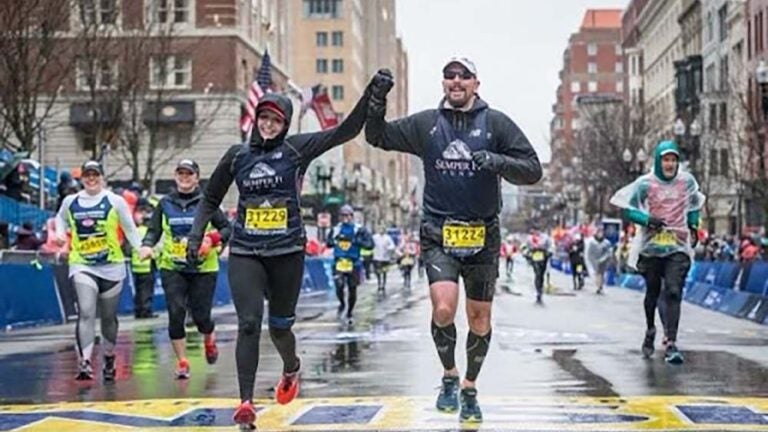
“One and done.” That was Dave Fortier’s mindset going into the 2013 Boston Marathon.
Even as he was coming down Boylston and moving “lamppost to lamppost,” he kept his eyes on the finish line, believing that this would be his first and last time running the historic race.
The Newburyport resident had no idea that he would go on to run it again every year for the next decade, plus several other marathons. More importantly though, he had no idea how much his life would change, both personally and professionally.
It was in that final stretch that the first of two bombs exploded near the finish line in a terrorist attack that killed three people and injured hundreds of others.
In the days that followed the bombing, Fortier — who walked away with shrapnel wounds in his right foot and hearing loss — and other survivors were visited in the hospital by members of Semper Fi & America’s Fund, a group of veterans who survived their own life-changing injuries and trauma while in combat in Iraq, Afghanistan, and other places around the world.
Strength in survivors
By connecting with others who had experienced similar forms of trauma, Fortier and other survivors were able to find critical support and healing.
Ten years on, Fortier said those immediate efforts to form this sense of community were essential for building resiliency.
He credited the city, particularly Boston’s then-leader, Mayor Thomas Menino, with helping in that healing by bringing survivors together for various gatherings and ensuring that people had access to resources amid the aftermath of April 15, 2013.
Speaking with Boston.com, Fortier explained how helpful it was to hear from other survivors at these gatherings. If one survivor was able to talk about their trauma and say that they believed they would be OK, then others were more likely to believe that they would be, too.
Fortier lauded the countless first responders, volunteers behind the scenes, medical personnel at area hospitals, and the Boston Athletic Association — emphasizing how each stakeholder’s emergency preparedness took a role in saving lives.
“I feel like I watched Boston Strong happen,” he said.
“At the time, when this happened and where it happened and how it happened, the city was prepared for it,” Fortier said. “The city drills on stuff like this. Not necessarily bombings, but events and how to deal with it. The way the city responded saved lives that day.”

Though he didn’t know it at the time, it was through this experience that Fortier would later be inspired to help other survivors of domestic terrorism and, eventually, found One World Strong, a nonprofit network of survivors of terrorism in both the U.S. and around the world.
The power of peer-to-peer mentorship
The idea for a foundation like One World Strong didn’t really start to take shape until 2016 when a group of Boston survivors traveled down to Orlando to visit with survivors of the Pulse nightclub shooting.
On June 12, 2016, a gunman opened fire at the gay nightclub, killing 49 people and injuring dozens of others, making it the deadliest mass shooting in U.S. history up to that time.
While visiting with survivors of the massacre at their hospital bedsides, Fortier really saw the power of peer-to-peer mentorship.


“It was Orlando that became kind of the turning point,” he said.
When he returned to Massachusetts, Fortier, who lives on Plum Island, started looking for an organization that he could volunteer his time with, but he struggled to find what he was looking for, even after speaking with the United Nations and reaching out to different organizations.
Fortier said it became clear to him that there was no organization out there that did what he was looking to do without regard to race, ethnic background, politics, etc.

In 2017, he started the paperwork to establish his own foundation, and in 2018, One World Strong was official.
Over the past several years, One World Strong has formed connections with people all over the world. This includes countless survivors and families who have lost loved ones in mass shootings across the country and survivor communities in Jordan, Somalia, Syria, Lebanon, France, Belgium, and many other countries.
These partnerships have allowed Fortier to not only establish a community, but to put together a list of resources and support services. So, whenever tragedy strikes — no matter the location — One World Strong is available and ready to immediately connect with those most impacted.
Working alongside Fortier and serving on the Advisory Board, for example, is Stephanie Cinque, founder and director of the Resiliency Center of Newtown, a brick-and-mortar organization in Newtown, Connecticut, which aims to bring long-term healing to those affected by the Sandy Hook Elementary School shooting in which 27 people, including 20 children, were killed by a gunman, who also killed himself.
Online resiliency center
With the help of Cinque and a number of other critical stakeholders including Semper Fi & America’s Fund and the McCain Institute for International Leadership, as well as a federal grant from the Department of Homeland Security, One World Strong recently launched the ResilienceNet app, which aims to work as an online resiliency center for those affected by, or at risk of, domestic extremism.
The app — still in its early stages and growing — has a few main components: resilience building, which compiles lists of various hotlines, therapy treatments, and resources for those impacted by violence; peer connections, allowing survivors to network with others around the world with built-in translation in 28 languages via Microsoft Viva Engage; a toolkit and network for service members developed by Semper Fi & America’s Fund; and violence prevention, featuring a prevention practitioners network created by the McCain Institute that aims to connect licensed professionals with individuals or families at risk of violence.

“We learned that stories of survivors can have an impact on somebody thinking about doing something bad,” Fortier explained about the violence prevention effort.
“Humanizing who their victims might be” and other such details can affect someone who may be considering violence, he said.
10 years on from the bombing
Reflecting back on April 15, 2013, Fortier noted, “I can’t believe it’s been 10 years. Coming up to this, sometimes it seems like it was yesterday. And sometimes, it seems like it was 20 years ago.”
“I think the city of Boston learned a lot,” he added. “We can take a lot of what Boston learned and now share it with other cities. You can take something bad and try to make something good, and that’s what a lot of us have been trying to do.”
As he prepares for this next marathon, Fortier joked that he considers himself a non-runner, who will more likely jog it.
Still, “I’ve never gone to bed more exhausted, and I never wake up more excited to start the day,” he said. “Doing this — it’s taken me all over the world. Friendships and places and with people, I would have never known.”

Though working around tragedy can be “exhausting,” Fortier finds purpose through One World Strong.
“It can be tough, but taking what we saw and what we learned in Boston to other people to try to make (their healing) easier — I couldn’t think of anything else I’d rather be involved in,” he said.
Already looking ahead to 2024, Fortier is planning to bring survivors from various parts of the world to Boston to run the marathon alongside him.
It wouldn’t be the first time he ran 26.2 miles with a special guest. In 2019, Fortier ran the marathon with Andy Burnham, mayor of Granter Manchester in the U.K. Together, they had worked to bring two families that had each lost a child in the 2017 Ariana Grande concert bombing to Boston to spend marathon weekend with them, meeting other survivors impacted by the Boston bombing.
Every day, Fortier sees potential to reach another person, who has either been impacted by, or is at risk of, targeted violence.
“I get up with even more of a step to say, ‘How do we keep moving this thing forward? How do we reach people that may be thinking about doing something bad?’ And that’s a lot of what the mobile app has become — a place for families who might be concerned about somebody to go,” he said.



To comment, please create a screen name in your profile
To comment, please verify your email address
Conversation
This discussion has ended. Please join elsewhere on Boston.com