
Newsletter Signup
Stay up to date on all the latest news from Boston.com

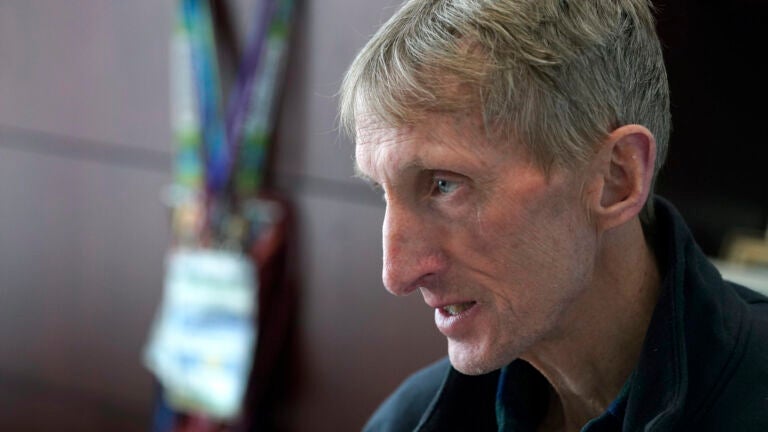
Ten years after two bombs exploded near the finish line of the 2013 Boston Marathon, what stands out to Tom Grilk is the emotions of the day and how everyone — spectators, runners, volunteers, first responders, and the city as a whole — responded to them.
In an essay published Tuesday in Boston magazine, the former executive director of the Boston Marathon reflected on his memories of the “gut-wrenching, horrible day” and the lasting lessons to be learned from the tragedy.
“Marathon Monday 2013 was the worst day, but it was also a day when we discovered the best of ourselves,” Grilk wrote. “And now, a decade on, it’s still a day we all carry with us. It remains deeply personal, even for those of us who were not injured that day. There are things that I began to learn that day about our city and ourselves, and time has only deepened them.”
The former president of the Boston Athletic Association noted that even as the city grappled with “fear, uncertainty, anger, and even bewilderment” in the moments and hours after the terrorist attack, what emerged was that there was “no hesitation to act.”
“We learned immediately that Boston was ready to stare into the face of horror that day and to take it on without hesitation—both individual citizens and all of the public safety and medical institutions,” Grilk wrote. “And we learned how proud it made so many of us feel to be citizens of Boston.”
Within seconds of the blasts, first responders and ordinary citizens sprang into action, rushing to care for the injured, he noted.
“Those citizen heroes on the sidewalk accounted for a large percentage of the initial, on-the-sidewalk measures that sustained the wounded while awaiting the EMTs,” Grilk wrote. “The Boston Marathon has a long history of people aiding others, whether they are runners helping other runners or spectators coming out to the same spot on the course year after year, generation after generation, to cheer and bring refreshments to runners. In so many ways, it’s the ordinary people who make the most extraordinary differences.”
Even with the acts of heroism that day, big and small, Grilk pointed to the important lesson of preparedness, writing that the city was “deeply fortunate” to have plans and a structure in place in the event of a mass casualty event.
“Before we were ‘Boston Strong,’ we were ‘Boston Prepared,’” he wrote.
“The lesson for me and for anyone in all this was that there is heroism in preparedness, in being ready for anything,” Grilk said. “The phrase ‘being ready’ doesn’t sound very exciting. I never connected planning with heroism. But … all of that planning, integrated across so many organizations, was decisive in saving lives in the wake of the bombings. It made us strong.”
Read Grilk’s full essay at Boston.

Stay up to date on all the latest news from Boston.com



To comment, please create a screen name in your profile
To comment, please verify your email address
Conversation
This discussion has ended. Please join elsewhere on Boston.com