Q&A: Shalane Flanagan talks retirement plans
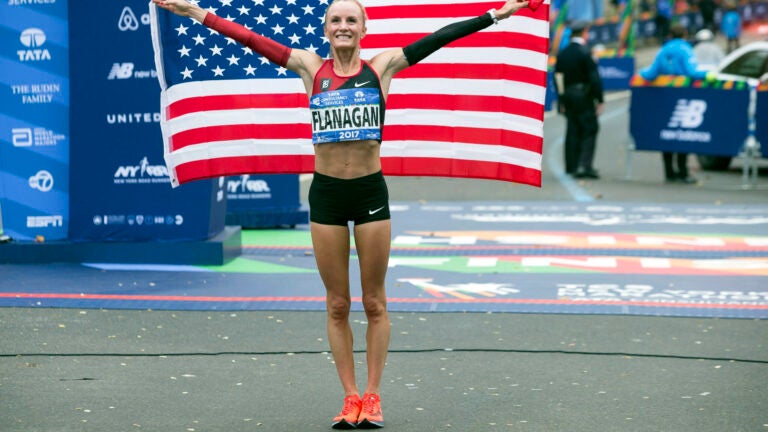
Shalane Flanagan, the four-time Olympian and winner of the New York City Marathon in 2017, called it quits on her running career in October — sort of.
Flanagan, who is 38 and has long trained with Nike’s Bowerman Track Club, is moving into coaching and television work. She will serve as the color analyst for ABC’s telecast of the New York City Marathon on Sunday, and once that is done she will return to Oregon to help coach the elite women who call themselves the “Bowerman Babes.”
There are few women coaching at the highest levels of running, even for female runners, and fewer who can still keep up with the athletes they train. That’s the kind of coach Flanagan plans to be as she moves into the next phase of her career.
“My dream is to become a personal pacer,” she said in a phone interview last week, during which she discussed her decision to hang up her racing shoes, Nike’s connection to the latest performance-enhancing drug scandal and whether, as an analyst, she will criticize runners she is coaching.
This conversation has been edited for clarity and condensed.
Q: Are you disappointed not to be running in a marathon you won so recently?
A: I’m not disappointed at all.
Q: Is that because you get to be the Tony Romo of running now, someone who was in the sport one day and in the broadcast booth the next?
A: Tony is one of my favorite commentators, so if I can resemble anything close to him then that will be great. Every time I listen to him I learn something about football I didn’t know.
Q: Will you be able to predict the future the way he does and tell everyone who is going to win midway through the race?
A: I’m guessing he can do that because he sees things that we don’t see and he has that insider’s look on a few things. We’ll see. Predicting what is going to happen can be pretty tough in a marathon. The more frequently you see runners, the more you can see their nuances with fatigue.
Q: You’re also now becoming a coach officially. Is that a role you have been playing unofficially for a while?
A: Prior to the last year I had always looked at myself as the elder on the team. A little motherly, maybe a bit bossy and mentoring to younger athletes. But ever since I finished my last race in New York a year ago I have known I wanted to coach, and I’ve been observing and watching more with a coaching eye than as a teammate. The last year has been a kind of informal internship.
Q: Why aren’t there more female coaches at the highest levels in track and field?
A: I never thought of it as a gender position or role, but having in the last year been in an environment and the arena of the coaching world, it has opened my eyes. At the U.S. championships, there are very few women coaches in the warm-up area, or even agents. It definitely feels strange.
Q: People who were the elite of the elite have trouble relating to athletes who are less talented. Any concern about that?
A: I want to make sure I don’t try to coach people as to what worked for me. I always want to come to their level and meet them where they are at. There is an art form in knowing the athlete and knowing what they need. You have to be compassionate about how hard things are. I have a lot of compassion. My understanding of what they were going through is very real. It’s all about trying to figure out how to get into a specific athlete’s head. I don’t have all the answers.
Q: Your sponsor, Nike, which funds your training group, worked closely with Alberto Salazar, who has been suspended from the sport for actions he took as coach of the Nike Oregon Project. Has the company done enough to make you feel that other Nike athletes will not be tainted by all of this?
A: They are currently looking at the situation. I am guessing that they are a bit shocked to some degree and they are going to evaluate how they format these teams in the future. It’s a big liability for them. It’s very complicated. I’m proud of the U.S. Anti-Doping Agency and the efforts they put forth and their commitment to clean sport.
Q: Were you surprised by what you read in the reports about the Oregon Project, that Nike’s chief executive, Mark Parker (who has since left that post), was kept in the loop through emails about experiments with performance-enhancing drugs?
A: We train on the Nike campus, but we very much stick to our neck of the woods. We kind of quarantine ourselves. Once Jerry Schumacher broke off with Alberto in 2009, we’ve been very separated. That said, I’m surprised but not surprised by the situation that unfolded. I trained with Kara Goucher sometimes and I was privy to what she was going through, so I am not completely ignorant on the subject. As for Mark Parker’s interactions, I was unaware of those. (Goucher was one of the main whistleblowers in the USADA investigation.)
Q: Are there any races in your career that you wish you could run again so you could do something different and come up with a different result?
A: I wish the day I ran that 2:22:02 in Boston that it coincided with a win, but I think I was seventh that day.
Q: Were you thinking earlier this year that you might be able to give the Olympic trials another shot?
A: Had my knees and my health aligned to set me up for a good training block, I would have been there. But I have to respect my body. I love running so much, and that outweighs trying to run 130-mile weeks and maybe damaging my knees permanently and being in a lot of pain. I want to make sure I can run for the next 20 years.
Q: Will you run with the women you are coaching?
A: I would love to pace someone like Shelby Houlihan to a 5K record attempt, or really any of our athletes. Being able to do that for them, that’s my motivation.
Q: Did you ever have a coach like that?
A: Jerry used to be able to hop in during some sessions. It made it so much more fun. When I was preparing for Boston I would make multiple trips and train on the course for multiple days. Jerry would get on and do workouts with me. I loved so much to have my coach give his body to help me attain my goals.
Q: So what does Jerry say about you commenting on television about runners in your training group?
A: Jerry would prefer I not commentate when I have athletes in races. I’m not sure I will change his mind on that aspect.