‘You don’t want to be another barrier’: What goes into helping pedestrians cross the Boston Marathon course during the race
“Most people know that it’s very difficult to get across the street. Of course you always have some people that will ask, ‘What’s going on?’ Which believe it or not happens more than you can say.”
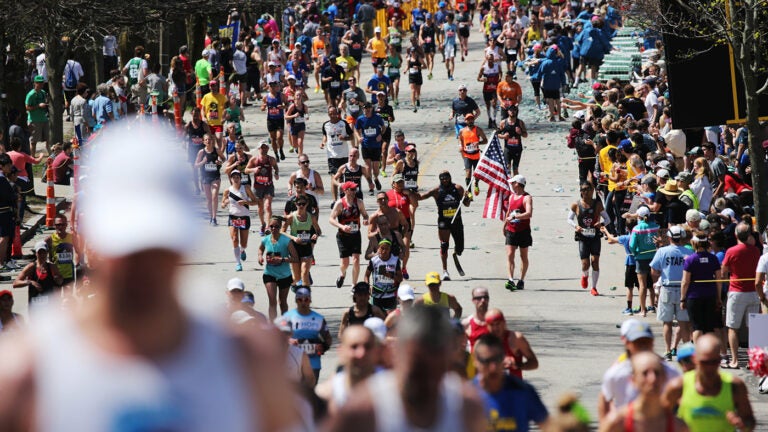
Come Marathon Monday, 30,000 runners will hurtle down the legendary course that carves a path through throngs of spectators from Hopkinton to Boston. And as the race participants chase dreams of crossing the finish line, Brookline police and volunteers with the Boston Athletic Association will engage in a delicate balancing act throughout the day — helping pedestrians cross the Boston Marathon course. The shepherding involves a handful of people at each of the town’s three crossing points, some string, and large arrow signs.
Brookline police Lt. Kevin Mealy, who will serve as operations chief for the department at the 2019 Boston Marathon, has been involved in the planning and on-the-ground implementation of the crossings for the last several years.
He said that the crossings — at the intersections of Beacon Street with Tappan Street, Webster Street, and Hawes Street — are not workable during the height of the race when the flow of runners is at its peak.
Related Links
-
Boston Marathon
Live blog: The very latest on the 2019 Boston Marathon
-
Boston Marathon
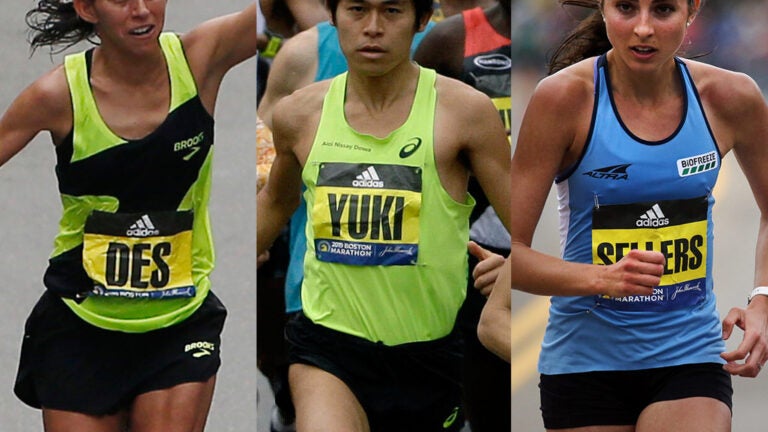
Sarah Sellers returns to the Boston Marathon a year after her surprising 2nd-place finish
-
2019 Boston Marathon
Rainy day could make Des Linden a Marathon favorite
-
2019 BOSTON MARATHON
Defending Boston champ Yuki Kawauchi is marathoning’s true iron man
-
Boston Marathon
‘Three rings, three medals’: Tedy Bruschi is running the 2019 Boston Marathon for a personal cause
“There are certain times during the race, say from noon time till 3:30 or so, where the flow of runners is so constant and so thick you just cannot step out safely into the road and divert them into a half of a lane,” he told Boston.com. “It’s just too constricted. You run the risk of people tripping, falling, colliding, etc.”
When that happens, the crossings get completely closed, he said.
It is usually early or late in the race that officials at the crossings make determinations about whether or not it is feasible to allow people to cross the street. The paramount goal is to stay out of the way of race participants.
“We’re toward the end of the race and a lot of people are struggling at that point, and you don’t want to deviate them from their straight line,” the lieutenant said. “You don’t want to be another barrier, but we are trying to get as many people across to go about their business as we can. But there’s just certain times during the race where you just can’t. It’s just physically impossible to get people across because of the flow of runners.”
The crossing itself can be pretty quick.
Mealy said BAA staff at the crossing will look for a break in the runners and make the call on when people can go from one side of the street to the other. As the BAA uses the string and arrows to divert the runners, police officers assist in directing the pedestrians into the rectangle outlined on the pavement in the middle of the course — and prevent too many people from trying to squeeze in, he said.
“It’s really 100 percent up to the BAA and the officers on the scene to make that determination,” he said. “So they’re just looking to see if we can fill in that entire box with people and get everyone across at one time.”
There has to be enough people trying to cross the course to make it “worth it” to divert the runners, Mealy said.
The whole system relies on cooperation, not only of the police and BAA representatives at the scene, but of the spectators and pedestrians who want to cross, he said.
“Most people know that it’s very difficult to get across the street,” Mealy said. “Of course you always have some people that will ask, ‘What’s going on?’ Which believe it or not happens more than you can say. But most people are pretty patient. They know once they’re on one side of the street at the height of the race they’re just going to have to wait.”