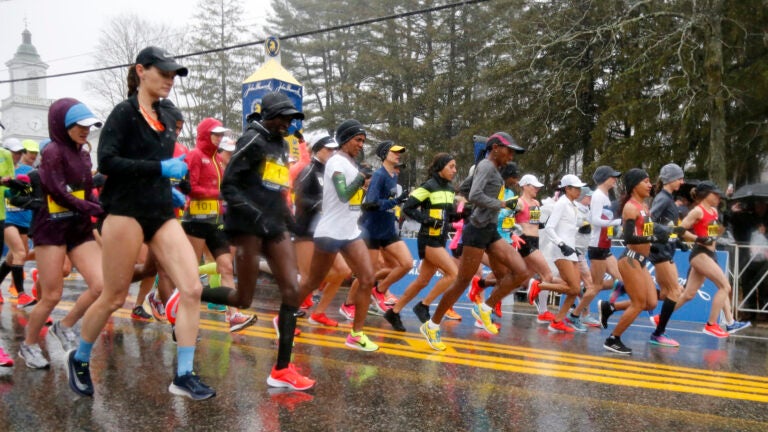
Amby Burfoot is set to run the Boston Marathon on the 50th anniversary of his 1968 victory
"I’m older and slower, of course, but I feel young at heart and I think I can still finish the Boston Marathon."
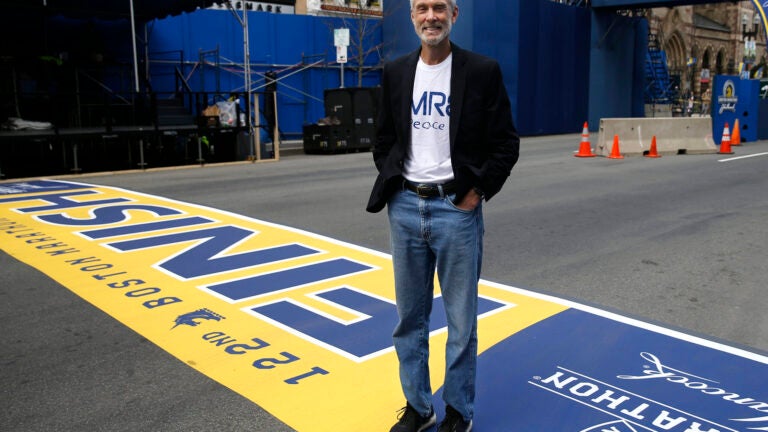
Kelley Passes Torch to Pupil Burfoot, Who Wins the Boston Marathon.
That’s the headline Amby Burfoot would have written across the cover of Runner’s World, had he been Editor-in-Chief on Patriots Day, 1968. Burfoot has spent the past 40 years with the magazine, but on that April morning he wasn’t covering the race, he was a 21-year-old Wesleyan senior winning it.
Monday marks the 50th anniversary of Burfoot’s victory. The 71-year-old plans to celebrate the occasion with yet another jaunt over the Newton Hills.
Related Links
“I’ve run 110,000 miles. I do realize that I am very fortunate to be as healthy as I am at this point. I’m structurally very healthy,” Burfoot told Boston.com. “I’m older and slower, of course, but I feel young at heart and I think I can still finish the Boston Marathon.”
He expects to clock in at around 4 hours and 15 minutes, 10 minutes ahead of the qualifying standard for his age group but a few ticks slower than the 2-hour, 22-minute time he posted in ’68.
Burfoot burst up Heartbreak Hill that April day with no one in front and Bill Clark’s shadow hovering just behind him. Clark was the better finisher, so Burfoot knew he’d have to lose him on the climb around the 21-mile mark to have a chance down the stretch. He did not. Clark was still matching him stride for stride when they crested the hill, but as they started to descend, Clark’s legs cramped and Burfoot broke the tape alone.
“I won the race. I collapsed into Jock Semple’s arms. A laurel wreath was placed on my head by the mayor of Boston. None of that made any difference to me. The only thing I wanted was to be reunited with John Kelley so I could say thank you to him for everything he had given me,” Burfoot recalled.

Amby Burfoot on his way to a laurel wreath in the 1968 Boston Marathon.
Kelley, he of the passed torch, was John “The Younger” Kelley, head coach of the Fitch High School cross country team. Burfoot walked on to that Groton, Connecticut team and had the “incredible good fortune” to discover that his coach would be a two-time Olympian and winner of the 1958 Boston Marathon. But Burfoot says that the running drills Kelley taught were less important than the life lessons he imparted.
“He never preached to us about running,” Burfoot said. “He preached to us about the world, particularly the environment, the interdependency of all aspects of life on this planet.”
Burfoot had plenty of time to ponder these ideas as he ran 35 miles a week during his senior year at Fitch, then doubled that total to 75 miles for his first year at Wesleyan University (where his roommate and running partner was 4-time Boston Marathon champion Bill Rodgers). He had no headphones to keep him company, so the thoughts arrived undisturbed and eventually poured out in Runner’s World and three books: First Ladies of Running, The Runner’s Guide to the Meaning of Life, and his latest, Run Forever: Your Complete Guide to Healthy Lifetime Running.
“The fact is that in the pre-digital age we were all spending many, many hours out there on the roads and we didn’t have anything to entertain us other than our own thoughts. We got quite in tune with ourselves, our thinking, our philosophies and the questions of life — the ways that each of us individually respond to those questions and the highs and lows that life inevitably showers upon all of us. From all of this thinking while we were out there running, those who had the talent chose to write about running drew on this immense amount of time and sweat to produce thoughtful and moving tributes to the sport. Many of them individual, because all we can really do is write about ourselves. But in writing about ourselves we can perhaps explore situations and circumstances that everyone encounters in life.”
In Run Forever, Burfoot passes on the principles that have served him well over the 110,000 miles. He tried to provide a guide to enjoying the sport at every stage of your life, even when your legs don’t mow down the miles like they used to. The book’s cover stresses the word healthy, but Burfoot actually fought with the publisher over whether to include it because he believes the word wasn’t necessary.
“The general population thinks that runners all have bad knees and bad hips and their body generally disintegrates through the ages, whereas the research and studies show the opposite — that we are at least as healthy in the key joints as the general population and in many studies actually doing better,” Burfoot said.
For most of his career, he used that good health to run Boston every fifth year. But 2018 will be his sixth in a row. After the bombings in 2013 stopped him at the 25-mile mark, Burfoot was determined to return in 2014, and with that he figured he might as well run in ’15,’17, and ’18, too.
“For several days after the race day in 2013, we all worried that it would be, if not the end of the Boston Marathon and similar events, then it might be a really strong blow against such mass participation events because obviously on the open avenues and streets of a big city, we are all vulnerable to whatever,” Burfoot said. “But after a couple of days of worry, we all sensed this same resilience and Boston Strong spirit…The 2014 Boston Marathon was absolutely the greatest foot race in the history of the earth.”
Better than ’68? Yes, Burfoot laughed, even better than ’68.
“The success of 2014 and all the races since then have really proved that the runners and the citizenry of Greater Boston are a force to be reckoned with and a force that won’t be held down,” he said.
Burfoot will add his feet to that force once again on Monday, 50 years after he accepted the torch from John Kelley and a laurel wreath from the Boston Athletic Association.
Gallery: The Boston Marathon through the years
[bdc-gallery id=”138482″]