
Marathon bombing survivor’s book chronicles friendships forged after Boston’s ‘worst day’
‘Not everybody knows of the good that came out of that day.’
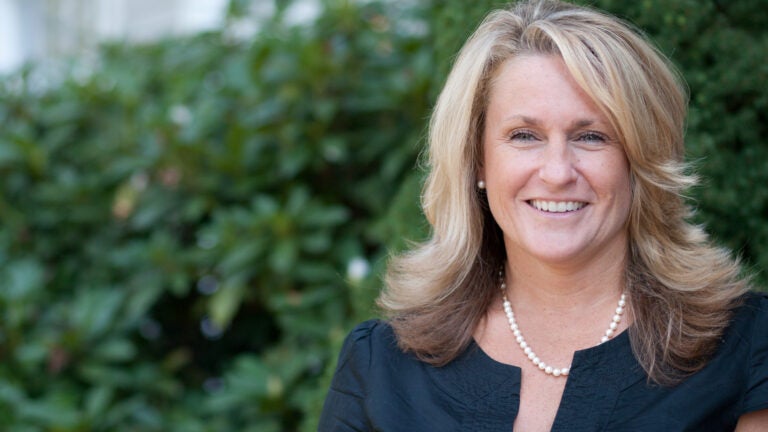
Roseann Sdoia says she’s bonded for life with the three strangers who saved her life when she was critically injured by a pressure-cooker bomb at the Boston Marathon in 2013.
Related Links
Sdoia tells the story of how their friendships were forged in her new book, “Perfect Strangers,” which published at the end of March. In it, she describes how Northeastern student Shores Salter ran toward the smoke from the bombs and heard her calls for help.
She explains how Boston Police officer Shana Cottone commandeered the police wagon that transported her to the hospital when an ambulance wasn’t available.
And she shares how a Boston firefighter Mike Materia, now her fiancé, helped care for her at the scene and held her hand on the way to the hospital.
“This is a story about my favorite day in my favorite city in the world and how, in an instant, that day went from being pure celebration to desperate survival,” Sdoia writes in the book’s introduction. “For those of us who made it off the sidewalk that horrific day, and those who made sure we did, this book is about taking back our favorite day while never forgetting those who were lost.”
Sdoia told Boston.com it was therapeutic to write the book, but what really made her share her story was the feeling that, “everybody knows what happened that day, but not everybody knows of the good that came out of that day.”
Ahead, Sdoia discussed how it felt to put her experience to paper and what she hopes readers will take away from her story.
What was the most challenging part of writing the book?
It’s really difficult to read about yourself, [to] put your story on paper. It’s hard to open up and let some of that out. It was really hard emotionally [and] mentally to open up about it. Not just the day itself, but a lot in general about family things. You’re really kind of putting it all out there.
Is there a part of your story that was most difficult to share?
To really get personal is really difficult. You kind of just have to throw caution to the wind and say, ‘Oh, people will forget about it tomorrow.’ That was really difficult.
Was there a moment or something that you most wanted to share?
Honestly, I think the most important part was just to show how much good came out of it. How we bonded together. That there was support from random people, and those random people are now, in my mind, family. And I think that is really important to share, especially with first responders and people that they’ve helped. They do the job every day and they don’t make that connection.
It’s one of those things where you’re lucky when someone comes into your life — for whatever reason that might be — and your paths cross. I really think that it was important to show that there was so much good that happened that day even though there was so much bad.
Do you feel the writing process helped you learn anything about yourself or your story that you didn’t realize before?
Mike, Shana, Shores, and I were all there that day, and the three of them were working on me. When I would read their sections, it was always interesting to me because some stuff I didn’t know, or it was never really elaborated. So it really gave me more of a sense of what happened that day. There were some just some bits and pieces that all got tied together. I was able to understand better the sequence of events and how that all played out.
You have a section titled “Resources” at the end of the book that contains information, not only on organizations for amputees, but your own advice and suggestions for dealing with loss of a limb. What were your thoughts behind including that?
Early on, I was so fortunate to have so many people that were amputees come and offer their advice and guidance. There’s no book out there that tells you how to deal with this situation. Even though not everybody involved in an amputation touches mine in regards to the trauma of how I became amputated, it is a trauma regardless.
I just really wanted to pay it forward to other people as I had people helping me. If someone picks up the book and reads it, it will make me feel good knowing that I was able to pass that along.

In this photo from May 2013, Mike Materia picks up Roseann Sdoia in a hug following a press conference marking her release from Spaulding Rehabilitation Hospital.
Can you speak a little bit about significance of the Boston Marathon to you before 2013?
Our dad would take us in on Marathon Monday for the Red Sox game, and then after the game, we would walk to Kenmore Square and watch the runners come in.
Through the years that tradition of going in on that day really remained the same, then I started going in with my friends instead of my family. It was a day that I’d look forward to. I lived out of state, and I’d come home for that day. It was my favorite day in the city. So any chance that I could get to go, I would be there Marathon Monday —no question.
How are you feeling this year about Marathon Monday with this milestone of publishing a book about your experience?
I don’t think that it will ever be my favorite day in Boston again. I don’t think there’s a way to get that back 100 percent. But over the last several years, I have gone back and spent time, with baby steps. …
This year is even more special because Shores is running the marathon with the bib I gave him. He’s running for the Heather Abbott Foundation, which is near and dear to my heart, and it will definitely be very special.
I’ll be there, and hopefully it will be a good day.
What do you hope people take away from your story?
There are a lot of messages that can be taken from it, I think. Number one, although it was a bad day, something really good came out of it with my bonds with Mike, Shana, and Shores. And even better now: I’m engaged to Mike.
I think also that it’s not so much of what happens to you, but how you react and how you handle it. Not even just for myself. I feel that pretty much all of the survivors have really done a fantastic job with the ways that they’ve handled themselves over the last four years. I think that’s what makes the difference, and I hope that people see that.
You can read an excerpt of “Perfect Strangers” here.
This interview has been lightly edited and condensed.


