
Get the latest Boston sports news
Receive updates on your favorite Boston teams, straight from our newsroom to your inbox.
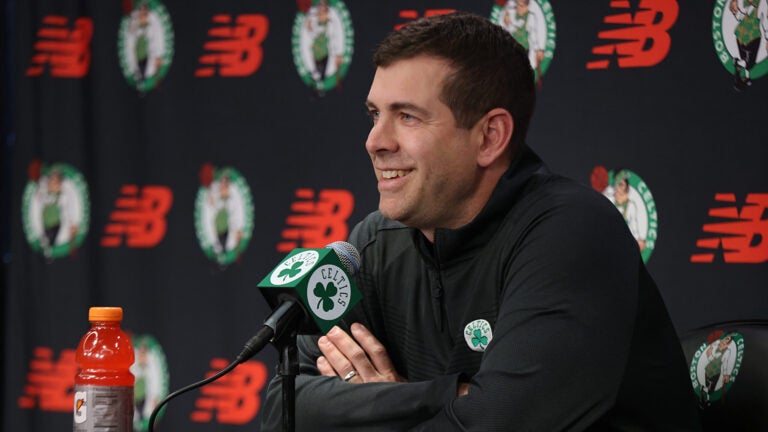
On Saturday, the Celtics made one final roster move for the regular season, signing Dalano Banton to a two-year contract to complete their playoff roster.
The move is minuscule; Banton will be near the end of the bench for Boston’s playoff run. But his signing has been calculated for some time, and its completion highlights the performance Brad Stevens has put on since the summer of 2025.
It was one of the worst-kept secrets in the NBA that the Celtics were going to shed salary cap ahead of this season. They were over the second apron of the luxury tax for consecutive seasons, and the punishments for being over it a third time are severe.
But Stevens didn’t stop when he got below the second apron. He took Boston out of the luxury tax altogether, while keeping a competitive enough lineup for Joe Mazzulla to flex his own muscles as a great young coach.
Then he added depth at the trade deadline and still maintained his space under the luxury tax. And now, after juggling 10-day contracts for over a month, he officially solidified the Celtics’ playoff caliber roster in a remarkable balancing act that didn’t hurt Boston’s future, but didn’t punt away 2025-26 either.
Here’s a recap of arguably Stevens’s best performance as a GM:
The Celtics entered last offseason with five large contracts, needing to get rid of at least one, but more likely two of those deals. Between Jayson Tatum, Jaylen Brown, Derrick White, Kristaps Porzingis, and Jrue Holiday, sacrifices needed to be made early in the summer.
Tatum and Brown, of course, weren’t going anywhere, and Stevens decided early that the core he wanted was the Jays and White. So, he shipped away Porzingis and Holiday, which turned out to be the right move. But with Tatum expected to miss most or all of the regular season, Stevens was essentially losing three of his five best players from the NBA Championship team in 2024.
Stripping Boston’s lineup down to the studs allowed a clear picture for how Stevens planned to rebuild it.
A lot of Boston’s success early this season hinged on players rising to the challenge and outperforming their individual projections. The two best examples of that were Payton Pritchard and Neemias Queta.
Stevens gave Pritchard a deal three years ago that turned into one of the best value contracts in the NBA. He signed Pritchard to a 4-year, $30 million deal when he wasn’t getting many minutes, was the sixth man of the year last season, and has started 50 games this season averaging 17 points per game.
Queta was brought in to be a depth big with defensive upside, and he’s transformed into a bonafide starting caliber NBA center. Which is a good thing, since Stevens constructed the roster so that he needed to be the center. It was sink or swim, and Queta certainly swam. He’s done so much for the Celtics this season that his teammates are pulling for him to be considered for Most Improved Player.
There are other examples, too. Sam Hauser and Jordan Walsh have stepped up in their own right to help Boston stay competitive.
The 2025 NBA Draft was very top-heavy. The first five players off the board were considered slam dunks. After that, the waters got murky.
Yet, at No. 28 overall, Stevens found a European named Hugo Gonzalez and gave him a shot. On the surface, he filled a big need. On Boston’s championship roster, it had two guards who played smothering defense. Losing Holiday in the summer lost some of that defensive edge. Pritchard might be an upgrade offensively in the starting lineup, but he isn’t the touted defender Holiday is.
But Gonzalez’s length as a guard and experience playing overseas made him a valuable defensive asset, and he’s fit right in with the Celtics this year, particularly as a complement to Pritchard.
Stevens didn’t do a whole lot to rework the lineup in-season, but the small moves he did make were solid. He ditched Anfernee Simons, who was a good idea in principle but didn’t quite fit with Boston, and added Nikola Vucevic at the deadline.
Neither move disrupted the flow the Celtics were creating, but the Vucevic addition gave Boston a center depth with veteran NBA experience behind Queta. And even though Stevens cycled through a few different placeholders for the last roster spot, he did so in a very calculated way, knowing the road ended with Banton.
Boston signed Banton to his initial 10-day contract in February, and then stashed him away in Maine until it could sign him again for the playoff run. Banton was on the Celtics already, he knows Mazzulla’s coaching style, and is yet another undisruptive signing that could get minutes in a pinch without being a liability on the floor.
Stevens, like a great chess player, has been thinking five moves ahead for nearly a year now. If he would’ve closed his eyes 10 months ago and pictured April 2026, this probably would’ve been the best-case scenario.
Tatum is back and finding his groove right before the playoffs. Brown had a whole season to prove he’s a bigger star in the NBA than people gave him credit for. And the Celtics are positioned as the No. 2 seed in the East with a lineup that has legitimate NBA title aspirations.
Stevens was a good coach in the NBA. But he’s been an extremely good executive, and this season is the best proof of that.
Receive updates on your favorite Boston teams, straight from our newsroom to your inbox.




Be civil. Be kind.
Read our full community guidelines.To comment, please create a screen name in your profile
To comment, please verify your email address