
What is the NBA’s second apron? And how do the Celtics escape it?
An explanation of what the second apron is, what the penalties are, and how the Celtics can avoid them.
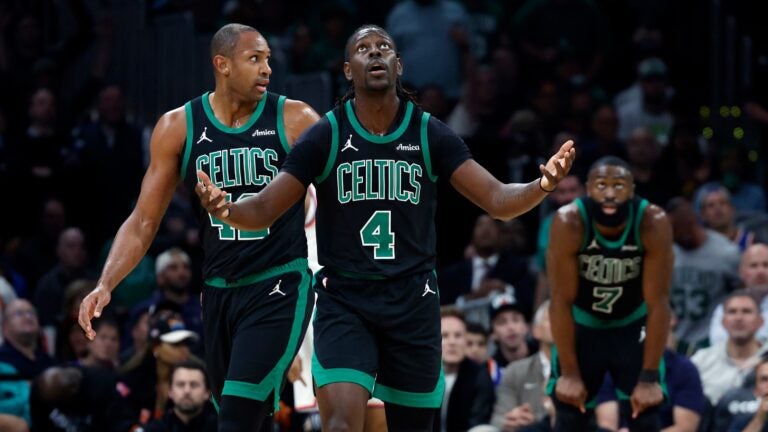
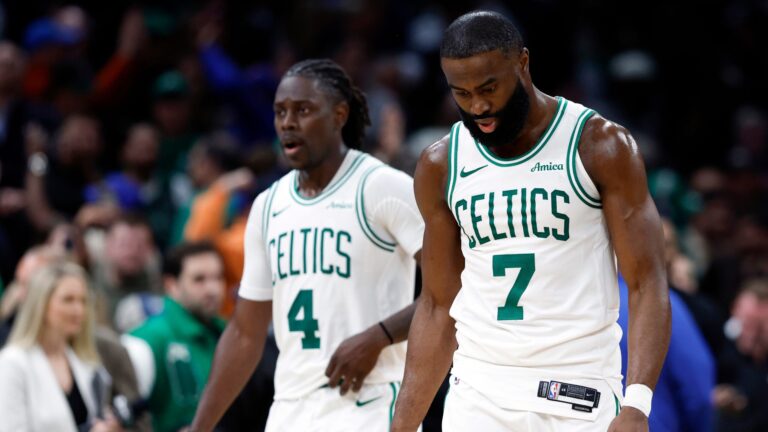
Two months ago, Celtics governor Wyc Grousbeck said that the Celtics’ roster, as currently constructed, is unsustainable.
The penalties that come with being in the NBA’s second luxury tax apron are so severe that Grousbeck predicted no team would stay above that threshold for more than two seasons over the next 40 years.
Cost-cutting moves are likely on the way this summer, and the Celtics’ roster as we know it could change significantly.
But, why? What is it about the second apron penalties that makes staying there so uncomfortable for teams?
Here’s an overview of what the second apron is, what happens to teams who stay there, and what it would take for the Celtics to get out.
What is the second apron?
The second apron is a financial threshold. The NBA operates on a soft salary cap, which means that teams can spend more than the cap if they choose.
However, there is a price for that. Teams whose payroll exceeds the cap have to pay luxury taxes. The second apron is the spending threshold that triggers the highest level of luxury tax penalties once crossed.
According to a memo sent to NBA teams obtained by ESPN, next year’s salary cap is expected to rise to $156.4 million. ESPN projects the luxury tax line to be at $189.7 million, the first apron line at $195.9 million, and the second apron line at $207.8 million.
Where do the Celtics stand?
According to Spotrac, the Celtics’ payroll is set to be around $227.8 million next year. That number does not include Al Horford, Luke Kornet, and Torrey Craig, who are free agents.
The Celtics have their entire starting five of Jayson Tatum, Jaylen Brown, Derrick White, Kristaps Porzingis, and Jrue Holiday, as well as reigning Sixth Man of the Year Payton Pritchard, all under contract through at least next season.
They have been in the second apron the past two seasons. They have been over the salary cap each of the last three seasons.
What are the penalties?
Luxury Tax: The NBA has a set of standard luxury tax rates, and even steeper rates for “repeaters” whose salaries stay above the luxury tax level in three or more of the four years proceeding the current salary cap year.
The Celtics count as repeaters for next season. Rates are based on a team’s spending above the cap.
The league sets a tax bracket amount, which is an amount equal to $5 million multiplied by a fraction of which the numerator is the salary cap of a given year, and the denominator is the salary cap for the 2023-24 year.
An example given by the league in the collective bargaining agreement is: Assume the 2025 cap is 140.7 million and the 2024 cap was 134 million. $140,700,000 divided by $134,000,000 is 1.05. $5 million multiplied by 1.05 = $5,250,0000.
The luxury tax rates for repeaters are as follows:
0-100 percent of tax bracket amount: $3.00 for $1 over.
100-200 percent: $3.25 for $1
200-300 percent: $5:50 for $1
300-400 percent: $6.75 for $1
400 percent and higher: $6.75 plus $0.50 for each additional 100 percent.
If the Celtics were to keep the team intact, their tax bill alone would likely be more than what the actual salaries cost. Spotrac estimates that the Celtics would have to pay north of $238 million in luxury taxes to keep the team together, bringing the total spend close to half-a-billion dollars.
On top of the financial penalties, there are basketball penalties for teams that reach the first and second apron levels of spending. Here are some of the notable ones.
First Apron: -No sign-and-trades allowed if the player acquired keeps the team above the apron.
- Cannot sign players that make more than the $12.2 mid-level exception if they were cut during the regular-season.
- Salary matching in trades has to be within 110 percent instead of the usual 125 percent.
Second Apron:
- All the first apron penalties plus the following:
- Cannot use the mid-level exception at all.
- First-round pick from seven years out cannot be traded.
- Cannot use cash in trades.
- First round pick automatically moves to the back of the first round if the team stays in the second apron three out of five years.
What do the Celtics have to do to get out of the second apron?
The Celtics would need to shed roughly $20 million ($19,959,873, per Spotrac) in salary to get below the second apron threshold for next season. Getting below the first apron would take an additional $12 million or so in cost cuts beyond the $20 million.
The Celtics have five players scheduled to make north of $28 million apiece next season. Those five players’ salaries alone, at roughly $198.4 million, would put the Celtics in the first apron.
This upcoming season will be the first one with both Jayson Tatum and Jaylen Brown on their supermax deals at the same time. They’ll make $54.1 million and $53.1 million respectively. Jrue Holiday is scheduled to make $32.4 million, Kristaps Porzingis is scheduled to make $30.7 million, and Derrick White is scheduled to make $28.1 million.
Trading any one of the starters for draft capital without taking on additional salary would put the Celtics under the second apron.
The Celtics could also trade one or more of the starters for a package involving a less expensive player or players to make the numbers work.
Who might they move to make it happen?
Because of his combination of injury history and high salary, the Celtics may look at moving Porzingis. He missed 40 of the Celtics 82 regular-season games this season and struggled during the playoffs with symptoms from a viral illness.
Holiday’s age (he turns 35 next month) and salary combination could also make him someone the Celtics may take a hard look at, despite what he brings to the table as one of the best defenders in the league.
Brown played through a partial meniscus tear in the playoffs and is deciding whether or not to get surgery. He averaged 22.1 points and 7.1 rebounds during the playoffs while playing through the injury. Moving his salary could free up a lot of room for the Celtics, and there might be a robust trade market for him. Moving the 2024 Finals MVP, though, would be quite a shakeup.
Tatum, who was already unlikely to be traded, just suffered the first major injury of his career — a ruptured Achilles tendon that could keep him out for most or all of next season, and potentially impact his game beyond that. The Celtics saw firsthand how much his absence can hurt during their blowout loss to the Knicks in Game 6 of the Eastern Conference semifinals.
White has been the most dependable of the starters not named Tatum or Brown, both in terms of availability and clutch play. He’s younger than Holiday and has been more durable than Porzingis. His salary is significantly less than Tatum’s and Brown’s.
The Nets (with a projected $55 million in cap space) are currently the only team in the league that could afford to take on the salary of any of the Celtics’ starters via trade without having to send cash considerations or other salary back in return.
Detroit is the only other team with more than $20 million in cap space, which is around the number the Celtics need to shed to get under the second apron. Memphis has roughly $17.5 million, Chicago has roughly $14.3 million, and New Orleans has roughly $12.4 million. All the other teams have less than $5 million in cap space. Those numbers could change as offseason moves are made.
Sam Hauser and Payton Pritchard are the team’s priciest bench players under contract, at $10 million and $7.2 million respectively. The rest of the reserves under contract are earning less than $2.6 million apiece next year.
Those players don’t make enough to put the Celtics under the cap without moving one of the starters.
Trading Hauser, Pritchard, and Schierman ($19.8 million combined) would get the Celtics close to the number they need, but ultimately just short of it. NBA teams are required to carry at least 14 players, and the Celtics would need to pick up additional contracts to meet that requirement.





To comment, please create a screen name in your profile
To comment, please verify your email address
Conversation
This discussion has ended. Please join elsewhere on Boston.com