
Jaylen Brown’s new contract with Celtics shows evolution of NBA
The times are changing.
COMMENTARY
In 1946, a man named Joe Fulks was the highest-paid player in the Basketball Association of America – a sharp-shooting scorer who once dropped 63 points in a game. In terms of spending power, Fulks’ $8,000-per-year salary amounted to roughly $90k in modern money.
Fulks died 30 years later in 1976, killed in an argument with a family member over a handgun. By that time, NBA salaries had spiked. Kareem Abdul-Jabbar was the highest-paid professional basketball player at $650k, which equates to roughly $3.5 million by today’s standards. Abdul-Jabbar, of course, is now remembered as the greatest player of his generation — a man with an unstoppable skyhook that set a scoring record so lofty, it stood for nearly 60 years.
JAYLEN BROWN'S CONTRACT
Last year, LeBron James — the greatest player of his generation — broke Abdul-Jabbar’s scoring record with a step-back jumper against the Oklahoma City Thunder. During the 2022-23 season, James made $44.4 million, more than 10 times what Abdul-Jabbar made in 1976. Like Abdul-Jabbar, James will be remembered as one of the greatest NBA players — perhaps the greatest NBA player — of all time.
To be abundantly clear, we outline all of this not to say that today’s players are overpaid. Per the NBA’s CBA, players get a little less than half of the basketball-related income that comes from attendance, TV/streaming deals, gambling, and other avenues. You could make a case that today’s almost unimaginably rich players are actually underpaid by the current system.
We aren’t really trying to wade into those waters either. All we are trying to say is that the NBA landscape evolves very quickly, and the teams that succeed are the ones that can keep up with it.
Times are changing.
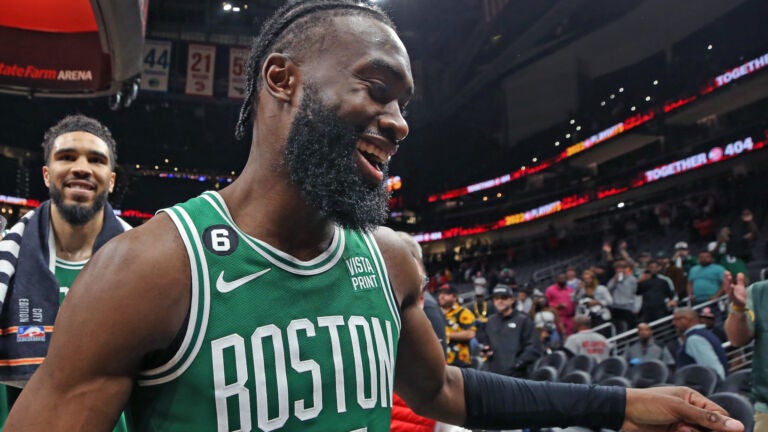
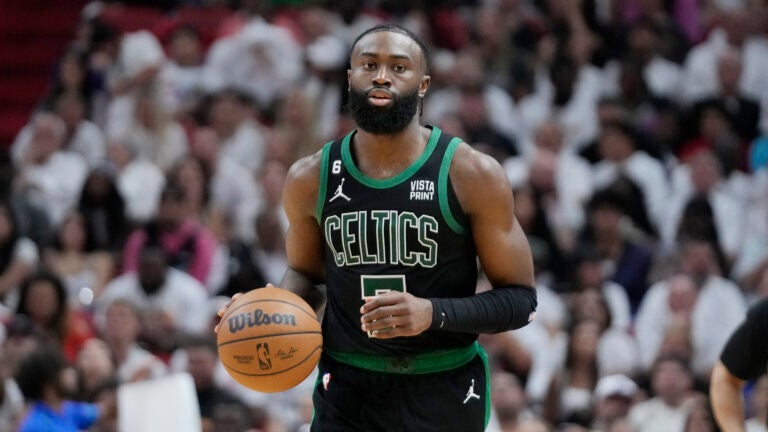
On Tuesday, Celtics star Jaylen Brown reportedly agreed to a deal worth $304 million over the next five years. The contract reportedly features no incentives and no player option in the final year, when Brown will make an eye-popping $69.1 million. The contract will almost certainly be outstripped by Jayson Tatum’s extension next season (and others going forward), but for the time being, Brown’s deal is the richest in NBA history, and he will receive every penny of it.
The timing of the deal is a little bit interesting: Brown can’t be traded for a year now, and if he is traded, he reportedly will have a trade kicker (this, incidentally, is why Brown’s deal is worth up to $304 million, rather than $290 million). In other words, shut down the trade machine until no sooner than July 25, 2024. Brown isn’t going anywhere in the near term.
Brown’s long-term future is much less certain. The Celtics are unlikely to be able to afford both Brown and Tatum over the next five years, since the new CBA is built to devastate teams that fly over the second apron. If the Celtics want to win a title with their current core, they need to do it in the next few years.
Brown will help that cause, although plenty of critics will (not entirely unfairly) note his struggles against playoff defenses. But Brown was a net positive in the playoffs last year, with the Celtics outscoring opponents by 2.5 points per 100 possessions when he was on the floor. In the modern Celtics’ lone trip to the Finals, Brown averaged 23.5 points, 7.3 rebounds, and 3.7 assists per game. The turnover struggles are real, but so are the contributions, and so is the playoff experience. Brown has been playing in highly meaningful playoff games since his rookie season. The same can’t be said of every NBA star.
Meanwhile, Brown often gives the Celtics a stretch of regular-season basketball that keeps them afloat. Tatum has all-time great credentials — no other Celtics player in the history of the franchise has averaged more than 30 points per game in a season — but he can be streaky, and Brown’s ability to fill in during the periods of famine could be the difference between maintaining a top-two seed and sliding to third or fourth. That kind of floor (and ceiling) raiser is worth a big contract, even if “big contract” numbers are increasingly hard to process with every new influx of TV and gambling money.
If nothing else, this summer has been a clarifying one for the Celtics. Gone is most of the mystery around this team’s dealings: They spoke highly of Marcus Smart, but Stevens, who coached Smart for the majority of his career, dealt the defensive-minded point guard for a 7-foot-3 sniper in Kristaps Porzingis. Grant Williams helped enormously against Giannis Antetokounmpo and Kevin Durant during the Celtics’ lone run to the NBA Finals since 2010, but the punitive nature of the new CBA forced the Celtics to trade him in exchange for a few second-round picks.
The NBA landscape evolves. The Celtics are trying to succeed. They are trying to keep up with it.
Brown will make a lot of money over the next few years, but be prepared to see him elsewhere by the end of this contract if we assume the Celtics want to keep Tatum more than Brown for the long term. A potential trade could get complicated, since other teams can certainly see that the Tatum-Brown duo is probably unsustainable long-term. How much can the Celtics realistically hope to get if they trade Brown on a contract that nobody would consider a bargain, especially given that other teams know they need to do it? Stevens will have his work cut out for him, and he might have some difficult decisions to make if he waits until the last minute.
But so far in his tenure at the helm of the Celtics, Stevens has proven he has absolutely no interest in waiting until the last minute. He immediately rid himself of Kemba Walker’s contract when he stepped into his role as president of basketball operations, despite his personal affection for Walker. He didn’t hesitate to trade Smart when a deal for Malcolm Brogdon fell through. At this point, the idea that Stevens has a nice-guy “Aw Shucks” Indiana persona is outdated and inaccurate. He has proven to be shrewd and cold when necessary in a job where being cold and shrewd would be at the top of the LinkedIn qualifications.
For now, expect the Celtics to look at least somewhat familiar next season. They are guaranteed to have Brown for at least 365 days. They still have Tatum. Robert Williams and Al Horford should both be back. Derrick White is entering his third year (sort of) with the team. Believe it or not, Sam Hauser is too. There are some recognizable throughlines stretching through this team and the group that went to the Eastern Conference finals in four of the last six seasons.
This offseason, however, feels like the first time we can see the extent of those throughlines. This group of Celtics has an expiration date.
Again: As Bob Dylan put it in 1964, when Wilt Chamberlain was the NBA’s highest-paid player at $65k per year, the times are a-changin’.



To comment, please create a screen name in your profile
To comment, please verify your email address
Conversation
This discussion has ended. Please join elsewhere on Boston.com