
‘Go get another one’: Looking back at the 2013 Celtics-Nets trade that sent Kevin Garnett and Paul Pierce to Brooklyn
A decade later, Wyc Grousbeck offered more details behind the now-famous trade, and why the 2017 pick-swap that Boston turned into Jayson Tatum "seemed like a pretty harmless little icing on the cake of this deal."
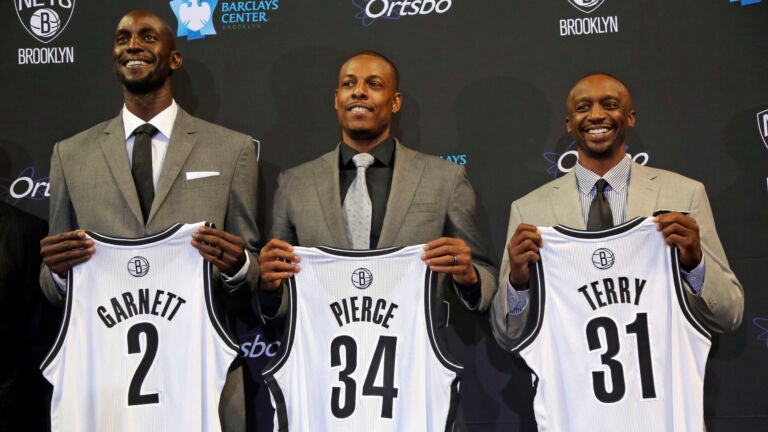
In the summer of 2013, the Celtics and Nets made one of the more impactful trades in recent NBA history, as franchise pillars Kevin Garnett and Paul Pierce were sent to Brooklyn in exchange for what proved to be a bountiful haul of draft picks.
At the time of the trade, it seemed like a potentially crowning achievement for the Nets, providing the roster with a critical mass of talent to chase a championship. The Celtics, meanwhile, were plunged into a rebuilding effort. Yet within only a few years, the fortunes of the two teams reversed.
The fallout from the trade has eventually made it a cautionary tale for NBA general managers. The Nets banked on short term success that never materialized. Brooklyn’s all-in approach quickly backfired as the correspondingly resurgent Celtics not only made a playoff run in 2017, but got the rights to the No. 1 overall pick in that year’s draft lottery via the Nets.
A decade after the fact, one side of the trade’s legacy is well established. The deal, clearly, was a historic failure for Brooklyn.
For Boston, it was an unmitigated success, though the story is an ongoing one. New franchise faces Jaylen Brown and Jayson Tatum — both drafted either directly or indirectly as a result of the trade — are still defining their own legacies. And as Celtics co-owner Wyc Grousbeck noted in a recent interview, the team ultimately doesn’t measure success through trades alone.
“I am subdued about taking victory laps anywhere,” Grousbeck said, reflecting on the 2013 deal. “We haven’t won a championship since the trade, and that’s how I measure myself: by banners.”
Looking back, it can be easy — in fact, natural — to view the trade through the prism of its ultimate outcome: Boston selling high on aging stars and reaping the reward of forward thinking draft pick acquisitions.
The reality, especially considering some of the initial reactions to the trade, offers a more interesting picture.
“It did feel like a turning point.”
At the end of the 2012-2013 season, the Celtics were eliminated in the first round of the playoffs for the first time since the acquisition of Garnett. Boston lost to the Knicks in six painfully low-scoring games. It was, as New York coach Mike Woodson succinctly noted, “an ugly series.”
For Boston, it was far more than that. The team’s aging roster struggled where only a few years earlier it had excelled. Despite partially climbing out of a 3-0 series hole (and nearly rallying from 26 points down in Game 6), the Celtics could not hold back the Knicks from claiming a first playoff series win in 13 years.

The easily discernible takeaway was that Garnett and Pierce, the two remaining pieces of the originl “Big Three” (Ray Allen had already departed to Miami as a free agent in 2012), were no longer able to carry a team to a title.
“It did feel like a turning point,” Grousbeck said of the playoff defeat.
What little doubt remained about the team’s direction was removed when longtime Celtics head coach Doc Rivers opted for an exit.
“After that loss, Doc let us know that he was going to leave. We had recently extended him. He still had some time left,” Grousbeck explained. “He wasn’t asked to leave. We wanted him to stay, but it was clear that we were going to go into a rebuild. We just didn’t have the ability to get out of the first round.”
Following a protracted negotiating period with the Clippers, the Celtics agreed to send Rivers to Los Angeles in exchange for a first-round pick.
The rebuilding had begun, and as ESPN’s Jackie MacMullan said following the Rivers news, “[Ainge] recognized the best way to accumulate the first-round draft picks he covets would be to relinquish his two most valued assets — Rivers and Kevin Garnett.”
With Rivers gone, Garnett was officially on the trade block.
“Go get another one.”
On June 27, the day of the 2013 NBA Draft, Grousbeck was seated in the “Red Auerbach” conference room at the team’s then-Causeway Street office.
Ainge, who had been exploring the possibility of trading key pieces of the team’s roster, swept in and matter-of-factly informed Celtics leadership of what would be a landscape-altering trade.
“I remember being in the war room, which was our Celtics board room in the Boston office,” Grousbeck said. “Danny came in and said, ‘I’ve got a trade worked out for Pierce and Garnett to go to Brooklyn.'”
Ainge offered some backstory during a 2013 interview with Bill Simmons.
“It’s like how a lot of trades happen,” said Ainge. “It evolved with a conversation about something completely different into a bigger deal.”
“I think we originally were going to get one unprotected first-round pick,” Grousbeck recalled. “I said, ‘Go back and get another one.'”
“I don’t normally do that in trades, but my reading of the situation was that the owner of the Nets was a newer owner and he was very gung-ho — as I am — in that it’s all about winning,” Grousbeck added.
The Nets had been bought by Russian billionaire Mikhail Prokhorov in 2010. Since taking a controlling interest in the team, Prokhorov had made no secret of his intention to win, and win quickly. He brashly predicted a championship within five years.
Yet Prokhorov was also gone much of the time (including on the day of the draft). In his place, the mercurial owner left Dmitry Razumov, a fellow Russian (and Brooklyn’s chairman of the board of directors). Razumov had no experience in basketball, or running a professional sports team.
“I was pretty sure that [Prokhorov’s] staff had probably told him, ‘If we get these two guys we’re gonna be the favorites for the championship,'” Grousbeck explained. “And so I thought we ought to just see what else they’d give us, because I thought [Nets’ management] didn’t want to tell him that the deal had fallen through.”
This proved an accurate assessment.
“Dmitry’s a star chaser,” a former Nets executive told Stefan Bondy of the New York Daily News in 2017. The person who Ainge was negotiating with, however, was not Razumov but his Nets counterpart, Billy King.
King, who had been Brooklyn’s general manager since 2010, had his own history of chasing trades with perhaps too much enthusiasm. In 2012, he made what was later described as a “panic trade” for forward Gerald Wallace, sending center Mehmet Okur, small forward Shawne Williams and the Nets’ 2012 first-round pick to the Trail Blazers in return.
Though the pick King traded was top-three protected, it still ended up being sixth overall, which Portland used to happily select superstar Damian Lillard.
“I wanted to push the other side to the max,” Grousbeck said of negotiations. When Ainge returned a little while later saying that the Nets had actually now agreed to include three picks, the Celtics’ owner repeated his earlier request.
“I said, ‘Go get another one.'”
Ainge, Grousbeck noted, was skeptical.
“Danny’s not a shy person,” Grousbeck added, but the Celtics executive was concerned about continually raising the price.
“He went off and got on the phone again with the Nets,” Grousbeck said of Ainge. “He came back pretty shortly thereafter as I recall, and told me, ‘They said no, not going to do it.'”
Having pushed and pushed, it appeared the Celtics had finally shattered the deal.
“It seemed like a pretty harmless little icing on the cake of this deal.”
After Brooklyn rebuffed the request for yet another first-round pick, the Celtics worked out a creative alternative: Instead of adding a fourth pick, the two teams would give Boston the right to swap first-rounders in 2017 if Brooklyn had a worse record.
“The thought was that a swap — even a few years out — is not going to likely be an advantage to us,” said Grousbeck. “Therefore, it’s easy for [the Nets] to agree to that. And it would be a lottery ticket for us — literally in this case with the NBA.”
With the Nets on the precipice of becoming an NBA contender for the next few seasons, the prospect of Brooklyn being lower in the standings than Boston — even by 2017 — felt remote.
“[The Nets] were still going to have a first-round pick in that [swap] year one way or another, and it was going to be pretty unlikely that the swap would come into effect,” Grousbeck recalled. “So it seemed like a pretty harmless little icing on the cake of this deal.”
Brooklyn, Ainge reported shortly thereafter, found the terms acceptable, and the colossal trade was formally agreed to.
“This back-and-forth was less than 60 minutes,” Grousbeck remembered. It was an hour that — for a very different reasons — would loom over both teams for years to come.

A decade later, here’s a look at the full terms of how the trade played out:
Nets received:
- 2017 1st round draft pick swap (Kyle Kuzma was later selected with the swapped pick)
- 2017 2nd round draft pick (Sasha Vezenkov was later selected)
Celtics received:
- 2014 1st round draft pick (James Young was later selected)
- 2016 1st round draft pick (Jaylen Brown was later selected)
- 2017 1st round draft pick swap (Boston traded the pick to Philadelphia and selected Jayson Tatum with the pick acquired from the 76ers)
- 2018 1st round draft pick (Boston traded the pick to Cleveland as part of the 2017 Kyrie Irving deal, Collin Sexton was later selected by the Cavaliers).
“We thought we were going to be pretty terrible.”
As news began to filter out about the deal Boston and Brooklyn had agreed to, the initial wave of reactions was tepid at best.
Simmons, then an analyst for ESPN’s draft coverage, called it “35 cents on the dollar” as he was told live on-air about the trade.
“There’s no guarantee that any of those picks will get in the lottery,” he added.
Simmons was far from alone in his assessment of the draft pick potential. The consensus wisdom held that Brooklyn would contend, potentially for several years. And even when Simmons found out about the 2017 pick swap on June 28 — a fact which caused him to rethink his initial analysis — the Celtics were unsure if it would even become a factor.
“We didn’t know the swap was going to work. We thought we were going to be pretty terrible,” Grousbeck admitted. The history of NBA pick-swaps supports this notion. As The Ringer’s Zach Cram researched in 2022, 61 percent of pick-swaps in the NBA have ultimately been worthless.
Brooklyn, now boasting a theoretical starting five of Deron Williams, Joe Johnson, Pierce, Garnett, and Brook Lopez, appeared to be penciled in as an Eastern Conference power for the foreseeable future.
“We’ve got pieces now that we can compete for a championship, and that’s our goal,” King proudly said at the introductory press conference for Garnett, Pierce, and Jason Terry.
The reality of the 2013-2014 Nets proved to be disappointingly mediocre. The team finished the regular season with fewer wins than it had the previous year, and despite rallying to defeat the Raptors in the first round of the playoffs in seven games, Brooklyn was easily swatted aside by LeBron James and the Miami Heat.
Having assembled the NBA’s largest payroll — which led to Brooklyn paying a then-league record $90.57 million in luxury taxes — the Nets had somehow slipped farther away from Prokhorov’s promised championship.
In the summer of 2014, Brooklyn signaled an acknowledgement that the commitment to veterans had failed, as the team elected to pass on re-signing Pierce (who promptly joined the Wizards in free agency). Brooklyn coach Jason Kidd also left, heading for Milwaukee.
By the next season, the Nets’ foundation continued to crumble. The team staggered to an even worse record (38-44), and elected to trade Garnett back to Minnesota — where he had spent the first 12 years of his NBA career — in a deal before the trade deadline.
From there, the wheels completely fell off, as Brooklyn would win a combined 41 games over the next two seasons. In that time, culminating with the draft lottery in 2017 — the agreed year for the swap — the Celtics waxed as the Nets waned.
The part of the deal that even Grousbeck had initially thought would be the “harmless little icing” turned into the No. 1 pick, as Boston gleefully exercised its right to swap with Brooklyn. The moment had barely sunk in for Grousbeck even as he stood alongside Magic Johnson and Joel Embiid at the 2017 NBA Lottery.
“I remember standing there on the lottery stage — I think I was next to Embiid and Magic — holding the number one pick, and I’m thinking to myself, ‘What is this guy doing up here?'”
“We weren’t robbing anybody.”
That the Celtics were able to use the 2013 trade as a slingshot through the rebuilding process was not simply because of favorable draft picks alone. Boston didn’t make the playoffs in the season after the deal, but returned the following the year (and hasn’t missed since). The central figures of the teams in that time (2014-2017) had little to do with the Garnett-Pierce deal.
The Celtics front office also still had to make astute decisions regarding the 2016 and 2017 drafts. The team opted to pick Brown third overall in 2016 even though he was seemingly not the preferred choice (Celtics fans booed the pick at the time). And in 2017, Ainge made the nearly unprecedented decision to trade down from first overall to third, safe in the knowledge that his favored choice (Tatum) would be there.
“Danny should be in the Hall of Fame as a general manager as far as I’m concerned,” said Grousbeck, who praised the former president of basketball operations for not only designing the trade, but leveraging the good fortune of the picks that came back in return.
Grousbeck admitted that he’s “pretty proud of the deal,” but countered the notion that the Celtics somehow knew what would happen to Brooklyn.
“I think that at the time it seemed like we pushed them farther [in the trade], but we weren’t robbing anybody,” he said. “We were going into a hole. We had lesser players and no coach and a multi-year rebuild. There was no celebration. We were sending two of our future Hall of Famers away. There was nothing good about this deal other than that we were doing the best we could.”
As successful as the team has been since the deal — four Eastern Conference finals appearances and one trip to the NBA finals — the Celtics are still chasing a post-trade championship 10 years after the fact, something Grousbeck is acutely aware of.
“It was two great players leaving who we love to this day, two of the best Celtics ever, Hall of Famers and champions,” he said of Garnett and Pierce. “Then it was Danny getting something done with the deal, negotiating the deal and eventually turning it into Jayson and Jaylen, which was amazing.
“But until we take that final step, I’m not going to be celebrating.”



To comment, please create a screen name in your profile
To comment, please verify your email address
Conversation
This discussion has ended. Please join elsewhere on Boston.com