
Why Marcus Smart didn’t have an issue with Joe Mazzulla’s lack of timeouts in pivotal 3rd quarter against Heat
"We’ve got to come together and we’ve got to start helping each other out on both ends.”
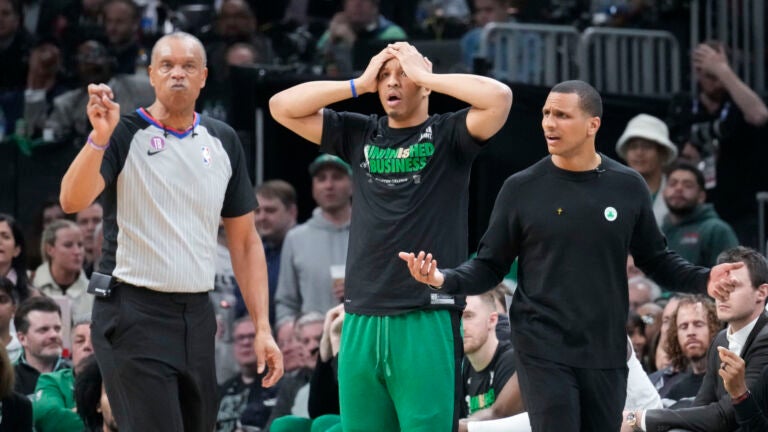
As the seconds ticked off the scoreboard at TD Garden, the Celtics felt yet another win on home court slipping through their grasp.
What was once a double-digit lead for Boston early in the third quarter on Wednesday was crumbling in a hurry thanks to Jimmy Butler and the Heat.
By the time the dust settled in the frame, Miami outscored Boston, 46-25, over those pivotal 12 minutes. It was a back-breaking swing that the Celtics were unable to recover from en route to a 123-116 loss in Game 1 of the Eastern Conference Finals.
At various stages of that momentum-shifting quarter, Joe Mazzulla and the Celtics had the opportunity to call a timeout in order to stop the bleeding.
But Boston’s head coach opted to let his players fight through their miscues in hopes that the lopsided score would brew up some much-needed resolve and pushback.
By the time Boston finally righted the ship for some stretches of action in the fourth, the damage was already done.
Postgame, Mazzulla bristled at a question posed about his timeout usage and when to make such a call on the court.
“I called two in the first quarter,” Mazzulla said.
As for the lack of a similar motion in the third?
“Don’t call two in the first quarter,” Mazzulla said. “Save it for the third quarter run.”
Mazzulla’s timeout usage (or lack thereof) has often been a conduit of criticism for the first-year head coach.
While Mazzulla puts full faith in his players to claw out of whatever deficit they find themselves in, it presents plenty of risk if that execution isn’t carried out in critical junctures.
But Marcus Smart defended his coach when asked if a timeout would have turned things around during Miami’s third-quarter surge.
“No, Joe’s real big on — a lot of times, not bailing us out on stuff when we’re playing like [expletive]. We’ve got to look at ourselves in the mirror,” Smart said. “Joe could call a timeout and then what? We come out and do the same thing? It’s on us.
“Joe and his coaching staff, they put in a lot of work to come up with a game plan and put us in the right spots to succeed. But they’re not out there playing. So we’ve got to come together and we’ve got to start helping each other out on both ends.”
The battle of when (or when not) to call time can potentially help a team stave off a late-game rally — or further exacerbate a lineup’s woes if it has fallen into a funk.
On Wednesday night, it worked in favor of Erik Spoelstra and the Heat.
After Boston reeled off a quick 7-0 run in the fourth quarter to cut its deficit to five, Miami’s head coach called time in search of a regroup for his team.
The result? Miami limited Boston to just two baskets over the next four-plus minutes of play on the way to a critical road win.
Expect the chess match between Mazzulla and Spoelstra to continue on Friday night at TD Garden.




To comment, please create a screen name in your profile
To comment, please verify your email address
Conversation
This discussion has ended. Please join elsewhere on Boston.com