
Jaylen Brown’s usage wasn’t really an issue for the Celtics’ offense in Game 4
"I think it’s a balance and it’s a duality."
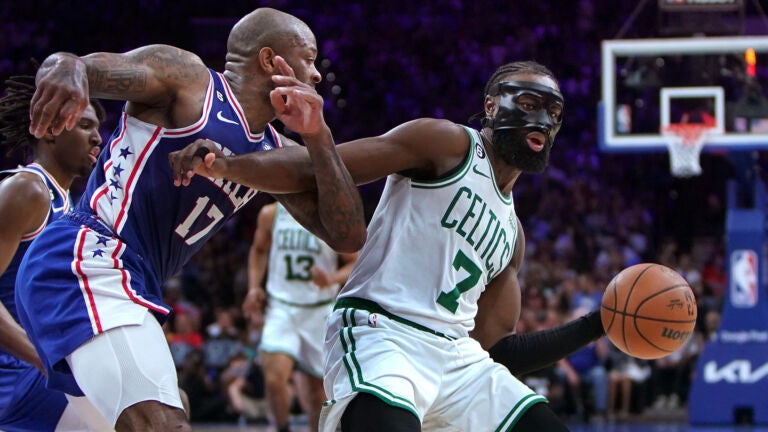
After the Celtics dropped Game 4 to the 76ers on Sunday, Jaylen Brown raised some eyebrows when he said he needed to “demand the ball a little bit more.”
Brown’s comments came in response to a query about his performance in the second half, when he took just five shots – none of which came in overtime. Brown started the game red-hot from the field and scored 12 of the Celtics’ first 14 points, but he was relatively quiet the rest of the way, finishing with 23 points.
The Celtics rely heavily on their two stars – Brown and Jayson Tatum – and when one of those stars is off, it can throw the balance of the team out of whack. So was Brown’s usage in the second half on Sunday an issue that should worry the Celtics, or at least prompt some change?
Not really. In fact, until those disastrous final seconds, there wasn’t anything wrong with the Celtics’ offense at all.
Let’s start with the quote itself, which was tailor-made (presumably unintentionally) to whip the internet into a frenzy. Twitter loves when a star expresses something that could be interpreted as displeasure toward his franchise, thus prompting a trade demand in the offseason.
But in context, Brown sounds less like he is angry about his role and more like he was trying to find a satisfactory answer to a difficult question, which was about how he can “become more active” in the offense.
The Celtics’ star paused for several seconds before answering.
“Uh,” Brown said. “I guess I’ve got to demand the ball a little bit more. I thought good things happened when I had it in my hands. But I thought our offense was okay. I thought we chipped away, we made big-time shots, we got great looks all game long, and we just came up short in the end.”
Note where Brown’s answer ends, rather than where it begins. He believed good things happened when he had the ball in his hands, which was objectively true – Brown was a tidy 10-for-16 from the field, and he recorded five assists (four of which created 3-pointers) and just one turnover. He was efficient and sharp offensively.
But the Celtics’ offense played well as a whole too, which was also a key part of Brown’s answer. They hit shots when they needed to prevent the game from getting out of hand. They made a big rally down the stretch and had opportunities to win. They bounced back after a frustrating start.
As Al Horford put it: “I saw something. I saw some growth in our group, things we haven’t been able to do all year, and [we were] able to do them tonight on this type of stage. I’m very encouraged for our group.”
Brown didn’t look particularly angsty at any point during Game 4 either. He showed some emotion a few times – with 7:33 remaining in the third quarter, Smart looked off Brown and passed to Horford instead, and Brown clapped in frustration, but Horford canned the 3-pointer.
A little while later, Brown called for the ball in transition as Smart brought it up – a reasonable request for one of the most prolific fast-break threats in the league, averaging 1.25 points per transition possession – but Smart looked him off, which seemed to annoy Brown until Smart found Tatum for a layup instead.
Those mildly emotional moments appeared natural and appropriate, especially in the context of a highly competitive playoff game, and they didn’t linger.
But should Brown have actually demanded the ball more? Again: There’s no real evidence that says he should. The Celtics scored at a healthy clip, notching 121.1 points per 100 possessions, and Brown was involved in the offense early. In the second half, Tatum assumed more responsibility, and that worked well too – he finished the second half 6-for-8 from the floor, and both he and Brown recorded four second-half assists. In the first half, Brown had 27.7 percent usage to Tatum’s 20.8. In the second half, those roles flipped – Tatum had 27.9 percent usage to Brown’s 13.2 percent. Maybe Brown should have been more involved, but the Celtics had an offensive rating of 139.0 and a net rating of 19.0. It’s hard to argue with the results.
Brown sounded confused when another reporter followed up on demanding the ball more, asking what he believes should change going forward.
“I’m not sure how to answer the question,” Brown said. “What needs to change? I’m not sure. I just think that we need to continue to execute, continue to emphasize what’s working, and I think that will carry us over. I think we had great moments in this game. I think we had great looks offensively.”
Emotions run high after a loss, and it’s fair for fans to wonder whether the Celtics should run more pick-and-roll through their stars (Heat guard Gabe Vincent runs more pick-and-rolls per game in the playoffs than both Tatum and Brown, which seems less than ideal).
But the Celtics had every opportunity to win Sunday’s contest until the final minute, and Brown continued a rock-solid playoff run for nearly the entire game. His involvement in the offense wasn’t really an issue, especially compared to his bad decision to double Embiid and the offense’s inability to create a quality shot in the final 18.2 seconds of overtime.
In a Zoom call on Monday, Mazzulla noted – when asked about Brown’s comments – that Brown also said the offense got great looks and executed well.
“I think it’s a balance and it’s a duality,” Mazzulla said. “I think two things can be true: I think he has to get more looks, and when the ball is in hands, good things do happen. And I think he’s doing a great job of making plays for us.
“At the same time, our clutch-time offense was 1.35, and we did a great job as a team of executing and fighting for the best shot. I think both of those things can be true, and we just have to make a conscious effort to continue to execute.”
The Celtics have shown that they can score against the Sixers. Brown will continue to be an integral part of that, whether or not he starts demanding the ball more.





To comment, please create a screen name in your profile
To comment, please verify your email address
Conversation
This discussion has ended. Please join elsewhere on Boston.com