
10 things to watch as Celtics face 76ers, including Jayson Tatum vs. Joel Embiid
How the Celtics defend Embiid could decide the series.
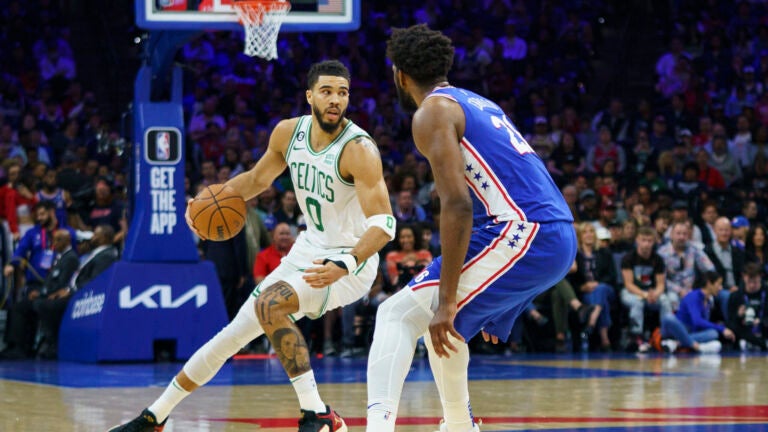
The Celtics might have looked ahead to their series against the 76ers one game too early – dropping a Game 5 against the Hawks that they should have won – but now everyone can put Trae Young in the rear view and examine the next opponent.
The Sixers promise to be a much more interesting test. In the regular season, the Hawks had the 19th-best net rating in the NBA and the league’s 22nd-best defense. The 76ers trailed only the Celtics and the Cavaliers in net rating – owners of the third-best offense and the eighth-best defense. The Hawks were led by a talented-but-flawed star who needed to be on the floor but took quite a bit off of it. The 76ers are led by the league’s presumptive MVP – a destructive two-way force who warps entire game plans.
So while the Celtics find themselves betting favorites to reach the NBA Finals with good reason — given their star power and depth, as well as the Bucks’ stunning defeat at the hands of the Heat — they are about to face a much stiffer competition than they did in the first round. We’ll discuss 10 things to watch here, including:
- How the Celtics defend Joel Embiid (in 2023)
- Why the transition battle matters
- The importance of Al Horford’s offense in this series
- Why Grant Williams will see more time
- Plus a lot more.
Let’s get into it.
1. We need to dispense with the idea that Al Horford can hold Joel Embiid in check 1-on-1. That’s outdated. Embiid is too strong and too skilled at this stage in his career, and Horford might be too nearly-37-years-old.
That said, Horford does defend Embiid with more credibility than most players in the NBA, and that still matters even if Embiid fries everyone the Celtics throw at him individually. Horford’s presence allows the Celtics a more intriguing set of defensive options than most teams can boast against the Sixers.
The only problem? We probably haven’t seen how the Celtics actually intend to defend Embiid in months. Embiid scored 41 points in a late February win by the Celtics (you may remember Jayson Tatum’s game-winning triple), and then he pummeled them with 52 points in April. But the Celtics clearly had little interest in tipping their hand defensively against Embiid in either game – particularly the latter, in which Horford was almost never Embiid’s primary matchup. Instead, the assignment fell to Grant Williams (more on that in a minute). The Celtics also largely steered clear of doubling, either immediately or late.
Embiid will score a lot in this series, but the Celtics will likely throw a lot more at him than they did in April. If they limit him at all, or even make him less efficient, the Sixers might find themselves in trouble.
2. It’s never easy to parse through gamesmanship vs. genuine concern in the postseason, but Doc Rivers listed Embiid as doubtful “if I was a betting man” to start the series after he sprained his knee and missed the end of the Sixers’ series against the Nets.
If Embiid isn’t fully healthy, the road for the Sixers gets very difficult — maybe impossible against a team with the Celtics’ firepower. They took care of the Nets in Embiid’s absence, but – like the Celtics – they will find their second-round opponents a much more concrete test.
3. Embiid will likely win regular-season MVP this year in part due to his gargantuan numbers, but also in part because of his hefty two-way impact – the Sixers were 6.2 points better offensively and 4.7 points better defensively when he was on the floor (10.9 points better overall).
Al Horford will have to be more involved. Against the Hawks, Horford went scoreless in Game 4 and scored just six, eight, eight, three and 10 in Games 1, 2, 3, 5 and 6. That’s mostly fine against the Hawks – particularly if the Celtics were intentional about letting Horford cruise through an easy series – but it can’t happen against the Sixers. Horford’s ability to space the floor is essential in either drawing Embiid out of the paint or putting him into uncomfortable rotations, especially if the Sixers’ star isn’t 100 percent healthy.
The Celtics also need to be somewhat careful with their kick outs. The Sixers are used to seeing teams probe the paint and try to pass when they reach the Embiid road block, and they can punish teams who jump and try to pass without a plan. The Sixers generally play slowly (24th percentile in transition at 13.9 percent), but when they do get out in transition, they score more points per play than any other team in the league, per Cleaning the Glass.
4. Something to watch (that might not matter): The Sixers’ defensive rating slipped all the way down to 17th in the regular season since the All-Star break. The Sixers may have simply hit the regular-season doldrums, but the Celtics have the offensive pieces to feast against slumping defenses.
5. James Harden will need to turn back the clock if the Sixers will be without Embiid in Games 1 and 2, and he might need to do so anyway. The Celtics defend him pretty well – Marcus Smart has famously battled him in the past, and Derrick White keeps his hands back and avoids fouls against top-notch foul drawers like Harden better than just about anyone in the NBA.
Harden shot 5-for-16 and 7-for-17 in his final two games against the Celtics during the regular season. The Celtics were generally okay with switching his pick-and-rolls and leaving big defenders like Grant Williams and Al Horford on an island to defend his step-back 3-pointers and isolation attempts, but Harden remains one of the NBA’s better iso players – scoring 1.10 points per possession, which is in the 83rd percentile.
How the Celtics defend him – while also keeping an eye on Embiid, if he plays – will be a key storyline.
6. This will be a big series for Grant Williams in a number of ways. He barely played in Games 1-5 against the Hawks, but he will be back in the rotation now, and the Celtics will lean heavily on his combination of strength, defensive versatility and floor spacing against a much-bigger Sixers roster.
Playing Williams 1-on-1 as Embiid’s primary defender was largely an unserious exercise for the simplest possible basketball reason: Embiid is too tall. When he catches the ball deep, Williams is done for. When Embiid catches the ball in the mid-post, he can shoot over Williams. As strong as Williams is, Embiid is nearly 40 pounds heavier and well accustomed to shooting over smaller players.
Still, Williams is versatile enough to take some turns guarding Embiid while rotating to defend others as well. That’s an important skill – one he shares with Al Horford, which helps the Celtics quite a bit as they try to contain the entire Sixers group.
Williams’ contract demands this offseason will be linked to his versatility. Presumably, his agent will make the case that few role players are as versatile both ways as Williams, and that versatility matters enormously in the playoffs.
The Eastern Conference semifinals will be Williams’ first postseason opportunity to prove his point.
7. Tatum and Embiid – who work out together during the offseason with high-profile trainer Drew Hanlen – always seem to relish the opportunity to go against each other.
Tatum challenges Embiid often – per the NBA’s matchup data, Embiid was the primary defender against more of Tatum’s shots this season than any of his teammates in every meeting between the Celtics and Sixers. Tobias Harris, meanwhile, spent the most time guarding Tatum of any player in the NBA and defended 70.3 possessions.
In simpler terms, the Sixers often stick Harris on Tatum and let Embiid help at the rim when Tatum gets by Harris. The results have been solid – Tatum averaged just 21 points and 44 percent shooting (28.6 percent from deep) against the Sixers. Getting Tatum loose in this series will be an important goal for the Celtics, since forcing the Sixers into rotation often yields good results.
8. We aren’t going to draw a bunch of conclusions from a one-game sample size, but Robert Williams had a net rating of +22 in his lone game against the 76ers this season. In this case, the sample size itself is interesting – the 76ers aren’t used to dealing with Williams, who is the Celtics’ third-best on/off player this year and part of most of the Celtics’ most deadly lineups. Williams’ vertical spacing bends opposing defenses nearly to the breaking point.
9. The 76ers acquired Jalen McDaniels at the trade deadline, but their bench unit gets a little thin after their starters come out – De’Anthony Melton, Georges Niang and Paul Reed have been the other members of the bench rotation along with McDaniels in the postseason.
The Celtics have the clear advantage on that front, starting with Sixth-Man-of-the-Year Malcolm Brogdon, as well as both Robert and Grant Williams and Sam Hauser, although it will be interesting to see how much Hauser plays in this series. Hauser Hunting doesn’t always produce great results, but Harden’s iso-acumen might be damaging. During the regular season, the Celtics didn’t play Hauser much (7.1 minutes per game), but he did shoot 4-for-5 from three.
10. The Celtics/76ers rivalry has been very one-sided in the respective Joel Embiid and Jayson Tatum/Jaylen Brown eras, and Embiid could do a lot for his legacy by finally overcoming the Celtics.
If Embiid is fully healthy, the pick here is is Celtics in 7 because the Sixers probably need him to submit a dominant start-to-finish performance, and being that dominant for that long is hard. If he isn’t healthy, our pick is Celtics in 5 – everything the Sixers do revolves around Embiid’s singular brilliance. Take that away, and they are in trouble.
So we will split the difference and predict Celtics in 6, but that the two losses will be immensely frustrating for Celtics fans. That feels like a reasonable takeaway from the first round.
Game 1 tips off at 7:30 p.m. on Monday.



To comment, please create a screen name in your profile
To comment, please verify your email address
Conversation
This discussion has ended. Please join elsewhere on Boston.com