
Jayson Tatum won’t be NBA MVP, but here’s what that argument looks like
Here's the case for the Celtics superstar to win MVP over Embiid, Jokić, or Antetokounmpo, should anyone want to make it.
COMMENTARY
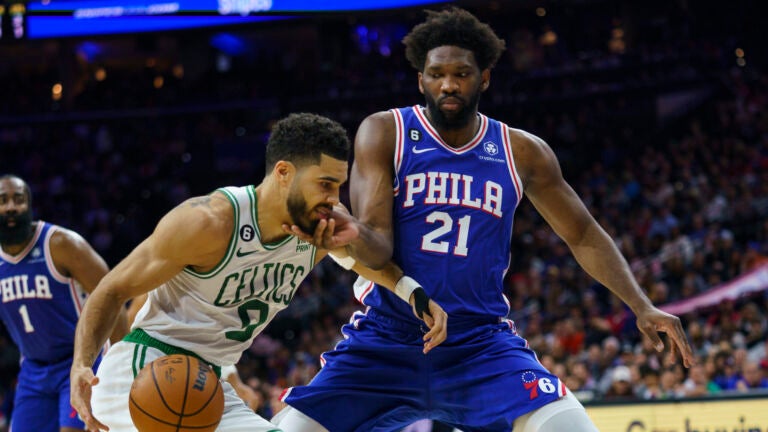
Jayson Tatum is not going to win the NBA’s Most Valuable Player Award. After leading the discussion a quarter of the way through the season, he was usurped by the trio that has dominated coverage since – Giannis Antetokounmpo, Joel Embiid, and Nikola Jokić. One of them will win the trophy, and with good reason. For my money, it has to be either Antetokounmpo or Embiid, as the competition in the West was too soft for me to give Jokić my theoretical first-place vote.
Which of those three will win is not my focus today. My focus is what if you did want to make the case for Tatum, who averaged 30.1 points, 8.8 rebounds, and 4.6 assists per game this season? What would that look like? Let’s explore.
The true scoring champ
We generally think of the scoring champion in basketball as the player who averages the most points per game. This season, that is Joel Embiid, at 33.1. But the person who has scored the most points in this NBA season is Tatum, with 2,225. He did this in a number of ways. One, he vastly improving his two-point field goal percentage, while maintaining his three-point field goal and free-throw percentages from last season (yes, despite all the negativity, he finished the regular season shooting .350 from 3, basically the same as last season’s .353).
There were two main ways Tatum improved as a two-point shooter. The first is that he just took it to the hole more frequently, and when he did, he was borderline unstoppable. This season, 23.5 percent of Tatum’s shots came from zero to three feet away from the bucket. These are mostly layups and dunks. This wasn’t his highest for his career, but it was his highest since the bubble season. On these attempts, he shot .738, which ranked 28th in the NBA among non-centers, according to Basketball-Reference. But he also shot a career-high percentage from three to 10 feet away from the hoop – 20.8%, and on these attempts, he shot a career-best .457. Altogether, he took a career-best 44.3 percent of his shots from 0-10 ft. away.
The inverse is true for his two point shots that came from further than 10 feet away. These were just 11.8% of his shots, a career low. These mid-range shots are generally thought of as the least efficient shots you can take, unless you’re really good at them. While Tatum certainly is capable of hitting from just about anywhere, weeding out these lower percentage shots helped his field goal percentage a great deal.
Choosing shots in closer also had another benefit – the closer you get to rim, the more likely you are to encounter contact. And when you’re taking it up strong, that means more free throws. This season, Tatum hit more free throws than he attempted last season. Last season, he hit 400 of his 469 free throws. This season, he hit 531 of his 622 free throws. Those are near identical percentages, .853 and .854, respectively, but the uptick in attempts — from 6.2 to 8.4 per game — was huge.
Put it all together, and Tatum tallied career best marks in 2FG%, effective field goal percentage (eFG%) and true shooting percentage (TS%). His .466 FG% overall was the second-best mark of his career, and the best since his rookie year, when he took half as many shots per game. But it of course wasn’t just about how efficient Tatum’s shot diet was.
The best ability is availability.
Tatum played in 74 games this season, and probably would have played more than that if the team let him. Compare that to 69 games for Jokić, 66 for Embiid, and 63 for Antetokounmpo. In fact, Tatum played more games than the other nine players who were among the official league leaders in points per game, with only Trae Young clearing the 70-game bar at 73 games played. Does it really matter that Damian Lillard averaged 2.1 more points per game than Tatum when he played in 16 fewer games?
For the season, only six players logged more total minutes, and only two logged more minutes on a per game basis. The onset of the Load Management Era has been incredibly unpopular with fans, so much so that the NBA has imposed a 65-game minimum in order to qualify for the All-NBA teams starting next season. Several players who are likely to make the teams or in consideration for them this season – Antetokounmpo, Lillard, LeBron James, Stephen Curry, James Harden, Jimmy Butler, Paul George, Kawhi Leonard, Anthony Davis, and Kevin Durant among them – don’t clear that bar this season. Many of them probably won’t clear it next year. Tatum? Tatum shows up, and only takes breathers when the team forces him to.
Defense matters
Of course, showing up is not enough. Shooting well is not enough. There’s a whole other side of the coin — defense. There are two ways to look at defense. The NBA and other companies break out a bushel full of individual defensive stats. In some of these, Tatum excels. He was in the top 20 in in deflections among forwards, as he got a hand on more than two passes per game. He also finished second in the NBA in loose balls recovered, with 65 – only Tari Eason of Houston recovered more. Most importantly, Tatum hits the defensive glass hard. Only seven players grabbed more defensive rebounds in the entire NBA than Tatum, and five of them are centers. Per game, there is little change – Tatum’s 7.7 defensive rebounds were 10th best in the NBA.
You can see that how those defensive boards affected the team’s overall defensive stats. No team collected a higher percentage of defensive rebounds, and no one collected more of those on the C’s than Tatum (he collected 190 more than Jaylen Brown, who was second on the team with 381). Overall, the Celtics had the second-best defensive rating in the NBA, and only three teams allowed fewer points per game than Boston. A lot of the credit for that has to go Tatum, whose willingness and desire to guard any player on the floor is not only commendable but necessary given the team’s switch-everything defensive scheme.
Elevating his game
One of the things that media members often cite when deciding who to cast their MVP vote for is which players are getting better? It’s often cited in reference to people who have already won MVP, but let’s apply it to Tatum here. Tatum set several career bests this year. He set career bests in points, rebounds, defensive rebounds, assists, and minutes played per game, as well as offensive rating, assist to turnover ratio, points in the paint, and as already mentioned, 2PT%, eFG%, and TS%. The biggest leap was in points per game, as he scored 3.2 points per game more than last season, and in the process became just the first Celtics player to ever average more than 30 points per game. And he did it without a huge jump in his usage rate, as that only jumped from 31.3 to 31.9.
Doing it all
When races are close, as they are this year, people’s individual preferences are going to be key. All of the best players make their mark in one way or another. One thing that often gets overlooked with Tatum is that there isn’t anything he does poorly. Jayson Tatum does it all. Defend a point guard? Run the break? Hit a clutch three? Be ready to play every single night? Be a facilitator? Adapt to double teams? All of that, Tatum does with a smile on his face, blowing kisses to the crowd. Can you say that about Jokić, who often is ineffective and uninterested in playing defense? Or about Antetokounmpo and his big drop off in shooting percentages on any shot more than three feet from the cup? This isn’t the year Tatum will win MVP, but there’s certainly a case to be made, and in some season soon, there’s a good bet that he adds the regular season MVP award to his trophy case.





To comment, please create a screen name in your profile
To comment, please verify your email address
Conversation
This discussion has ended. Please join elsewhere on Boston.com