
Kyrie Irving’s rivalry with Boston fans shows no signs of slowing as profane chants continue at Fenway Park
Wednesday's Celtics-Nets game could be raucous.
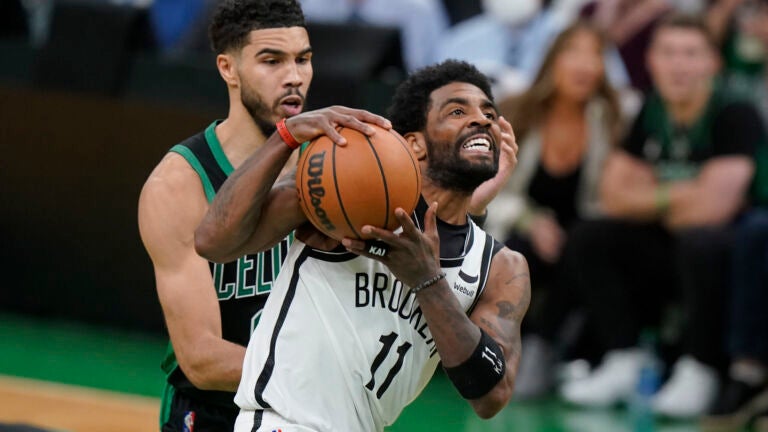
Kyrie Irving wasn’t at Fenway Park on Tuesday (we assume), but fans kept him in mind.
For two games in a row, chants of “F— Kyrie!” broke out during a Red Sox game. On Tuesday, an audible serenade could be heard over the NESN broadcast in the bottom of the sixth inning.
The day before, cell phone footage caught an even more robust chant.
Irving was fined $50k on Tuesday after flipping off fans on multiple occasions at TD Garden during Game 1 of the Nets’ series against the Celtics. Irving went on to score 39 points and nearly propelled the Nets to a win, but Jayson Tatum’s spinning layup as time expired boosted the Celtics to a 1-0 series lead.
Throughout the evening, Irving and Celtics fans exchanged barbs. Afterwards, Irving said he was just giving back the same energy he received.
“It’s not every fan,” Irving clarified. “I don’t want to attack every Boston fan, but when people start yelling ‘P—-‘, and ‘B—- and ‘F— you’ and all this other stuff, there’s only but so much you can take as a competitor, and we’re the ones expected to be docile and be humble and take a humble approach.
“Nah, f— that. It’s the playoffs. This is what it is. … If somebody’s going to call me out of my name, I’m going to look at them straight in the eye and see if they’re really about it. Most of the time they’re not.”
Irving then went back and forth with a reporter about the term “hostility.” The reporter noted that flipping off the fans seemed like hostility on some level. Irving repeatedly insisted that the interactions were not hostile.
“Embrace it,” he said finally. “It’s the dark side. Embrace it.”
If there’s anyone who understands what Irving is experiencing, it’s his teammate Kevin Durant. Durant left the Thunder for the Warriors in 2016 — a decision that was widely panned across the NBA and turned the narrative against Durant for the first time since he was drafted. Eventually, Durant left Golden State as well to join the Nets.
Through it all, Durant had to learn how to deal with the negative attention and he broke down what Irving is going through for reporters on Tuesday.
“Some days he might be up for it, some days he might not,” Durant said. “But he understands what his job entails and he understands what the situation is. He might not be in the mood for it next game, who knows. It’s just a feel thing. You never know what may trigger you in the moment, somebody saying something to get you to react. NBA crowds in the playoffs tend to try to pick at players, especially ones that played for their team recently.
“So we all understand that stuff. Kyrie’s reaction was his reaction, and we all stood behind him. I feel him exactly what he said: it’s the same energy they’re giving off to him, he’s giving it right back.”
Irving, of course, spent two lackluster seasons in Boston. In 2017-18, he was injured for the Celtics’ deep run in the postseason. In 2018-19, the Celtics were one of the most disappointing teams in the league. Toward the end of his tenure, it became increasingly clear that he was unhappy and that the Celtics’ dreams of pairing him with Anthony Davis were likely to fall apart.
“It’s rooted in love,” Durant said. “They once loved you, once cheered for you, and bought your merchandise. Had life-altering experiences coming to games watching you play. So when that gets ripped from them with something like demanding a trade or wanting to leave, it feels like a piece of them is gone too.”
Celtics fans might quibble with Durant’s assertion that the heckling is “rooted in love,” but there’s little doubt Celtics fans seem to feel like something was ripped away — even if it was just the potential for a great partnership in Boston.
“It’s an emotional attachment that they have to professional sports, and they say that’s the gift and the curse of having a team in your city where you grew up,” Durant said. “That shows that people care, and people have emotions, and people really respect and admire who we are as individuals. Sometimes it gets a little dark and deep but that’s just how the human brain works. We understand all that, and the fans understand where we come from too because we have our own platforms and speak on stuff like this.
“It’s healthy once everyone understands both sides.”



To comment, please create a screen name in your profile
To comment, please verify your email address
Conversation
This discussion has ended. Please join elsewhere on Boston.com