
Enough with the hot takes, this Celtics team is good
No, our last image of the 2019-20 Celtics wasn’t pretty. But in the big picture, the bright blue sky is the limit for the green.
Related Links
The Venn Diagram of fans that care about the Celtics, Patriots, Red Sox, and Bruins has to be pretty close to a single circle, right? We have the same rooting interests around here, the same sports DNA.
So why is it that the Celtics inspire the worst takes?
The lasting perception of the 2019-20 Celtics, who began this strangest of seasons back on Oct. 23 with a 14-point loss to a Sixers team that was presumed to be a championship contender, should be clear now that the maddening haze of the season-ending Game 6 collapse against the Heat in the Eastern Conference has burned off:
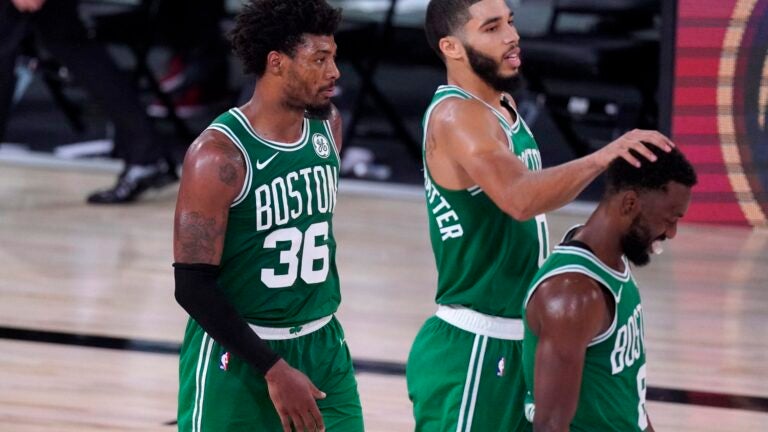
This season was a huge leap forward for the franchise’s future championship hopes, because the two most important things happened – Jaylen Brown and Jayson Tatum, ages 23 and 22, blossomed into genuine stars, with still more room to grow. Yet the frustration in the aftermath of the loss to the Heat was warranted, too, because the Celtics let a very real chance to reach the Finals slip from their grasp like one more late-game turnover.
In the micro sense, man, there’s a lot to lament from this movie’s final scenes. In the macro sense, this was a year of encouraging progress, and I can’t wait to see them again, whenever that might be. Miami is an excellent team, one wildly underestimated by so many Celtics fans – I trust you’re familiar with Edrice Femi “Bam” Adebayo now, yes? But the Celtics could have had them. Maybe they should have had them. And they didn’t get it done.
Argh. Frustrating. It’s OK to be both disappointed and hopeful. Despite the ugly ending, assessing the Celtics right now is not complicated – they are in a great place, have enviable top-end talent, and will grow from this defeat.
So why is there such a barrage of bad takes – so, so many bad takes — spewed on sports radio and social media timelines in the days after the defeat?
This was not a championship or bust season, so why treat it like the team needs a full talent and personality makeover and perhaps a coaching change while they’re at it?
It’s absurd, and yet that reactionary burn-it-down mindset seems to be more prevalent with the Celtics than with any other Boston team.
Is it because the fan base is made up of younger fans who have been conditioned by this century’s successes to believe every year that doesn’t result in a banner is a failure, and older fans who love to do the back-in-my-day-everything-was-better routine, which this nostalgic grump will admit is certainly easy to do when you got to watch Bill Russell, John Havlicek or Larry Bird?
Is it because the negativity of sports radio, with its hosts finding it so lucrative to be parasites of joy, has conditioned fans to think like they do, even if their opinions are only sporadically authentic?
I don’t know. I wish I did, but I don’t. But it has become especially tiresome when it comes to this team.
So the least we can do is attempt, with clenched fists and rolling eyes, to puncture the lamest of those narratives.
Brad Stevens can’t get them past the Eastern Conference finals: There is no doubt the Celtics’ seventh-year coach – yep, he’s been here longer than he was the head coach at Butler, so let’s stop dismissing him condescendingly as a “college coach” – deserves some blame for how the season ended.
His even-keel, nice-guy-from-Indiana personality works over the long haul, but there were times when the Celtics needed more aggressiveness and fire from him, whether it was disputing bad calls and using his challenges, deploying his timeouts when the Heat started to roll, or calling out his players when they became too one-on-one oriented. He got outcoached by Eric Spoelstra, and there’s no shame in that – he’s headed for the Hall of Fame. But it was frustrating watching it play out.
However: Criticizing Stevens because he hasn’t taken the Celtics to the Finals yet is to show a stunning lack of awareness about the Celtics’ recent history and what he’s achieved here.
He’s reached the conference finals with three very different teams. The first trip to the East Finals came in 2016-17, which was expected to be a rebuilding year. The Celtics’ starting five in the fifth and deciding game against the Cavaliers was Al Horford, Kelly Olynyk, Jae Crowder, Marcus Smart, and Avery Bradley. (Isaiah Thomas was out with a hip injury.)
The Celtics made it back the next season, taking the Cavs to 7 games, despite season-ending injuries to expected cornerstones Gordon Hayward and Kyrie Irving.
And this year’s team – the third different incarnation of the Celtics he’s guided to the NBA’s final four – was not supposed to get this far after the offseason departures of Irving and Horford, among others.
Stevens’s Celtics teams, save for the Uncle Drew-poisoned 2018-19 squad, have overachieved based on early-season expectations. It’s insane to me that anyone would want to replace him with Doc Rivers, who left the Celtics because he didn’t want to be part of a rebuild and then spent seven years with the Clippers without getting past the second round. Stevens isn’t perfect, but he’s better than most.
They have no leadership: When a team comes up short, even rational fans struggle to resist applying negative characteristics to a team: they’re too immature, they’re too soft, they lack leadership. We all do it, even when sometimes it’s just a matter of shots falling for one team and not the other.
The Celtics did lack maturity at times in this series, though we should note that they were unified and aggressive in Game 3, their first game after their locker-room blow-up following Game 2.
We know this team is not soft. They beat the proud defending champion Raptors in seven games in the second round. A soft team doesn’t do that. They played terribly at the start of Game 5 in this series, and a soft team – like, say, Doc’s Clippers – might have started daydreaming of leaving the bubble and folded. Instead, they stuck together, shots began to fall, and they rallied for the win.
As for leadership, I think part of the problem is that too many players try to lead. Marcus Smart, whose relentless determination is admirable yet sometimes detrimental, takes matters into his own hands too often (there’s no way he should have taken 22 shots in Game 7, and Stevens needs to rein in that impulse.)
Jaylen Brown is a born leader, but he’s just 23, gets treated like the third wheel in the offense, and sometimes isn’t assertive enough. Jayson Tatum tries to lead by taking dagger 3s in big spots, a literal hit-or-miss strategy.
The truest leader is Kemba Walker, who picks up his teammates, encourages them, and also warns them when they’re not doing things the right way, as the ESPN cameras caught him doing in conversation with Brown early in Game 2, when the Celtics were winning but playing carelessly. But the Charlotte refugee doesn’t have the cachet of a veteran who owns a couple of championship pelts. This was new to him, too.
The assorted attempts at leadership come from a good place – they’re desperate to win, which sometimes leads to misguided decisions – and they’ll learn from it. When do we stop citing growing pains? When they stop growing.
Time to blow it up: This is the most annoying take of all, because it shows no understanding of where the Celtics have come from or where they now stand.
Blow it up? Don’t you remember? It blew up on them, just last season, and they ended up better for it. These guys meshed. Tatum and Brown blossomed. Walker was a sizeable fraction of the player Irving was, and the selfless exact opposite as a teammate. Hayward played some of his best basketball as a Celtic before another injury. Daniel Theis, who played 6 minutes a game in the playoffs last year, emerged as a reliable if undersized center. Smart was the heart.
The Celtics went from loaded with individual talent and utterly unlikable last year to … well, a little less talented this year, but with much better chemistry and results. This was a team that cared about winning; you don’t reach the final four of the 22 teams summoned in July for Bubble Ball if you don’t.
When last season ended, the Celtics needed a culture change and an attitude makeover. This year went so well, right up until the sour end, that they’ll only require fringe alterations this offseason. Veteran depth, a shooter, and the continued progress of the Williamses would deepen the bench. The modern versions of P.J. Brown, James Posey, and Eddie House (who actually started his career with struggles similar to Carsen Edwards’s) would be more than welcome.
It’s frustrating that Danny Ainge didn’t acquire someone like Andre Iguodala – who is basically ’08 Posey at this point — at the deadline, but he wasn’t coming here. Revere Beach just doesn’t have the same appeal as South Beach to NBA veterans for some reason.
No, our last image of the 2019-20 Celtics wasn’t pretty. But in the big picture, the bright blue sky is the limit for the green.
You want to complain about blown chances and lost causes, I’d suggest brushing up on the Sixers. You know, that team that was supposed to be so much better than the Celtics way back when this season began.

Get Boston.com's browser alerts:
Enable breaking news notifications straight to your internet browser.



To comment, please create a screen name in your profile
To comment, please verify your email address
Conversation
This discussion has ended. Please join elsewhere on Boston.com