3 takeaways from the Bucks’ dominant Game 2 win over the Celtics
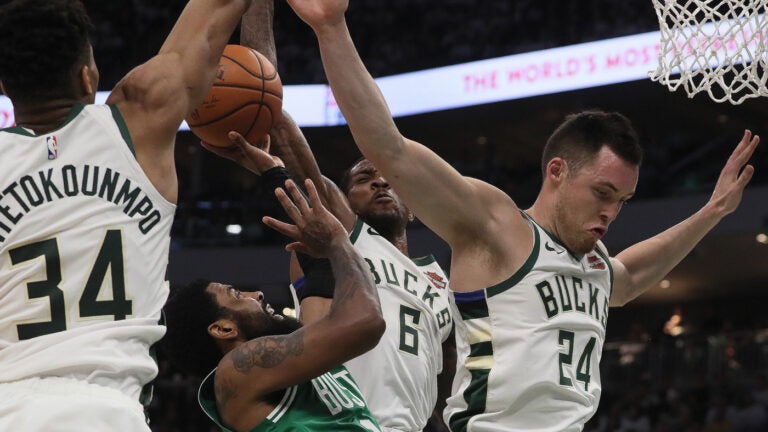
The Bucks closed the third quarter on a 24-2 run and earned a comfortable cushion for the fourth.
COMMENTARY
MILWAUKEE — It’s all tied up.
Two days after the Celtics handed them their worst loss of the season, the Milwaukee Bucks bounced back to issue a beatdown of their own Tuesday night at Fiserv Forum. The Bucks seemed in control of the game from the get-go, although the Celtics stayed within striking distance before going cold in the third quarter.
“I thought they dominated a lot in the first half, and we were lucky to be down by four,” Celtics coach Brad Stevens said after the 123-102 loss. “Then it just steamrolled on us. They were great tonight. They deserved to win, and we need to look at what we need to do better. We knew they were going to be really good tonight.”
Up by just three points midway through the third, the Bucks closed the quarter on a 24-2 run to build a comfortable 25-point cushion heading into the fourth. The Celtics proceeded to miss five of their first six shots in the final frame, and Stevens soon waved the white flag — subbing in a finishing lineup featuring the likes of Brad Wanamaker, Guerschon Yabusele, and Robert Williams.
With the victory, Milwaukee evened the series at one game apiece.
“You have to get back on track,” said forward Giannis Antetokounmpo, who scored a team-high 29 points. “That’s what we did tonight. That’s how we’ve responded all year long. That’s what’s so great about this team.”
Here’s what we learned from Game 2:
Kyrie Irving didn’t put his stamp on the game.
“Playoff Kyrie” was nowhere to be found Tuesday.
Celtics point guard Kyrie Irving struggled in nearly all 31 of his minutes, finishing with just nine points on 4-for-18 shooting. In 57 career playoff games leading up to Game 2, Irving had failed to score in double-digits on just one occasion.
It was clear from tip-off that Irving was having an off night, as he went 0-for-6 in the first quarter — tying his most attempts without a make in a quarter this season. His first field goal came on a turnaround fadeaway rainbow along the baseline with 6 minutes and 22 seconds remaining in the second quarter. Irving drilled a 32-footer moments later, but there was no eruption of scoring that followed.
Irving’s third and fourth baskets came on layups at the beginning of the third, but he, like his teammates, went cold, while the Bucks pulled ahead. During Milwaukee’s 24-2 third-quarter run, the Celtics missed 10 shots and recorded five turnovers.
“Some shots are going to go in, some shots aren’t,” Irving said. “I tried to get to my spots, but they were really sending three [defenders] over every single place I went on the court. That’s a sign of respect. For me, I just got to be more efficient in controlling the tempo of the game.”
In addition to his shooting struggles, Irving seemed to lack his usual command as a playmaker. He turned the ball over three times on off-target passes, and finished with a postseason-low of four assists. Irving acknowledged he failed to make the right reads in the paint, whether that be dishing it out, attacking a certain matchup, or simply slowing the game down.
“We’ll look at film, but I think I already have a clue of how I want to play going into Game 3,” he said. “This is what I signed up. This is what Boston traded for me for. Being able to go back, get back in the trenches, and get ready for another battle on Friday, it’s what you live for. Basketball is fun when you have to respond.”
Khris Middleton continues to have his way with the Celtics.
Bucks starting forward Khris Middleton once again seemed to have the hot hand against the Celtics, tallying 28 points on 10-for-18 shooting — including a dazzling 7-for-10 performance from behind the arc. Twenty of Middleton’s points came in the first half, highlighted by back-to-back threes in the second quarter to give Milwaukee a four-point lead and prompt Stevens to call a timeout.
“He is an All-Star; he is one of the 12 best players in the East this year,” Stevens said. “We have to do a better job on him. We did not do a good enough job on him. He still might make it, but he got too many looks.”
In the first two games of the series, Middleton is shooting 50 percent from the field and an absurd 71.4 percent from three-point range.
His ability to knock down shots helps the Bucks offense operate at its best, as the team can play with pace and capitalize in transition. In Game 2, for example, six of Middleton’s field goals came immediately after a Boston missed shot — four of which were misfires by Irving. Another of Middleton’s makes was off of one of Boston’s 13 turnovers.
“They’re a great defensive team when they get set,” Middleton said. “The main thing is for us to get out, try to get a stop, and get out and run.”
Middleton’s shot-making ability, as well as that of the rest of the Bucks lineup, also allows Antekounmpo to operate at his best. While Antetokounmpo is as dangerous as it gets when attacking the paint, having Middleton, point guard Eric Bledsoe, and others available on the perimeter offers him an outlet when opportunities aren’t opening up around the rim.
Antetokounmpo, Middleton, and Bledsoe combined for 78 of Milwaukee’s 123 points Tuesday.
“It works hand-in-hand,” Middleton said. “[Giannis] is at his best when he’s being aggressive, getting downhill, and getting to the paint [and] putting pressure on the defense. In order for us to loosen up for them, we have to be willing to take — and make — shots, threes, and play aggressive. It works hand-in-hand.”
The Bucks made adjustments.
Despite downplaying the value of adjustments, going as so far to call them “overrated,” Bucks coach Mike Budenholzer did, in fact, make some changes for Game 2.
The first was the insertion of forward Nikola Mirotic into the starting rotation. With starter Malcolm Brogdon still recovering from a foot injury, Sterling Brown got the nod in Game 1 as well as in Milwaukee’s first-round series against the Detroit Pistons. But after Brown experienced back spasms and shot 1-for-7 in Game 1, Budenholzer opted to go with Mirotic to start Game 2.
“Obviously, he’s such an incredible shooter and can shoot it from deep,” Budenholzer said. “You’re just waiting for him to pop off five, seven, eight threes in a game, so to get him in the game more, to get that 3-point shooting, that 3-point threat out there just made sense.”
Mirotic, however, quickly picked up two fouls in the opening three minutes of action, making that tweak a rather moot point. He ultimately finished with nine points in 25 minutes.
The adjustment that really made a difference was Milwaukee’s decision to switch on defense. More than they have all season, the Bucks switched against screens while keeping center Brook Lopez as their rim protector. The change made it more difficult for the Celtics to get open looks on their pick-and-pops and seemingly forced them to settle.
“In Game 1, we got beat one-on-one, screen-and-roll, Al Horford popping and getting wide open looks,” Bledsoe said. “When we looked at it in film, we just thought that was the right thing. Coach Bud did a great job, his staff did a great job of making adjustments.”