Ranking all the key players in the Celtics-Bucks series
Kyrie Irving and Giannis Antetokounmpo are the stars to watch in the Celtics' second-round playoff series.
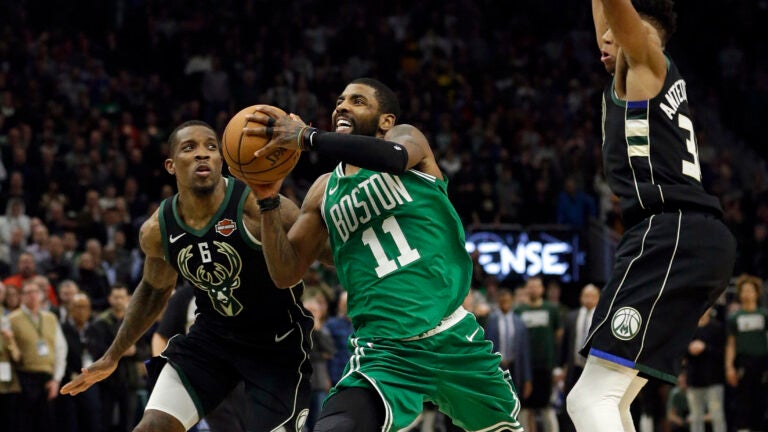
COMMENTARYA year after the teams engaged in a seven-game battle effectively decided by home-court advantage, the Celtics and Bucks begin another playoff series this weekend — this time at Fiserv Forum, rather than TD Garden, because Milwaukee opened its new arena with a regular season that featured 60 wins and secured the Eastern Conference’s No. 1 seed.
Since the teams met last spring — when the Celtics played host to the East’s No. 2 vs. No. 7 matchup — the Bucks have established themselves with a well-built roster that nicely blends top-end talent with purposeful role players. There’s not a lot of redundancy among the rotation players, which creates a nice balance for coach Mike Budenholzer, and has provided the necessary supports around superstar Giannis Antetokounmpo.
The Celtics might have just as much talent. Maybe even more. But the season-long grind to 48 wins has exposed the Celtics roster as one with too much of some qualities, not enough of others, and a mix that doesn’t complement each other as well as the Bucks’ does.
It’s close enough that anything could happen in the best-of-seven forthcoming — but in evaluating the way they’ve played this year, played of late, and project to impact this series, the Bucks appear to have an edge. Here’s a look at how the 20 most important players in the series stack up at the start.
20. Semi Ojeleye: He logged all of 28 seconds against the Pacers, though the Celtics’ coaches have in the past seen Ojeleye as something of a specialist against the Bucks. He started three playoff games against Milwaukee last year, and also started two of the teams’ three meetings this season. He’s lost his place in Boston’s rotation, but don’t be surprised if he gets a shot at bodying up Antetokounmpo.
19. Ersan Ilyasova: The 31-year-old journeyman has had a down year, but he popped off for 15 points in Game 3 against the Pistons, and scored 14 against the Celtics as a member of the Sixers last postseason. He’s a good enough rebounder and 3-point shooter that in a tight series he could make an impact even in limited minutes.
18. Marcus Smart: Will he play? Time will tell — but time is on the Celtics’ side, thanks to the NBA’s elongated playoff schedule. If this series goes seven games, that game will fall on May 13, five weeks and a day after Smart incurred an oblique injury that was said to sideline him for four to six weeks. He’s sweating again, and running, and his coach says his timetable hasn’t changed. If his teammates can make this a long series, they could be receiving a big reinforcement.
Danny Ainge said he doesn’t have any updates on Marcus Smart other than he won’t play this weekend.
— Nicole Yang (@nicolecyang) April 26, 2019
17. Malcolm Brogdon: The Bucks may get a boost from a returning cog, too. A heel injury has put him on the bench since March 15, and he’s been ruled out for Games 1 and 2, but the third year guard could return as soon as the series shifts back to Boston. He’s an excellent player who was enjoying a career-best year in terms of scoring and shooting, and he always seems to play well against the Celtics.
16. Aron Baynes: Rim protection could be a priority against a Milwaukee team that ranked third in the NBA by averaging more than 53 points a game in the paint. Even if he isn’t blocking shots, Baynes could be a factor simply by using his big body to take up space and get physical with Antetokounmpo and whichever other Bucks attack the basket.
15. Nikola Mirotic: Another big man who can stretch the floor, Mirotic doesn’t play a lot, but when he’s on the floor he’s not afraid to shoot and that’s part of the reason he averaged 11.6 points in just 22 minutes this season. He’s an example of the group of functional role players that make the Bucks roster composition so effective.
14. Pat Connaughton: The Arlington native had a nice series against the Pistons, twice scoring in double-figures and posting a plus/minus of at least 10 in each of the final three games. He averaged close to 28 minutes in the series, though against the Celtics this season he only played once, and spent just 8:54 on the court. That suggests matchups may determine Connaughton’s impact and role.
13. Terry Rozier: Thriving off his rivalry with Eric Bledsoe, Rozier’s best stretch as a Celtic may have come during the Milwaukee series a year ago. He averaged 22 points in Boston’s four home games, including a 26-point outburst in Game 7. His role figures to be far different with a healthy Kyrie Irving in the mix, but the C’s have to be hoping there’s more coming from the reserve guard in this series than there was against Indiana.
12. George Hill: The veteran has played in 106 playoff games over his 11 seasons, speaking to his reliability and knack for making the right play. Consistent, professional minutes have value at this time of year.
11. Sterling Brown: Joining the Bucks’ starting lineup after Brogdon went down, Brown has thrived defensively, on the boards, and even chipped in as a scorer. He plays bigger than a 6-foot, 6-inch shooting guard, so it could be interesting to see who the Bucks match him up against at the defensive end.
10. Marcus Morris: No longer a starter, Morris has settled into a role that fits well. Even with his 0-for-8 egg in Game 2, he averaged 12.3 points against the Pacers and pulled down at least seven rebounds three times, too. Bench scoring will be important for Boston in this series, and Morris is the best option to provide it.
9. Gordon Hayward: It wasn’t until Game 4 that he made a major impact against Indiana, and the building aggressiveness that marked the end of his regular season seemed to wane a bit during the sweep. The Celtics are at their best when Hayward is a legitimate, No. 2 scoring threat; seven shots in nearly 30 minutes isn’t threatening enough.
Gordon Hayward wanted revenge 👀 https://t.co/YATJwfx7ZP
— Dime (@DimeUPROXX) April 21, 2019
8. Jaylen Brown: Offensively, Brown was a disappointment in the opening series (even with a 23-point effort in the mix), but defensively he helped to fill some of the void vacated by Smart, and earned the opportunity to remain in the starting lineup. He was a monster at times in last year’s series against Milwaukee, and averaged 18 points while shooting the ball well in two meetings this campaign. He could be in line for a big series.
7. Brook Lopez: Following a career path similar to Horford in one respect, Lopez attempted seven 3-pointers in his first six NBA seasons — and chucked an average of 6.3 per game this year. He’s not bad at it, either, shooting 36.5 percent for the year, and helping to create lanes for others to penetrate. He’s not a great rebounder for a player his size, but he’s a relatively accomplished scorer and needs to be accounted for in the C’s pick-and-roll plans.
6. Jayson Tatum: Maybe the two most encouraging stats for the Celtics in Round 1 were Tatum’s .533 success rate from 3-point territory and his 17 free-throw attempts. After the All-Star break, Tatum was a .353 shooter from distance, and he attempted only 97 free throws all season. If he’s dangerous from behind the arc, but willing to be aggressive, he’s going to be a difficult player to stop from scoring.
5. Al Horford: He struggled from the floor in the first round, but Horford’s primary responsibility in Round 2 figures to be at the other end, where previous meetings say he’ll bear the brunt of trying to slow down Antetokounmpo. If he were to do that he would belong even higher on the list of this series’ most important players — and give the Celtics a really good shot at upsetting the East’s No. 1 seed.
ICYMI: Here’s the Al Horford block that led to Tatum’s game-winning three 👏 pic.twitter.com/Qob8RhVVvg
— Celtics on NBC Sports Boston (@NBCSCeltics) April 18, 2019
4. Khris Middleton: After scoring at least 23 points in six of the seven contests last postseason against the Celtics, Middleton made his first All-Star team this February, and has continued to emerge as a premier scorer. Only three times has he been held to less than double figures this season, and Milwaukee is 23-8 when he hits for at least 20 points.
3. Eric Bledsoe: A year ago at this time, it looked like Bledsoe had let the heated tussle with the Drew Bledsoe-backed Rozier get into his head over the course of what was a largely ineffective series against the Celtics. His response this season, however, has been impressive, with his 8.2 win shares equal to the total of Ben Simmons and putting him on the cusp of the league’s 20 most impactful players.
2. Kyrie Irving: The Celtics’ star did a little bit of everything against the Pacers, scoring 37 points in Game 2, then balancing out his poor shooting in the three other tilts by sharing the ball, rebounding, and contributing defensively. His shooting will need to be better if Boston is to keep pace with the league’s No. 1 scoring team — but for his career he’s averaging 23.8 points in playoff games, compared to 22.2 in the regular season. These appear to be the types of moments and challenges that Kyrie craves.
1. Giannis Antetokounmpo: He continues to improve, evidenced most recently by numbers showing he shot a higher percentage on shots from beyond 10 feet this year than he has in any prior season, with his success rate on two-point shots taken from at least 16 feet topping 40 percent for the first time. More than 57 percent of his field goal tries still come from within three feet of the rim, though, and what’ll frustrate Celtics fans is that on top of the freakish athleticism and the 6-11 frame, he’s also started attracting the types of calls that come with stardom in the NBA. That’s not the only reason, but consider this: Antetokounmpo drew 347 shooting fouls this season; the top four Celtics drew a total of 357, and no one Celtic drew more than Brown’s 100. Keeping the presumptive MVP away from the rim, and the foul line, is almost impossible.