Did we overrate the Celtics’ talent from the beginning?
Maybe the blame for Boston failing to meet expectations belongs on nothing but the expectations themselves.
COMMENTARYSunday represented a frustratingly typical night for the 2018-19 edition of the Celtics.About 30 minutes before their own tip-off against the Magic, the Celtics learned they’d clinched home-court for the first round of the postseason by virtue of the Pacers’ loss to the Nets. Its recent surge, which included wins over Indiana on consecutive Fridays, had officially secured Boston the No. 4 seed in the East.
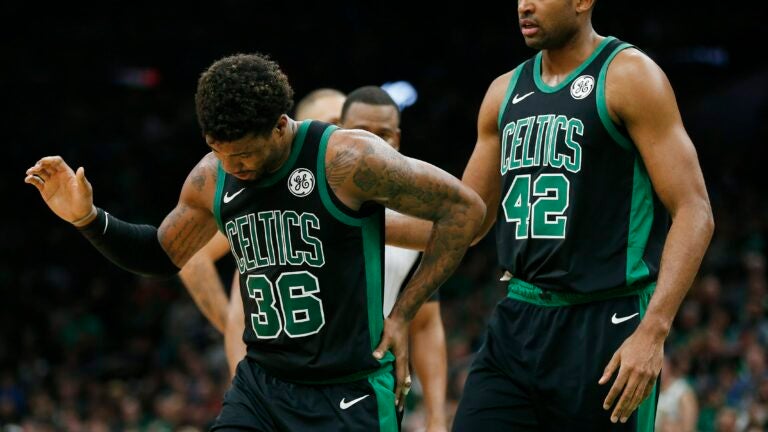
That meant there was nothing at stake for the C’s in Sunday’s penultimate regular-season contest, but with their playoff opener likely to wait until the next weekend, Brad Stevens went forward with his plan to play his rotation its normal minutes. The coach decided staying sharp took precedence over avoiding injury risk — then, six minutes in, Jayson Tatum left with a shin contusion. In the second half, Marcus Smart crumpled to the parquet with what’s being reported as a strained oblique.
Nevertheless, the Celtics opened up a 13-point lead in the middle of the second quarter. That lead evaporated quickly, and by the fourth quarter they were down 14. They rallied back to tie the game at 106, although from there the Magic scored 10 of the game’s final 12 points, and despite 38 minutes from Gordon Hayward, 35 from Kyrie Irving, and an honest effort to win, Boston was bettered on its own floor by a mediocre Orlando team that projects to be shredded by the Raptors in Round 1.
It was another example that nothing’s come simply for the Celtics this season, which has had as many ups and downs as anything they can strap you into at Six Flags out in Agawam. Six months ago, these C’s were projected as a team that could potentially win 60 games and could well have home-court for every series it played in the East. Instead, it failed to win 50 games, and its tussle with Indiana is likely the only series it’ll open at TD Garden.
Along the way, the blame has been blasted in all sorts of directions. At Stevens’s coaching ability. At Irving’s leadership. At the inability of players to adjust to their role.
But maybe it’s all been miscast. Maybe the blame for Boston failing to meet expectations belongs on nothing but the expectations themselves. Because maybe from the start we’ve all significantly overrated the talent on the Celtics’ roster.
That’s not to say this is a team void of talent. Nor is it to suggest there is not great potential among that talent over the years to come. But for this season it was overly ambitious to look at what Boston was bringing back and think it was legitimately the favorite of the newly LeBron-less Eastern Conference.
📽 The plays that made us @NBA Southeast Division Champions. pic.twitter.com/kup0BfaeMs
— Orlando Magic (@OrlandoMagic) April 8, 2019
To some extent, the Celtics acknowledged as much early on.
By mid-November, a month in, they transitioned away from their original starting lineup. There was some convenience to it, considering the way Marcus Morris earned the opportunity by playing so well before Christmas, but the real significance of the decision was its admission that Hayward wasn’t right.
The hope was that Hayward, injured in the first game of the 2017-18 season, would after a full year be back to the player who earned a max contract two summers earlier. After his own horrific ankle injury effectively cost him a full campaign, Paul George averaged 23 points a game and was an All-NBA player in the first full season of his return. George came back burdened by being the Pacers’ go-to guy, too. Hayward, then, could slide back in as Boston’s No. 2.
Except he couldn’t. He was inconsistent, looked tentative at times, and lacked the explosiveness that made his such an effective scorer in Utah. It was apparent fairly quickly that this wasn’t the Hayward that those lofty expectations had factored into the equation, and so the Celtics would need someone to fill the void.
The logical choice was Tatum, the second-year wing whose star was ascending so quickly that last summer ESPN ranked him No. 24 on its list of the NBA’s best players. He is undoubtedly a building block — be it in Boston or New Orleans, as the clincher in Anthony Davis trade — but he was 20 most of the season. This is his second year. Average of 15.7 points and six rebounds are excellent numbers for a player of that age and experience, however those are not the numbers of the second option on a team that’s a true contender.
Through Sunday, Tatum ranked 70th in scoring across the league, and according to the Win Shares calculation that tries to quantify a player’s value, he ranked 84th according to Basketball-Reference. It’s also worth noting that among those ahead of him in Win Shares were seven other second-year players.
In shaping the NBA’s upper-level elite, age and experience matter. In 2002-03, Richard Jefferson’s Nets met Tony Parker’s Spurs in the Finals — and those are the only two instances since the turn of the century that a team relying on a second-year player for at least 15 points per game has won its conference.
There’s risk to relying on youth at a full-team level, too. Over the past 15 seasons, the 2008-09 Lakers (26.1) are the only NBA champion with an average age of younger than 27. Last year’s finalists were two of the three teams collectively aged 28 or older, while the Celtics’ average age was fifth-youngest, at 24.8.
This year, Boston is closer to the middle of the pack, but an average age of 25.9 suggests they’re a year away from their championship prime.
In the NBA, with age and experience tends to come consistency — and that’s where the Celtics supposed depth may have been the most overrated aspect of its title aspirations. Guys like Jaylen Brown and Terry Rozier generated optimism and hope with their performances in last year’s playoffs, as key pieces to the team’s deep run to Game 7 of the Eastern finals, but by September it had seemingly been forgotten that Brown would get off to great starts but struggle to sustain it through four quarters. Rozier was something of a revelation in Irving’s absence, but at the end of the Cleveland series he sandwiched a 28-point burst between shooting nights of 3-for-15 and 2-for-14.
So for all the talk of those two struggling to find themselves and figure out their role early in this year, perhaps their perceived difficulties were more the product of inflated expectations (both internally and externally). For the third straight season, Rozier will finish the regular season shooting less than 40 percent from the field, with less than three assists, and he’s only averaging about three fewer minutes a night this year than last. Brown is down about five minutes from last season, but if he merely shot the ball as well from 3-point territory as he did last season, he’d be scoring at roughly the same clip.
Both Rozier and Brown may be All-Stars someday. At this point in their careers, though, the metrics that attempt to evaluate a player’s value and impact say they’re both rather pedestrian. They may be a pair of athletic first-round picks, and flash star tendencies at times, but overall they keep the company of the nondescript journeymen that come off the bench for every decent NBA team.
To that point, Daniel Theis has been worth more Win Shares than either of them this season. Another popular measure of a player’s per-minute production is the Player Efficiency Rating (PER), which rates an average player at 15. There are 118 players across the NBA who meet that threshold while playing at least 1,000 minutes; the Celtics have four. Their first-round opponent, the Pacers, have six. The Sixers, after trading for two midseason, have five. So do the Raptors and Bucks.
The four Celtics who rate as better than average — Irving, 24.3 PER; Al Horford, 20.2; Hayward, 15.6; and Tatum 15.1 — are the keys to whatever playoff run awaits. And the past couple of weeks have offered some hope in that regard. Irving and Horford have been excellent all season, while Hayward has started to look like his old self in shooting almost 59 percent while averaging 16.4 points over his last eight games.
Tatum’s health is of obvious importance for the Celtics against the Pacers, as is that of Smart, who’s responsible for the team’s third-most win shares this season. Beyond that, though, is that Boston’s roster is basically a crapshoot, so fans should take their long-since reset expectations and enjoy whatever comes of the next few weeks. After Sunday there’s now 81 games of evidence to back that up that reality — but there’s nobody to blame for its frustrations.
Except, maybe, those who built this group up to be something it was never going to be.