3 questions for the Celtics after their first 2 preseason games
So far, the answers are all positive.
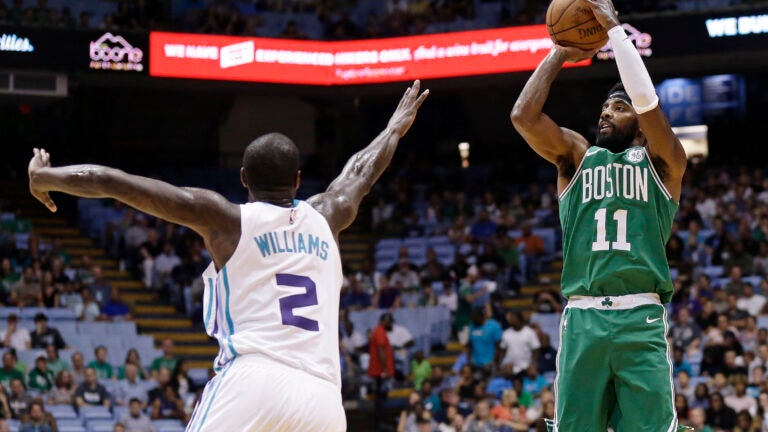
COMMENTARYThe human imagination is capable of some incredible things. We can step into a theoretical playground and perform amazing mental gymnastics that take us to places where reality isn’t a problem. Reality and theory have a complicated relationship, though. There are things we want to be true. There are things we think are, or can be, true. And there are things we hope to be true.The only way to know the actual truth is to experience reality, and then we can see how much of what we imagined holds up. For Celtics fans, this weekend was that initial exposure. Finally, Kyrie Irving’s knee and Gordon Hayward’s ankle and Jayson Tatum’s progression got to take their first steps out of our brains and onto a basketball court against NBA competition. We got our first side by side comparison of expectations versus reality to see if there’s any validity to those things we have been thinking for the past four months. The two games against Charlotte were the first dose. There’s little definitive about 40 or so minutes of basketball, but there was enough reality to get some answers we’ve been looking for.
Question 1: How’s Gordon Hayward’s ankle?
This is the biggest, most obvious question heading into this season. We’ve watched workout videos, read between lines every time someone’s given an interview, and searched WebMD for recovery timelines. There are plenty of Bostonians who fancy themselves experts in ankle anatomy at this point. None of that really mattered until Hayward actually took the court against another team. There is absolutely nothing that duplicates the speed of an NBA game against opponents who aren’t just teammates in a reversible jersey. Until Friday night, a non-injured, basketball-ready Hayward was little more than a character in an Instagram video. Now he’s played 43 minutes and 46 seconds of basketball, and the best answer at this point is that the ankle itself is fine. He can play and push off and stop when he needs to. Structurally, there seems to be nothing wrong with the ankle itself. That was never going to be the biggest issue, though. Even after all the physical rehabilitation, Hayward’s biggest challenge was going to be clearing the mental hurdles that kept him from being aware that he was very recently seriously hurt doing what he’s doing in that exact moment.Every game at this point might as well come with a trigger warning for Hayward. Add to that an inches thick layer of rust that he has to clear, and it’s obvious that it will take Hayward a little while to get back to being himself. Still, there have already been strong signs of progress. Here, for instance, is a Hayward drive in Friday night’s game. He fakes and beats his man off the dribble, which is great. He’s dribbling into traffic, so I can see why he wants to pass in that situation, but he rushes the pass. He could have challenged Cody Zeller there and gone straight up at him and drawn contact. He could have side stepped him and tried to finish at the front of the rim. He could have even slowed down, trapped his defender, and allowed space to get Horford a better pass. He did none of that, though. What he seemed to do was get rid of the ball as fast as he could. However, in the second game, Hayward started doing this.
This drive is slower, more methodical and probing, and he goes all the way to the rim and finishes through contact.
Granted, it wasn’t a chest-to-chest challenge of a dunk, but Hayward did get hit and he finished. Mentally, getting a play like that under his belt was huge. He went to the rim. He finished. He landed safely. Maybe that confidence is what led to this play.

Some of Hayward’s past explosiveness returned in this play. He did land awkwardly, but he got up, and he kept playing.
Eventually, Hayward will slide into the grind of the NBA and start to forget about what “was” and focus on what “is” and “will be.” He’s already made great strides in what amounts to be one actual NBA game’s worth of minutes. Once Hayward gets past some of the mental obstacles, we’ll get a better idea of whether there are any lasting physical limitations.
Question 2: How’s Kyrie Irving’s knee?
The answer, simply, is that it is fine, but you tell me.
The handles look as tight as ever, the shot was slow to fall but it’s getting there, and most of all, his knee looks to be a non-issue.
It’s really important to reiterate that the knee problems of last season were caused by a medical device that helped him heal from a fractured patella. The irritation and infection that ultimately sidelined him for the playoffs were because of that device. There was no secondary injury.
A lot of people want to bring up his knee injury as if they are part of a history of recurring knee issues. At this point, they aren’t. There was no fresh injury last season, and there was no structural damage. Medically, his knee is sound and he’s ready to go.
The biggest issue Irving is facing is a lack of conditioning due to the recovery from the infection-clearing surgery. While many guys were getting their summer workouts in, Irving was recovering, so he’s a step or two behind in that regard. Luckily for the Celtics, Terry Rozier and Marcus Smart are ready and able to give Boston the extra minutes needed to give Irving the time he needs to get to 100 percent.
Question 3: How is Jayson Tatum progressing?
The short answer is “he’s progressing well.” The long answer is “he’s progressing well, but it’s so early in preseason that it’s not entirely clear how it will translate… but it looks good” One thing the Celtics have done over the first two games is shoot. A lot. They shot 104 times on Friday night and 95 Sunday night. That’s a LOT of shots. For some perspective, Boston averaged 85.1 per game over the past two seasons. The league leader in field goal attempts last season was Chicago with 88.8. No team has averaged 90 field goal attempts since the ‘07-’08 Warriors. So it’s not realistic to expect Boston to average 100 shots per game over the course of the regular season. At least, I don’t think it is. For now, Boston is a “grab and go” team. Anyone in their anticipated starting lineup of Al Horford, Jaylen Brown, Hayward, Tatum, and Irving can bring the ball up the floor. When Charlotte has missed with this Celtics unit on the floor, the rebounder has simply turned and dribbled up the floor before looking for any outlet passes. That has led to an unreal pace and a lot of early shot opportunities. If they can continue that in the regular season, then then everyone on the team will have a chance to get a fair amount of shots. That will also be great for Tatum because he’ll get to create and use his skills to his advantage as defenses scramble to avoid mismatches. The downside is the free-flowing nature of this kind of offense has generated a little early sloppiness from Tatum. Tatum needs to not settle for long two-point shots, which are the most inefficient shots in the game. Some mid-range shots are fine to soften the defense, but shots a foot or two inside the three-point line are terrible. Instead, this is the type of play Tatum needs perfect. Instead of taking a dribble past his defender and stepping into a 20-foot shot, Tatum side-steps and stays behind the line. If he can get into the habit of doing that and firing more threes, he’ll be an even more efficient scorer. Remember, even if a player hits 50 out of 100 two-point shots, he’s still not scoring more than someone who hits 34 out of 100 three-point shots. Tatum shot 49.2 percent from two last season. He shot 43.4% from three. He should take more threes.That said, one nice element to Tatum’s game has been his post play. In today’s era of switching defenses, hunting out mismatches in the post will be something teams do more often. Tatum can really hurt teams if he finds himself on the low block against a smaller defender.
  Tatum can be the guy who destroys mismatches. His length alone will be enough to take advantage of situations where another perimeter player has switched onto him. Taking even similar sized players into the post can play to his advantage because Tatum knows how to gain advantages in tight spaces.Overall, Tatum’s aggressiveness has been noticeable. On Sunday night, he exploded for 13 points over 3:18 in a second quarter sequence that looked like this:11:08: Tatum Alley Oop Dunk
10:09: Tatum 27′ 3PT Jump Shot
8:53: Tatum 27′ 3PT Jump Shot
8:35: Tatum 2′ Running Finger Roll Layup
7:50: Tatum 27′ 3PT Step Back Jump Shot It was a true takeover stretch by a young player who is proving himself to be very capable of this kind of thing. It’s pretty clear he’s not as shy as he was last season. Again, there’s no guarantee much of this translates to the regular season. There hasn’t been enough reality to fully satisfy our quest for the truth. However, we’ve begun to answer these three questions, and so far, they’re all positive.