Kevin McHale recalls how Red Auerbach surprised him in the 1980 NBA Draft
McHale also discussed similarities between Auerbach and Danny Ainge, and why you shouldn't mix the '80s Celtics and '90s Knicks.
Few NBA trades have worked out as perfectly as Red Auerbach’s pre-draft masterpiece in 1980. Initially holding the first and 13th overall picks, Auerbach turned them into Kevin McHale (selected third overall) and fifth-year center Robert Parish in a trade with the Golden State Warriors two days before draft.
The newly-acquired talent combined with Larry Bird to form the “Big Three,” and the Celtics entered another golden era. At the time, McHale admits he had no idea what he was a part of.
“I didn’t know what was going on as far as what we were going to do,” McHale said of the team’s impending run to three NBA titles in six seasons. “When you’re doing it and you’re just in the middle, you’re not looking at anything. You don’t get too caught up in the whole, ‘What we were accomplishing.’”
Now that he’s removed from the day-to-day involvement (and serving as an analyst for NBA TV and the NBA on TNT), McHale is taking a longer view of the current Celtics setup.
“Looking at it now, I think the Celtics and the 76ers are going to have a hell of a rivalry in the next six, seven years,” McHale said of the Eastern Conference’s two emerging teams. “If you can have a competitive team that can fight for a championship for six or seven years, that’s a generational-type team. It doesn’t happen that often.”
And McHale could’ve just as easily not been a part of such a “generational” team. Had Auerbach gone with the consensus, history would’ve known McHale for his production on another, less talented team. Yet Auerbach was never one for consensus.
“I really hadn’t heard from the Celtics”
Heading into the 1980 draft, McHale was widely identified as one of three possible top picks. Along with guard Darrell Griffith and center Joe Barry Carroll, McHale – who flourished in four years at Minnesota – was seen as an elite talent. While it was a mystery as to who would go first, Carroll was considered to have a slight edge.
McHale had no idea that the Celtics, possessors of the No. 1 pick thanks to a creative Bob McAdoo compensation package from the Pistons, were interested in drafting him.
“I really hadn’t heard from the Celtics,” McHale said looking back. “I’d heard from Chicago, who were picking fourth. They said that if I was there, they were going to take me, so I kind of knew that was my backstop, but I didn’t really know where I was going to go.”
Auerbach, as usual, already knew exactly who he wanted. It’s a trait that McHale sees in current Celtics general manager Danny Ainge.
“Red knew the type of players he wanted, knew the type of players he liked,” McHale explained, “and Danny does the same thing now too. Of course, they’re looking for different players because it’s different eras.”
“Tomorrow after the third pick, you’ll be a Celtic”
“Our feeling – this was Red’s feeling – was that Kevin McHale would be our No. 1 pick,” former Celtics assistant general manager Jan Volk remembered of the ’80 draft. “If we have the No. 1 pick and we make no deal, we’re going to select Kevin McHale. But we think we can get McHale down lower.”
Secure in in their certainty, the Celtics front office set out to leverage what they saw as a flexible situation. McHale’s potential availability at a lower pick enabled the possibility of a trade.
Boston Globe sportswriter Bob Ryan predicted the trade almost in its entirety. Boston sent the first overall pick to the Warriors, along with the 13th overall pick (another of the McAdoo compensation picks).
In return, the Celtics acquired the third overall pick, where McHale loomed, and center Robert Parish. McHale’s first conversation with Auerbach was an introduction to the Celtics’ approach against the rest of the league. They were one step ahead of the competition.
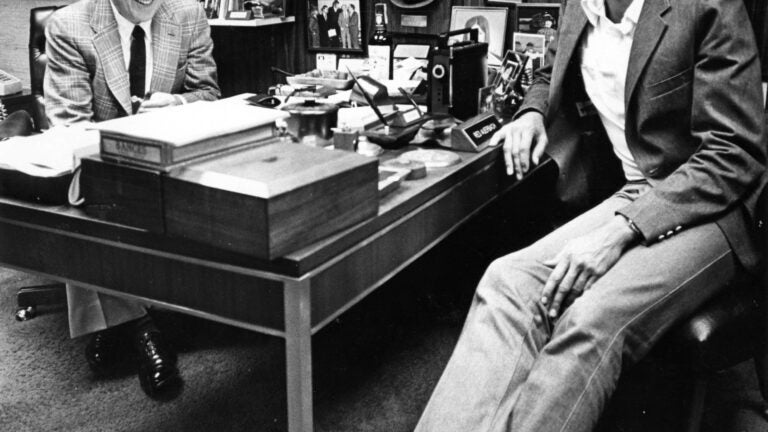
“Right before the draft, Red [Auerbach] calls me up and says, ‘I made a trade and got Robert Parish and the third pick for the first pick and the 13th pick,’ and he told me he would’ve taken me first, but now they can get me at three. He finished saying, ‘Tomorrow after the third pick, you’ll be a Celtic.’”
Given that the Celtics were coming off Larry Bird’s rookie season, where the team won 61 games and made it to the Eastern Conference Finals, McHale was ecstatic.
“When he told me that I thought, ‘Fantastic,’ because I knew that was a much better team to be going to than the other ones, who were all struggling.”
“We weren’t the ’90s Knicks”
One of the noticeable differences in McHale’s era of basketball and the current league is the exponential growth of three-point shooting. In 2018, the NBA set its sixth consecutive record for most three-pointers taken in a season.
Despite the increase in threes (and the increase in accuracy), league average scoring remains below the era of the ’80s. In 2018, the NBA averaged 106.3 points per game. The ’86 Celtics played in a league that averaged 110.2 points per game.
McHale offered an explanation:
In the ‘80s, we ran. We pushed that ball every chance we had. And we scored a lot, because there were just a lot more possessions. If we weren’t getting 100 shots up, we didn’t think we were pushing the ball. There was just a lot more attacking back then, because what you were trying to do is attack and create space through the break and pushing, so you didn’t always have to hit that five-on-five defense. You didn’t want to go against that set defense all the time.
And, as if proud of his era in comparison to what came in the following decade, McHale made it clear who the Celtics were not.
“After that, there was the hand-checking and a lot of the stuff that happened [later], but we weren’t that ‘90s Knicks,” said McHale. “People kind of get that confused with the Knicks who kind of slowed everything down and they had a lot of rule changes. We were the complete opposite of that if you look at the numbers.”