Celtics voice Mike Gorman can’t wait to see the team next season
"My takeaway from this year is that I can’t wait until next year."
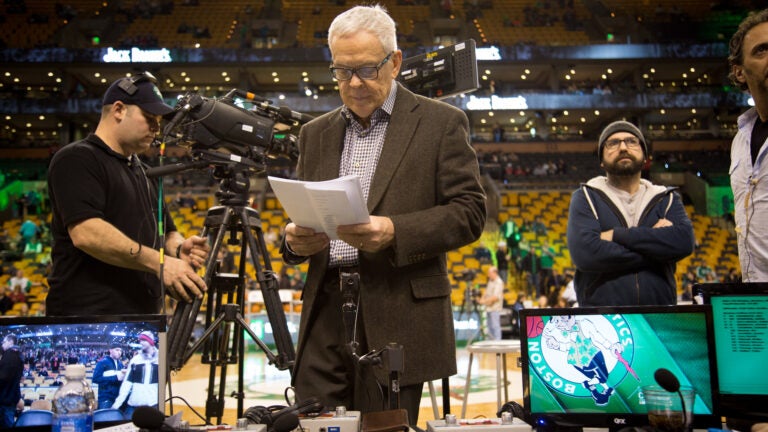
So far as I can tell, there are just two downsides to a deep playoff run by the Celtics.
1. Disappointment when LeBron James exerts his will and puts an end to the season before Celtics fans are ready to say goodbye.
2. After the first round, all of the games air exclusively on national television, meaning the familiar voices who know the team best — Mike Gorman and Tommy Heinsohn, who have called Celtics games locally for 37 consecutive years — aren’t the ones narrating the most important moments.
I caught up with Gorman recently to get his thoughts on how this remarkable season played out, and what’s ahead next year.
Q. With the injuries to Gordon Hayward and Kyrie Irving and the rise of Jayson Tatum and Jaylen Brown, this was one of the most eventful Celtics seasons I can recall. What will you remember best about the ’18 Celtics?
A. My takeaway from this year is that I can’t wait until next year. I thought it was funny that Brad [Stevens] said in his postgame press conference [following Game 7] that this is a tough loss and it will take a while to get over it and he wished training camp opened on Wednesday. I feel the same way. I want to see a healthy Gordon Hayward, I want to see a healthy Kyrie, I want to see the two kids battling for minutes, and you know Danny [Ainge], just by the nature of who he is, will make one addition to the roster.
Then there’s the unbelievably fast development of Tatum, who began the season at 19 years old and ended up being your leading scorer in the playoffs. He was one young guy who didn’t seem to be perplexed by the pressure of it all. I can’t imagine when he puts on 20-25 pounds of muscle, which I’m sure he will given his frame. He’s going to be LeBron-like in his size.
Q. Brad Stevens seems to have the roster that suits his system now — plenty of high-end talent, and incredible versatility among them.
A. Well, the other thing that was really satisfying to watch was Brad’s coaching and how he handles everything and how he gets guys to buy in, especially those who might be skeptical when they get here but quickly become part of the whole program.
When we had players going in and out three years ago — I think there ended up being 28 players on the roster that year — someone who was in the exit interviews with them said, to a man, they would say, “I’m a better basketball player now and probably a better person for my association with him.’’
Watching him go out every night and treat each game with the same gravitas, and to just coach hard for 48 minutes each night — he doesn’t spend a lot of time sitting down on the bench — that’s fascinating. Watching that system get more entrenched with the quality of players we have right now, and watching how they’ve searched for a certain kind of player in terms of character, that’s all coming together now.
Watching guys like Marcus Smart and Terry Rozier, who come from very difficult backgrounds, and realizing that they’re truly great kids from what I can see, that’s very satisfying.
Q. After Game 7, Brad was effusive in his praise of LeBron James. As disappointing as it was to see it end that way, as a basketball fan, don’t you have to have some appreciation for the way LeBron affects a game?
A. Absolutely. LeBron is a remarkable guy. You would be hard-pressed to come up with any other player, not just in the NBA but in any sport, who is under such a spotlight. Maybe someone in soccer, Ronaldo or someone with a worldwide following. He has cameras on him all the time and people are waiting for him to stumble.
Other than mishandling his departure from Cleveland with the Jim Gray fiasco, other than that, what has he ever done wrong in the public eye? He’s not a womanizer, it would appear, because that would have come out. He appears to be a happy family man. He’s generous to the community. For someone who has had microscopic scrutiny over 15 years in the league, there’s nothing bad there.
I understand why Boston fans don’t like him, because he’s in the way right now, but you can’t even get Boston fans to admit, “Boy, he’s a great player.’’ I hate to lose to him. But I’ve got to tip my hat to him.
Q. How do you feel about the state of the game right now, especially the emphasis on 3-pointers, which ultimately was a big part of the Celtics’ success, but also their downfall in Game 7?
A. I was watching the movie on 2008 [NBC Sports Boston’s “Anything is Possible,’’ on the champion Celtics], and it’s amazing how much the game has changed in just 10 years. It’s changed a lot. I’m curious to see where it ultimately lands.
There are some strange things about where it is right now. It takes some getting used to, to see a player pass up an open layup to whip it to the corner for a three. I’m like, “Gee, you just had a wide-open shot to get 2 points, and you’d rather kick out to a guy shooting, you know, 38 percent or something, for a shot at an extra point.’’
It doesn’t make sense to me, but it’s the philosophy and you have to stick to it. We’re going to spread the floor and we’re going to shoot threes, and that’s the goal of every possession, to get a three. It is weird to see a three-on-two break where the ball is pushed up the middle and the two guys on the wings fan out to the corners rather than taking the layup. It’s a very different game.
I remember Pat Riley, years ago, he was kind of pontificating wherever we happened to be, and he said, “This game in 15 years, everybody is going to play interchangeable positions, they’ll all be 6-8 to 6-10, and just run up and down the court and shoot threes’’. Say what you will about Pat Riley, but he was right on.