5 things that define a Brad Stevens-coached team
Last season, Jaylen Brown walked out to his car after a win over the Minnesota Timberwolves to discover that his vehicle had been filled to the brim with popcorn. The prank would not have been out of place in another era or even another NBA city, but there was no room for it on Brad Stevens’s Boston Celtics.
Stevens doesn’t allow rookie hazing. He wants the Celtics’ collection of young players to feel empowered, and the philosophy has paid off as Brown and Jayson Tatum power Boston ever deeper into the playoffs.
“I want everybody here to feel like they have ownership, can put their finger on things, and have a voice,” Stevens said. “I think it’s really important to empower younger people, not break them down.”
Tatum noted recently that he was glad the hazing restrictions exist, because he would “flip” if someone filled his car with kernels. Brown took the prank well, saying that he had planned on watching a movie that night anyways. But the policy reveals Stevens’s attitude towards team-building and the importance he places on having a cohesive unit bent on collective success.
Of his coach, Brown said, “He had my back.”
Here are some of the other hallmarks of a Brad Stevens-coached team:
Mental toughness.
Stevens has read Moneyball multiple times. During his tenure at Butler, he hired the first full-time statistical analyst in the NCAA. He holds a degree in economics and worked at a pharmaceutical firm after graduation before leaping off that career ladder into a volunteer position in Butler’s basketball office. But for all the advanced statistics Stevens uses to prepare his team, he doesn’t forget the qualities that can’t be captured on the scoresheet.
He once told the Boston Globe that his favorite part of Moneyball was focused on Lenny Dykstra, a player whose biggest strength was impossible-to-quantify: toughness.
“That may speak to some of the things you can measure,” Stevens said, “But there’s not much you can measure there other than, this guy has got some mental fortitude to get a hit when it matters.”
He tries to draw that mentality out of his players, so that they can continue to perform the job at hand no matter the conditions. In an interview with ESPN’s Zach Lowe, Stevens described toughness as the ability to stay focused even when the crowd is on your side or surging against you over a Joel Embiid dunk.
“It sounds cliché,” he said. “But the hardest thing to do is stay in the moment and do your job.”
Which player on the 2018 Boston Celtics best exemplifies that tenet of Stevens’s philosophy? The one who’s made a second home on the parquet, where he can be usually be found sprawling across the floor for a loose ball.
“I think he’s as tough as they come,” Stevens said, describing Marcus Smart. “He matches his intensity with a physical toughness… People talk about him all the time. Sometimes they focus on things that don’t matter, and the other times they focus on that he impacts winning.”
Marcus Smart with the hustle and finish!#CUsRise 95 | #WhateverItTakes 87
5:00 remaining in the 4th on @ESPNNBA pic.twitter.com/GuSs2IErGt
— NBA (@NBA) May 16, 2018
His players buy-in and do not panic.
Stevens said this week that visiting Bill Belichick’s operation in Foxborough made him feel “inadequate as a coach.” Robert Parish might say Stevens should feel that way, since he has yet to win a single championship, never mind the five Belichick has captured as Patriots head coach. But while the Celtics coach has yet to reach Belichick’s level (time is still very much on his side in that department), Stevens shares a similar sideline demeanor with New England’s general.
When the Celtics look to the bench, no matter the stakes or the situation, they find the same Stevens: even-keeled, assured, calm. Pagliuca noted that he never blames defeats on the players or takes credit for the wins. Stevens can be as tough as he needs to be to ensure the team is prepared, but the Celtics co-owner said he’s always transparent and honest, which “has paid huge dividends for him.”
“He never embarrasses the players and is always on top of what’s happening in the game,” Pagliuca said. “He knows the game is very important, but it’s not life or death. He never resorts to demeaning the players, or screaming at them, or doing anything that would make the players look bad. Instead, he takes it behind closed doors after the game to show them film and teach them.”
ESPN’s Lowe reports that when Stevens talks to players, whether it be during games or in film sesssions, he’s careful with the language he uses. Instead of criticizing a player’s character or tagging them with a negative label, he focuses on actions. Lowe writes that, “Stevens simply describes what did or did not happen, and what should happen next time. That has gone a long way in securing buy-in, players say. They feel Stevens is with them, even as he holds them — and himself — to almost impossible standards.”
The cool sideline demeanor acts as an ever-present message to his players: Keep calm and carry on. Refraining from any wild tantrums or frantic arm-waving might be part of the reason the Celtics have protected the ball so well in the playoffs. Keep your players calm, and they will carry you to within two games of the Finals with the lowest turnover mark in the conference.
“Some players have a tendency to get frazzled or emotional,” Ainge told Lowe. “Brad helps with that.”

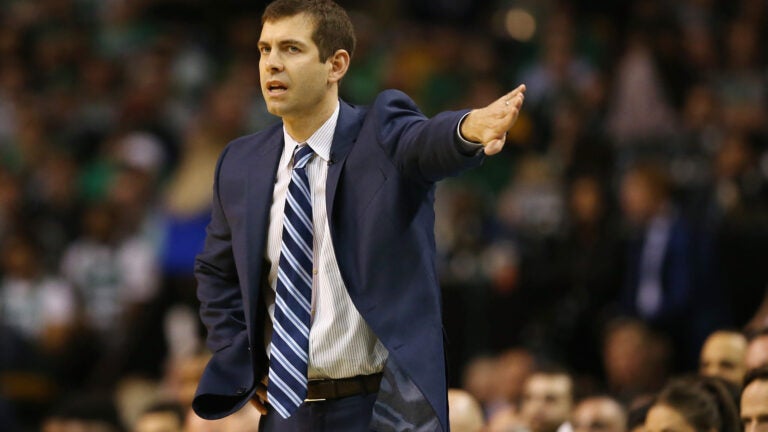
Boston Celtics head coach Brad Stevens crafts a play during a timeout in the first quarter of a game against the Dallas Mavericks on Dec. 6, 2017.
He turns role players into stars.
During his first two years in the league, Terry Rozier was on the fringes of the Celtics’ rotation. Stevens put the point guard and the rest of his neighbors on the end of the bench through mandatory off-day workouts to keep them sharp. Even for these players, the head coach would stay until the last shot landed, every time.
“He’d just always care,” Rozier said, per the Washington Post. “Even when guys would get extra reps, the guys that weren’t playing as much, he’d be there always watching until you were done. Sometimes, he would jump in the drills. You’re not seeing too many head coaches do that.”
These days, Rozier is earning his off days. He’s averaging 17.4 points for the Celtics during the playoffs, including two that came on a tomahawk dunk when Rozier soared above LeBron James. It’s a star turn for the former role player, and a story familiar to any Boston fan during the Stevens era.
First there was Evan Turner, who experienced a career revival after signing with the Celtics in 2014. He was dealt by the team that drafted him, the Sixers, and allowed to reach unrestricted free agency by the Pacers. In Boston, Turner filled in anywhere Stevens asked him to and averaged 10 points, 5 assists, and 5 rebounds over two years. He parlayed those numbers and strong defense into a stunning four-year, $70 million contract with the Portland Trail Blazers that had Turner himself laughing.
Stevens knew Turner was great with the ball, the coach said last year, so he gave him the ball.
“Everybody is in the NBA for a reason,” Stevens said. “They have a special talent. They have a special ability. Sometimes people get put in a box of what they can’t do, instead of focusing on what they can. Our jobs are taking the 15 guys on the team, focusing on what they do best, and helping them soar with what they do best.”
Then there was Isaiah Thomas.
“Isaiah Thomas is the 60th pick in the draft,” Celtics co-owner Steve Pagliuca recalled. “He had been on three teams — and we thought he was a good — but people thought he was just a spark plug off the bench. Under Brad Stevens and the system, he becomes an All-Star, two years in a row.”
The Brink’s truck looked to be backing up for Thomas, too, until a season-ending hip injury and two trades in six months sliced into his chances for a max deal. For what it’s worth, Turner and Thomas haven’t forgotten the coach that let them shine.
https://twitter.com/isaiahthomas/status/994293891388985344?ref_src=twsrc%5Etfw&ref_url=https%3A%2F%2Fwww.nbcsports.com%2Fboston%2Fceltics%2Fisaiah-thomas-brad-stevens-far-best-coach-nba
That’s crazy..only in America! https://t.co/D9TGkz5O8B
— Evan Turner (@thekidet) May 9, 2018
His teams are known for their switchability on defense.
In a league shifting towards positionless basketball, smaller lineups, and defenses that switch on everything, the Celtics roster stands out as one of the best equipped for the new NBA. Stevens has six players that can capably match up against all five positions, a five-time All-Star roving the paint, and an abundance of top-tier talent on the wing. Take that combination, sprinkle in the defensive intensity Stevens demands, and you get the top unit in the league by points allowed per possession and opponent’s three-point percentage.
The defensive system Stevens ran in college was so complicated that one player said it took until their junior year for the players to fully grasp it. It’s one thing to ask, and receive, the necessary buy-in from under-recruited, chip-on-their-shoulder teenagers at a mid-major. It’s another and infinitely more impressive accomplishment to do the same in the professional ranks.
How does Stevens do it?
There’s the assured presence and the careful language and the honesty, but there’s also a more pragmatic element.
“If guys aren’t doing their jobs,” Horford told Lowe. “They just won’t play.”
Another factor is that Stevens comes prepared. On Selection Sunday before Butler launched its second run to the Final Four, his players had 15 minutes of TV interviews after they found out they were matched up against Bucknell. Then they walked into a team meeting, where Stevens was waiting with a scouting report on their opponents. The players burst out laughing.
“I don’t even know where he gets that information so quickly,” one said.
Stevens proved at Butler that he can find an edge with analytics and maximize the talent on a roster. But it certainly helps when the roster is jam-packed with talent. The Celtics, as assembled by Danny Ainge, have the size, strength, and versatility to play lock-down defense through any array of switches and cause havoc when the same occurs on the opposite end of the court. They’re earning the respect of the coaches trying to poke holes in their plan.
“I have said this before, [the Celtics] are elite guarding their own men,” Sixers coach Brett Brown said after Boston held his star rookie to a single point in Game 2. “I think there’s a physicality and switch-ability that they got apples for apples on many, many different matchups. With Ben [Simmons], I give him credit. They do a good job defending him. There’s an element of physicality that I feel that they have applied to all of us and tonight Ben struggled as we see. I do give Boston’s defense a lot of credit and respect.”

Brad Stevens in the Celtics huddle during a time out against the Cleveland Cavaliers.
His offenses share the spotlight and execute in the clutch.
Much of the adulation that lands on Stevens’s offenses comes after one of his late-game ATO’s. Those after timeout plays sometimes have his players shaking their heads as he scribbles on the whiteboard, but the sport of basketball has a habit of working out as Stevens intends it to.
During the final seconds of overtime against Philadelphia in Game 3, Stevens called timeout and went to work. Boston came out of the huddle, ran a series of screens that drew Joel Embiid out of the paint, and found Al Horford one-on-one under the basket. Entry pass. Layup. Game.
After the buzzer sounded on another Celtics win, Horford was asked if the final play had gone as planned.
“Totally,” he answered. “Brad is a genius, man. Unbelievable. Sometimes he draws stuff up and I look at him like, ‘I didn’t think [that’d work].’”
Stevens’s ATO specials required a bit of adjustment when he first entered the NBA. In 2013, Gerald Wallace said his first-year head coach “still got some college in him.”
“One of the funnier things is when he draws up plays in the huddle during timeouts,” Wallace said. “He draws them like we have a 35-second clock.”
But once Stevens figured out the shorter shot clock, the Celtics became one of the best comeback and close-out teams in the league. In 2017, Boston had four more wins after trailing in the final 12 minutes, 25, than any other team. That Celtics outfit had Isaiah Thomas to take the ball with the game on the line, and for much of the this season Kyrie Irving filled the same role. But Boston relied more on its ball movement this year than any ball-dominant scorer, which set them up for continued success when Irving went out with a knee injury.
In Game 2 of the Eastern Conference finals, LeBron James had a 46.7 usage percentage for the Cavaliers. The Celtics player with the highest usage was Jaylen Brown, more than 20 percentage points lower at 25.7 percent. That shared scoring load, and the emergence of Terry Rozier, allowed Stevens to keep rolling out his system and watching the ‘next man up’ thrive.
For all the praise the Celtics head coach receives, he’d rather follow the lead of his players and share the spotlight.
“It’s silly,” Stevens said . “The praise is uncomfortable, and it’s just something that these guys should be getting it all. We all have a role to play, and we all need to play that role as well as we can.”