The Celtics are using positionless basketball to slow ‘The Process’
Here's how Boston is trying to contain Ben Simmons and the 76ers.
COMMENTARYThere was a common thread through Danny Ainge’s Summer of ‘17.He passed on the point guard everyone had at the top of the draft to trade down and take a 6-foot-8-inch wing. He signed a 6-foot-8-inch wing away from Utah. To do so, he had to make a trade, which brought him a 6-foot-9-inch wing. Of course he made other moves, but he added six players last summer who are listed between 6-feet-7-inches and 6-feet-9-inches.In Game 1 of the Conference semifinals, three of those guys — Marcus Morris, Jayson Tatum, and Semi Ojeleye — were among those called on to slow down future phenom Ben Simmons. The other two players who guarded him, Marcus Smart and Al Horford, fall just outside that height range but share similar attributes to those wings. This is what the Celtics always wanted. This is how it was always supposed to be. In a series where people are lauding the success of “The Process,” few are discussing the other plan we’re witnessing in action. Why have the Celtics been able to withstand the loss of player after player? How is it possible that Boston would come out of the gates with a pretty comfortable win even after Jaylen Brown was ruled out with a hamstring injury? Because the Celtics’ plan to construct an super-switchy roster full of basically 6-foot-8-inch forwards (give or take a couple inches either way) makes it possible. It doesn’t have a catchy name like “The Process,” but it is what the team intended to build. Brad Stevens acknowledged it at the Utah Summer League last July. “I don’t have the five positions anymore. It may be as simple as three positions now, where you’re either a ball-handler, a wing or a big.“It’s really important. We’ve become more versatile as the years have gone on.”This is where shorthanded success all begins. The basic building block of the “next man up” mentality is having a next man who can guard more than one type of player. Take Ojeleye, for example, who has been a defensive difference-maker since being called upon. He’s a 6-foot-7-inch “Ox” but he has enough quickness to slide in front of quick players while possessing enough combat muscle to keep bigger players from getting comfortable. In Game 1 against Philadelphia, he guarded Ben Simmons and Ersan Ilyasova for stretches before becoming the primary defender on the much smaller T.J. McConnell’s short stint in the game.

The Celtics’ Semi Ojeleye (right) keeps the pressure on the Bucks’ Giannis Antetokounmpo as he tries to make a move to the basket in the second half of Game 7.
Morris also had cracks at Simmons and Ilyasova while also having success guarding J.J. Redick, Marco Belinelli, and Dario Saric for 15 combined possessions (and holding them to two combined points).
Add to that mix the super-versatile Horford, who spent equal time covering Simmons and Embiid, and you can see how the Celtics can morph into whatever Brad Stevens wants them to be defensively. It may not always work perfectly, but it often does work well.
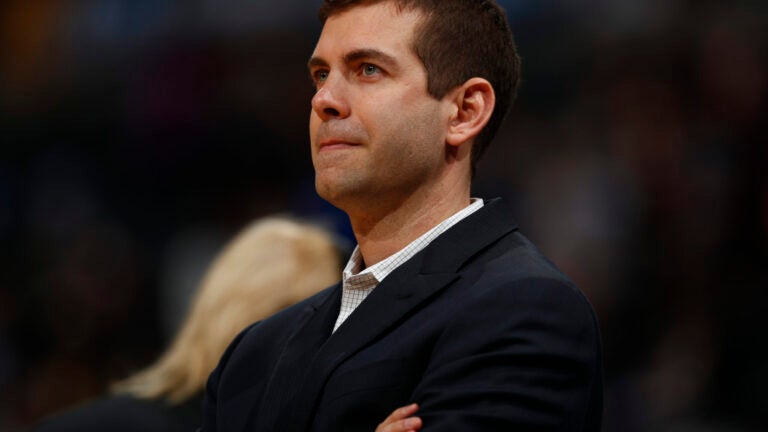
Stevens is the guy who gets most of the credit in these situations because he seems to be the constant as players shuffle in and out of the lineup. Stevens’s mastery of extracting every last drop of productivity from his cadre of switchy wings is the fire to Homer’s Flaming Moe.
Individually, and in different situations, these guys might just be bit players on some other team’s bench. In Boston, though, under Stevens, the mixture of their hard work and his (and his staff’s) tutelage and strategizing, this particular group of Celtics reaches unforeseen heights.
Those heights throw waves of defenders at individual players. By the end of the game, nine Celtics had a crack at defending Ilyasova. Eight Celtics took turns guarding Saric and Redick. Seven faced Belinelli at some point.
The Celtics defense in this series is predicated on a simple approach: Single-cover Embiid, stay home on the shooters, and contain Simmons so he’s not getting layups. With so many waves of Celtics flying at Philly’s shooters and making them uncomfortable, there is less of a chance the Sixers can bomb away freely and go on a huge run. With Simmons not dominating in the restricted area and not crushing the Celtics with assists, they’ve left him with his least-favorite option: jump shots.
From there, it almost doesn’t matter what Embiid does. His scoring isn’t always efficient and it isn’t what makes Philly so dangerous. The Sixers are at their best when Embiid is defending, Simmons is out in transition, and their shooters spot up to catch and shoot wide open shots. Embiid dominating possessions by holding the ball for nearly half of the shot clock before making a post move is the antithesis of that. That plays directly into the Celtics’ hands because it slows the pace down to their comfort level and it eliminates the greatest Sixers threats for extended runs.
There are adjustments to be made in this series for both teams, and Philadelphia’s talent and coaching make overreacting to Game 1 a fool’s errand. The Celtics, though, are constructed to adjust to that challenge. Win or lose, they will make Philadelphia earn everything they get on the floor.
That’s because the Sixers aren’t the only team watching a plan come to fruition. Theirs has been more dramatic and, for good reason, subject to much more scrutiny. But Boston’s is just as calculated. Their embrace of positionless basketball and the deployment of similarly sized and skilled players was hatched from Danny Ainge’s brain a long time ago, immediately embraced by Stevens, and polished by a long series of moves that has gotten this team closer than ever before to its desired roster construction. This is their process.
It just needs a catchy name.