5 takeaways from the Celtics’ thrilling Game 1 win over the Bucks
COMMENTARY
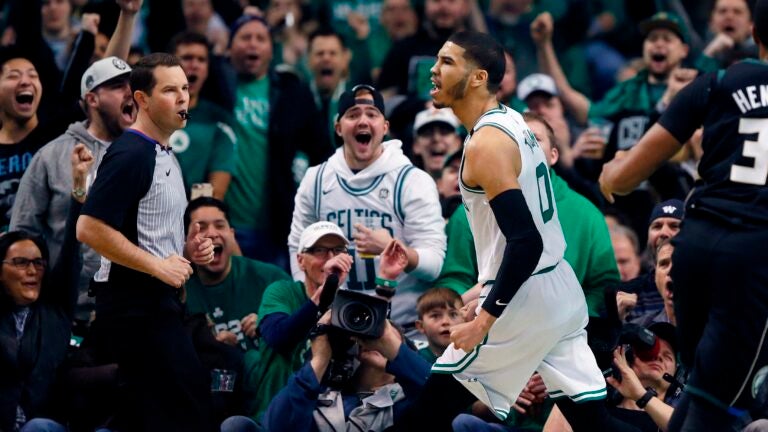
After nearly 48 minutes of back-and-forth basketball, Terry Rozier hit an open three-point shot to give the Celtics a 99-96 lead with 0.5 seconds remaining in regulation.
Game 1 appeared to be in the books.
But Milwaukee’s Khris Middleton proceeded to drill a long three of his own to tie the score at 99 apiece and force an overtime period. Middleton’s stunning 35-footer could have easily been discouraging, but the Celtics didn’t let it faze them.
“We never feel like the game is out of reach, especially with the way we’ve competed all year,” Jayson Tatum told reporters after the game. “In the games we’ve had great comebacks in, we always know it goes down to the wire with us.”
Five additional minutes of basketball later, and the Celtics pulled off a gritty 113-107 win to take the early 1-0 series lead.
Here’s what we learned from their victory:
The Celtics’ offense was a team effort.
Four Celtics — Al Horford, Jaylen Brown, Marcus Morris, and Rozier — all scored 20-plus points, with Tatum just one point shy of making it five. The Bucks’ offense, on the other hand, featured a combined 66-point effort from Middleton and Giannis Antetokounmpo.
“That’s what we’ve been about all year,” Horford told TNT after the game. “That’s the way we got to do it. We’re missing, obviously, a lot of our top players. We just got to find a way. We’re really moving the ball.”
Because of Milwaukee’s incredible length, the Celtics attempted to get more players involved by spreading the floor and passing the ball to the right spots.
“We just tried to get the ball to both sides,” Rozier explained. “We know they’re long and athletic, but we don’t feel they move as quick as us laterally, so we just try to keep moving the ball side-to-side and try to catch them sleeping. ”
Boston’s youngsters kept their composure.
Rozier said he was “mad as hell” when Middleton nailed the game-tying shot, but he never once thought the Celtics were out of the game.
“You could tell people were upset a little bit,” he told reporters. “But we’re still living in the moment and we had to fight. We had each other’s back and we never stopped believing. We could have easily been deflated at the end of regulation, but we all stuck together.”
Rozier said Brad Stevens and other members of the coaching staff did a great job with keeping the morale high, as the team entered the overtime period with an emphasis on unity and execution. Stevens said he knew his players wouldn’t hang their heads after Middleton’s improbable three-pointer, noting that the group is sometimes at its best when “those things” happen.
“It’s just a really resilient group of kids,” he said. “Not kids. Men.”
The Celtics battled a number of other challenges throughout the game, from questionable foul calls — Boston was over the penalty limit for the final eight minutes of regulation — to inconsistent shooting from the field. Tatum started 4-of-4 before missing his next seven shots, while Rozier was 1-of-6 from behind the arc before making a pair of critical three-pointers late in the game.
“They both have the ability to bounce back after those stretches,” Stevens said. “Sometimes young players don’t have that ability.”
“I don’t ever care about the shots,” he continued. “The shots will go if they go, as long as we’re taking good ones. … I mean, even the best players, they’ll go through their ups-and-downs — their lulls in the game.”
Al Horford’s performance was definitely not average.
Horford — who notched 15 double-doubles during the regular season — scored 24 points and grabbed 12 rebounds to appease the critics (e.g. Charles Barkley) who seemingly only look at the box score. Horford also recorded four assists, three blocks, and two steals, but his performance was impressive beyond its numbers.
Not only did the five-time All-Star do an exceptional job of guarding Antetokounmpo, but he also stayed aggressive on offense — both by pursuing the ball and involving his teammates.
“We’re going to ride Al,” Stevens said. “With where we are now, he’s going to be more of a featured scorer and facilitator, while also guarding Giannis and probably running our film session tomorrow.”
Horford accumulated over half of his points at the free-throw line, noting after the game that the Bucks did a good job of “fronting and making it difficult for [him] to get the ball.” Horford said Milwaukee’s defense forces him to play closer to the basket — an adjustment he says he’s comfortable making.
“He earned all 14 free-throw attempts,” Stevens said. “I know that because he was really, really working to get to the line and to get position early. I thought Al battled. I thought everybody looked a little gassed at the end of overtime. I’m not sure anybody was more tired than Al, because he put in an incredible effort for us.”
Horford’s efforts benefited the Celtics throughout the game, but his consistency was particularly impactful in the fourth quarter. The 31-year-old went 5-for-6 from the free-throw line to help the Celtics maintain a consistent three-point lead in the final 30 seconds of regulation — prompting the TD Garden to play Paul Simon’s “You Can Call Me Al” during a timeout.
“I just got to do a better job guarding Horford,” Antetokounmpo said after the game. “He’s a really big body. He knows he’s under control. He knows what he’s doing down there. Hopefully, in Game 2, I won’t play on my heels and I’ll play more on my toes.”
‘There’s no question ball handling is a critical part of this series.’
Both head coaches knowingly emphasized the importance of ball handling during their media availability before the game.
“There’s no question that ball handling is a critical part of this series,” Stevens told reporters. “We have to be able to handle the ball. We can’t turn the ball over because we have no chance to guard those guys on run outs.”
Stevens, unsurprisingly, was right. After jumping out to a 12-point lead to close the first quarter, the Celtics turned the ball over in four of their first five possessions to start the second. A series of uncharacteristically bad passes from Shane Larkin facilitated a 26-4 Milwaukee run, as Boston’s messy offense inhibited the team’s ability to get back on defense.
“There’s going to be ups and downs as you go through the game, OK?” Stevens told his team during a second-quarter timeout. “Let’s not compound them now. Let’s be better at handling the ball. Play the right way, handle the ball, be tough and be solid, good things will happen.”
The Bucks also struggled with ball security, logging eight turnovers in the first quarter alone. Milwaukee had 20 total turnovers throughout the entire game, which Middleton identified as a major missed opportunity for the team.
“Too many turnovers,” he told reporters. “That’s not getting the shot up. We feel like if we get our shot up, we’ll be good with our shots. We get great shots every time down the floor. Me, Giannis, and the other guys got to trust that they’re going to knock down the shot.”
Bucks coach Joe Prunty echoed Middleton’s sentiment: “One of the biggest things we have to do is take care of the ball because we’ve been sloppy … We do want to get downhill and then we want to kick it. That’s either a shot or kick it again.”
The Celtics can more than likely count on Marcus Smart’s return if they advance.
Still recovering from surgery to repair a torn ligament in his right thumb, Celtics guard Marcus Smart expressed confidence in his coming return.
“I got hopes,” he told reporters before tip-off. “We’re very optimistic. But the last thing we want to do is get out there and rush anything.”
Smart — who underwent a successful procedure in mid-March — said his rehab is on track for “definitely the second round” and possibly Game 7 of the Celtics-Bucks series. Smart’s assessment puts him on the earlier side of his original recovery timetable of six to eight weeks. It’s possible his return could be pushed up even earlier — depending on the results from his next doctor’s appointment.
“Hopefully, in the next couple weeks, things change and we can move it up earlier, but for right now, it’s going to stay the same,” he said. “We’re going to take it slow.”
The 24-year-old was on the court prior to tip-off Sunday afternoon — getting shots while wearing a new, smaller split that will protect the thumb from re-injury. He said the torn ligament is “fixed” and “100-percent healed,” so his current focus is trying to re-strengthen the muscle and re-acclimate to playing with contact.
“It feels pretty good, actually,” he said, after taking a series of jumpers and free throws. “For me to be able to feel the ball again is a big difference.”
Smart said his biggest limitation, as of now, is just re-stimulating his muscle memory and seeing how the splint affects handling the ball through contact.
“We’re just trying to ease our way in,” he said. “We want to pick things up, while trying to ensure we don’t go back to square one.”

Marcus Smart sits on the bench in the second half against the Utah Jazz, Wednesday, March 28, 2018.