
How can the Celtics stop Giannis Antetokounmpo?
The Greek Freak is already great at many things. The trick is getting him to do the things at which he isn't.
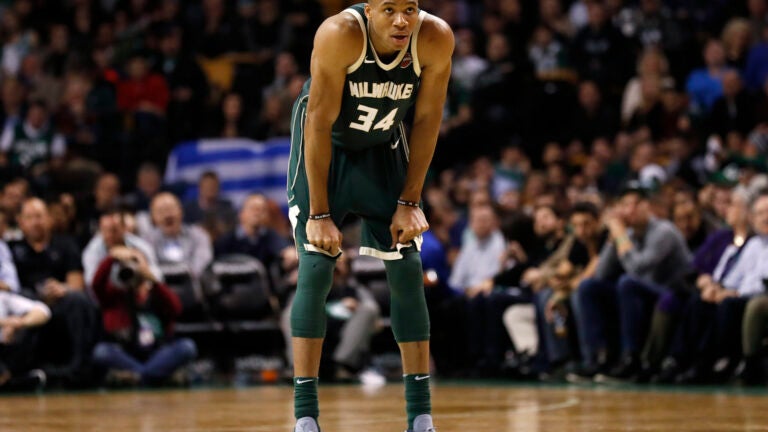
It’s a simple question on paper, but a difficult proposition on the court: How do you stop Giannis Antetokounmpo?
That’s the question Boston Celtics fans will be asking when the Milwaukee Bucks’ transcendent “Greek Freak” enters the TD Garden Sunday afternoon for Game 1 of their first-round playoff series. So far, not even the Celtics and their league-best defensive rating have truly had an answer.
Related Links
The question of Antetokounmpo has puzzled the rest of the NBA as well. The 6-foot-11 positionless 23-year-old averaged nearly 26.9 points, 10 rebounds, and 4.8 assists per game this season, and is considered a top-five MVP candidate.
The Bucks and Celtics split their four-game regular season series, with each team winning two games apiece. In those four games, Antetokounmpo’s averages ballooned to 33.5 points, 10.8 rebounds, and five assists on 53.9 percent overall shooting. Crucially, nearly half of the 89 shots he took in those four games came at the rim, where he shot 76 percent this season. Against the Celtics, Antetokounmpo was even better when he got to the rim, shooting 34 for 41, or nearly 83 percent.
However, outside of the distance at which his arms can reach the rim, his efficiency drops dramatically. On two-pointers outside of three feet, Antetokounmpo makes less than 35 percent of his shots. From three-point range, he shoots 30.7 percent.
The fact that Antetokounmpo’s shot is still a work in progress is somewhat obscured by his effectiveness getting to the rim. Against the Celtics, he shot just 6 for 28 from 10 feet or more from the basket. But those 28 shots were dwarfed by the 61 shots he took (of which he made more than two-thirds) inside of 10 feet.
So, again, stopping Antetokounmpo isn’t an overly complicated question. But as Al Horford noted Friday, it’s “easier said than done.”
Al Horford says the key to slowing Giannis is to “make sure we’re between him and the basket as much as possible,” but then he adds, “Easier said than done.”
— Boston Celtics (@celtics) April 13, 2018
Even though he plays like a ball-dominant wing, Antetokounmpo doesn’t use quickness or any dazzling crossovers to beat his defenders. Instead, he wields his 7-foot-3 wingspan and improved strength to stride to the rim. That combination of length and versatility can create matchup nightmares against smaller players or slow-footed big men.
However, a like-sized defender with the lateral quickness to stay in front of Antetokounmpo can at least bring him back to earth. Sound like anyone in particular?
As Horford told reporters Friday, the key is to “make sure we’re between him and the basket as much as possible.” As the “engine” of the Celtics’ heralded defense, the 6-foot-10 forward often found himself guarding Antetokounmpo in their first four matchups this season. In the Celtics’ win in Milwaukee last October, Horford was even able to limit the Greek Freak to a pedestrian (for him, at least) 28 points on 10 for 21 shooting by laying off the Bucks star on the perimeter and sliding to cut off his angles to the hoop.
But it won’t all be on Horford. The Celtics have used other players against Antetokounmpo, such as Marcus Morris and their sturdy rookie forward Semi Ojeleye, whose defense on him earned praise last October.
“It’s not on one person to guard Giannis,” Celtics coach Brad Stevens told reporters Friday. “We have to throw a lot of different bodies at him.”
Center Aron Baynes, whose been on the receiving end of a few of Antetokounmpo’s ferocious rim attacks, also told reporters earlier this week that it would be a team effort.
“It’s not one man’s job,” Baynes said. “It’s four or five men on a string.”
Aron Baynes on the challenge of defending Giannis in postseason: “It’s going to be a team effort. It’s not one man’s job. It’s four or five men on a string. … He’s very talented and he’s a great player so we’re going to have to lock in and do a job collectively on him.” pic.twitter.com/lZ693x08ZJ
— Chris Forsberg (@ChrisForsberg_) April 12, 2018
Beyond individual matchups, another key will be limiting Antetokounmpo’s opportunities in transition. Only Russell Westbrook and LeBron James had more fast-break points this season, but Antetokounmpo’s 1.20 points per possession in transition was more efficient than both of them. In comparison, his points per possession in half-court isolation or in the post are 0.88 and 0.92, respectively.
The Bucks offense relies heavily on the scoring and creation of Antetokounmpo, whose 31.2 percent usage rate is fifth among eligible league leaders. So if the Celtics can force him into the shots and situations in which he’s not most efficient — or at least not abjectly terrifying — they should have a good chance at warding off an upset.


