How the roles of various Celtics players change with Kyrie Irving sidelined
Terry Rozier, Shane Larkin, and other contributors have embraced added responsibility in Irving's absence.
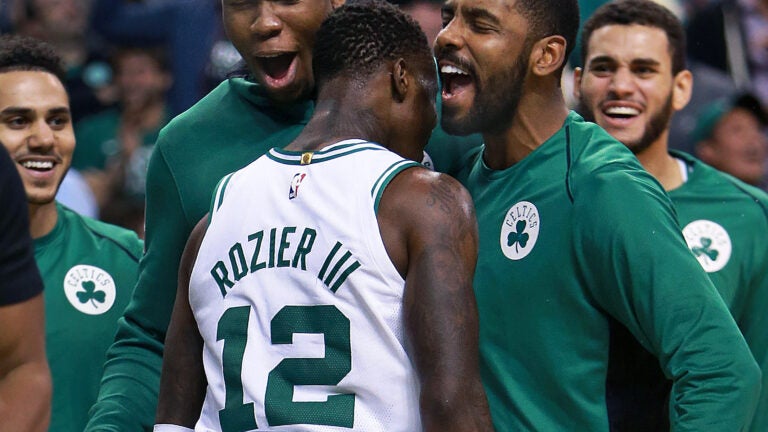
The Celtics’ chances of reaching the NBA Finals unquestionably took a significant hit with the news that Kyrie Irving will miss the remainder of the season, but just how much of a hit – and how far this team can advance without its best player – remains to be seen.
Some basketball pundits believe the Celtics will fizzle in the first round, while others feel as though reaching the Finals is still a legitimate goal. A season once brimming with promise has gradually morphed into one potentially marred by a ruthless string of injuries.
Time will tell how their playoff fate unfolds, but regardless, it’s clear this team’s identity is going to be different than it was the bulk of the season. Without Irving, who averaged 24.4 points, 5.1 assists, and 3.8 assists in 59 games this year, the Celtics were 14-7 as of Monday (including a game on Nov. 10 in which Irving played two minutes).
Here’s how the Celtics fared in games without Irving this season:
Hornets, Nov. 10, 90-87 W
Raptors, Nov. 12, 95-94 W
Bulls, Dec. 11, 108-85 L
76ers, Jan. 18, 89-80 L
Knicks, Jan. 31, 103-73 W
Hawks, Feb. 2, 119-110 W
Blazers, Feb. 4, 97-96 W
Bulls, March 5, 105-89 W
Wizards, March 14, 125-124 L
Magic, March 16, 92-83 W
Pelicans, March 18, 108-89 L
Thunder, March 20, 100-99 W
Blazers, March 23, 105-100 W
Kings, March 25, 104-93 W
Suns, March 26, 102-94 W
Jazz, March 28, 97-94 W
Raptors, March 31, 110-99 W
Bucks, April 3, 106-102 L
Raptors, April 4, 96-78 L
Bulls, April 6, 111-104 W
Hawks, April 8, 112-106 L
Boston was 6-5 against potential playoff teams, 2-4 against Eastern Conference playoff teams, and 0-2 against possible playoff opponents, ripping off a six-game winning streak in late March to shift the trend.
The Celtics have averaged 99.7 points without Irving this season (as of Monday), compared to 103.9 overall. However, they gave up 98 points per game with him gone, down from their season average of 100.3.
In addition to altering the team dynamic as a whole, Irving’s absence has a significant effect on individual players. Terry Rozier’s role has changed the most, but every rotational player has had to do a little bit more sans superstar.
Here’s a look at how various Celtics performed without Irving in the regular season, and how their roles are redefined with him sidelined.
Terry Rozier
Ever since Irving’s season ended March 11, Rozier has emerged as reliable option for the Celtics. They’re asking a lot of the third-year guard, but he’s delivered so far in a career-altering stretch.
Rozier’s season averages of 11.3 points, 4.7 rebounds, and 2.8 assists in 25.8 minutes are impressive alone, but his numbers have increased significantly, to 15.2 points, 6 rebounds, and 4.9 assists in 32.1 minutes without Irving.
No Doubt No Fear this way
— Terry Rozier (@T_Rozzay3) April 5, 2018
The shifty guard has certainly had some duds (2 points on 1 of 9 shooting against the Raptors on Wednesday, for instance), but his consistent production has helped mitigate the inevitable drop-off.
He has a rebound percentage of 9.8, which ties him for second in the NBA among players 6’4″ or shorter – behind Russell Westbrook and on par with Chris Paul.
The Celtics rely on Rozier in a heavy dose of pick-and-roll situations, and they count on him to be a main playmaker with the ball in his hands. His performance could end up being a major factor in how far they ultimately advance.
Shane Larkin
With Irving and Marcus Smart out, and with Rozier moving to a starting role, Larkin has emerged as the backup point guard. He had a tough game Sunday afternoon – missing two key free throws and a wide-open layup late – but overall he’s been a bright spot for coach Brad Stevens.
The 5’11″, 175-pound guard covers up his lack of size well, but the Celtics undoubtedly become smaller and less flexible with switches when he’s on the floor.
Larkin, the former Atlantic Coast Conference player of the year, averaged just 8.8 minutes per game in November and 7.3 in February, but he’s played 23.5 minutes per contest in March and 21 in April.
He’s averaging 4.1 points and 1.6 assists on the season, but those numbers have swelled to 7.3 points and 3.1 assists in 15 games without Irving.
Larkin has only played 10 playoff minutes in his career, back in 2013-14 with the Mavericks, so this is a major chance to prove himself in a high-stakes situation. The Celtics will count on him to hit open shots and find his teammates and play steady defense.
Al Horford
The Celtics have turned to Horford to bring the ball up in stretches this year. The 6’10 power forward is comfortable banging down low and hitting open perimeter shots, but he’s also consistently shown his versatility as a passer and dribbler.
Horford has attempted 10.5 field goals per game this season, his lowest in the last six years. Interestingly, he’s only attempted 11.1 when Irving has been absent, which isn’t much of a spike.
He’s been a threat from the outside (43.5 percent) without Irving, up slightly from his season average of 43.2 percent, but he’s attempted 2.5 3-pointers per game without him compared to 3.1 on the year.
His assist totals are actually lower when Irving doesn’t play (4.1 from 4.7) as well. Though some of his offensive numbers are down without Irving – and his game doesn’t become any more flashy – he’s been a major reason the Celtics’ defensive numbers are better in those games.
Jayson Tatum
Without Irving, the natural tendency would be to think that the sharpshooting rookie Tatum would take more shots, and that’s exactly what’s happened.
He’s attempted 13.4 shots per game without Irving, as opposed to 10.4 on the season, but his field goal percentage hasn’t decreased in the process (47 both with and without Irving).
.@jaytatum0 at the 🚨! https://t.co/Cj4NlrcRnH
— Boston Celtics (@celtics) April 4, 2018
Tatum is shooting 50 percent from the field, 45 percent from 3-point range, and 85 percent from the line in Celtics wins, compared to 42 percent from the floor, 38 percent from distance, and 78 percent from the stripe in losses. Irving or no Irving, it’s clear how important Tatum is to this team’s success.
He’s been the Celtics’ most durable player this season, and they’ll need him to produce efficiently in order to get out of the first round. It’s a lot to ask of a rookie, but a challenge he’s proven he’s capable of to this point.
Jaylen Brown
Brown has battled a serious injury of his own lately, but he’s been extremely efficient ever since returning to the lineup March 25. He’s shot 52 percent from the floor (46 for 88) in those eight games, while hitting 56 percent of his 3s (14 for 25).
His free-throw percentage was just 59 before the All-Star Break, but he’s shot 82.7 percent since.
Career-high 32 points on 7-10 from 👌 for @FCHWPO 🔥 https://t.co/3Tom6b9jQ4
— Boston Celtics (@celtics) April 7, 2018
Brown had perhaps his best game of the year Friday in a 111-104 win over the Bulls, when he scored a career-high 32 thanks in part to a whopping seven 3-pointers.
Jaylen Brown on running the point: “It was a little weird. Point guard is a lot of responsibility. You’re not just trying to score; you’re trying to get other guys involved. So we really appreciate guys like Terry, Kyrie, Marcus & Shane.”
— Boston Celtics (@celtics) April 4, 2018
With Irving out, Brown becomes even more of a focal point offensively. Like Tatum, the Celtics rely more on Brown for dribble penetration, and they trust him to be a playmaker and distributor as well.
Other Celtics
The most noticeable way other Celtics are affected by Irving’s absence is that they have to work harder for their shot on offense. When Gordon Hayward went down to start the year, it placed added pressure on the top scorers to produce. Now that Irving is gone, the onus falls even more on the other guys.
Monroe spins in the lane and scores the and-one bucket! https://t.co/JdC7rmNIQW
— Boston Celtics (@celtics) April 7, 2018
Greg Monroe, Marcus Morris, Aron Baynes, and Semi Ojeleye have all carved out a role for themselves, and they’ve given the Celtics some frontcourt depth they’ve lacked in recent years.
Life won’t be easy for the Celtics without Irving, but this core hopes its collective parts are enough to do the job.