These 3 Celtics players will be most impacted by the Kyrie Irving trade
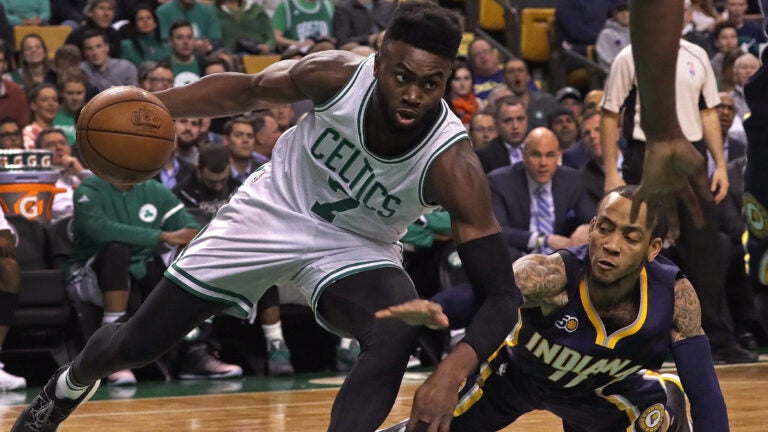
COMMENTARYKyrie Irving is a Celtic. I felt like that was a necessary reminder because just seeing that sentence, even after all that’s transpired, still feels like I’m living in an alternate universe. The Celtics have completely overhauled a roster that reached the Eastern Conference Finals last year. Four players, and just one starter, are coming back. That leaves a lot of opportunities for some very young guys to earn minutes in this new Celtics rotation. We know Irving, Gordon Hayward, and Al Horford will be starters. That’s the new Celtics “Big Three” and where most of the team’s success will be generated. But the typical NBA rotation is nine or ten players during the regular season, which means there are seven slots, two in the starting lineup, that need to be filled. So who will be impacted the most?Jaylen BrownThere’s a great chance he was going to be asked to do a lot this season regardless, but losing both Thomas and Crowder (after already losing Avery Bradley) is going to give Brown a chance to play a lot, and at a few different positions. In a recent podcast appearance, Brad Stevens told Chris Mannix in no uncertain terms that Brown would have to become a “lockdown defender” this season. Not only will the Celtics need to fill Crowder’s defensive loss on the wing, they’ll still need someone to help out on the perimeter.Some of the backcourt questions will be similar in the post-Thomas era. Aside from height, there is no real defensive upgrade in Irving over Thomas at the point guard position. While there is an inherent advantage in playing a 6’3” player rather than a 5’9” player at that spot, the Celtics will still have to find ways to hide Irving defensively.Starting the 6’7” Brown on the perimeter alongside Irving gives the Celtics a long, versatile defender who can switch onto guards and forwards. Brown could be asked to check either opposing guard to start games while the Celtics toggle between Aron Baynes and Marcus Morris to match up in the frontcourt. From there, the Celtics’ substitution patterns could shift Brown into a different role. If Stevens decides to bring Smart in for Hayward, then Brown would pick up a small forward. If the other team goes small, Stevens could counter with Smart in for Morris and slide Brown to the small-ball 4 slot.Losing Crowder puts some pressure on Boston to find a capable defensive replacement. Brown was always going to be looked at as a solution to defensive issues in the backcourt, but now he could play any of the non-ball handling perimeter positions. It’ll be asking a lot of a second-year player, but Brown has the athleticism and work-ethic to give himself a chance to live up to this expectation. There are a lot of minutes for Brown to earn on this team. He could see his totals from last season (17.4 minutes per game) nearly double. Marcus SmartAssuming the Celtics start Irving, Brown, Hayward, Horford, and Marcus Morris, Boston will need a lot of help scoring off the bench. Some of the second units will be helped by staggering Irving and Hayward (much like we’d figured Stevens would do with Hayward and Thomas), but the Celtics bench will still need to find other scorers. A lot of that will fall on Smart, both as a scorer and a facilitator. The Celtics will ask Hayward to initiate the offense from time to time, but Smart will essentially be the Celtics’ backup point guard. To do this, Smart is going to have to improve two big weaknesses: Shot selection and driving to score. The standard knock on Smart is “he can’t shoot.” While there is a lot of truth to that, it’s not as bad as it seems. Smart’s overall 3-point percentage was 28.3 (which is awful) but it was 31.2 percent on catch-and-shoot opportunities (still bad, but better) while it was 19.5 percent on pull-ups (vomit emoji). He shot 40.7 percent overall on corner 3’s while shooting 25.5 percent on above-the-break 3’s. He shot particularly well from the left corner (43.8 percent). That’s better than LeBron James (43.5 percent) and Steph Curry (43.3 percent). Those are a lot of numbers, but in then it really shows that if Smart can focus more on catch-and-shoot 3-point opportunities, especially from the corners, he can significantly improve his percentages. A great indicator of his ability to shoot is his improving free throw percentage, which has gone from 64.6 percent to 77.7 percent to 81.2% in his three years. Buried somewhere in all this “he can’t shoot” mess is a guy who can find a way to hit shot… at least enough of them to be respected by other defenders.Those free throws are also a great way to score. Unfortunately for Smart, he only took 3.2 per game last season, which was actually an uptick from 2.7 the previous year. Simply put, Smart needs to drive and get to the line more. Let’s do some quick math to add this all up: If Marcus Smart can play 75 games for the Celtics this year, take four 3’s per game and hit and an improved 33 percent (still below average, but significantly better), while getting to the line five times per game and hitting 80 percent of those free throws, while adding two or three two point shots (we’ll just use 2.5 as the number), he’ll average 13 points per game. Those are reasonable numbers and a three-point jump from last year.If he can do these things, he won’t just score more, he’ll become enough of a focal point to open things up for his teammates. He averaged 4.6 assists per game last season, and this level of efficient scoring would easily bump that up to nearly six. Not only is this reasonable, the Celtics will need him to step up and do that for the second unit. Jayson TatumYes, he’s a rookie, so we can’t realistically expect too much from him this season. But…If you believe the reports, Tatum was a guy Cleveland wanted, and the reason the Celtics had to give up the unprotected Brooklyn pick was to get the deal done without Tatum. So in the span of a few months, the Celtics traded away the top pick in in the 2017 draft and, possibly, a top pick in the 2018 draft just for the right to draft and keep Tatum. If you ever wanted an indication of what they think about this kid, there it is.In the short term, they will ask Tatum to fill a similar role as Brown did last season. You can expect 15-20 minutes per game that will fluctuate depending on how he’s doing on the floor. The need for bench production won’t sway Stevens who has historically pulled his rookies for egregious mistakes. Still, Tatum has shown an ability to create NBA-level offense for himself. I’d expect him to be play off of Al Horford a lot to maximize the abilities of perhaps the team’s best passer and smartest player. Tatum’s mid-range game can be particularly useful when teams over-commit to other shooters on the floor. In the long-term, though, the Celtics have clearly committed to Tatum as one of their future stars. They’ve resisted overtures and made big bets on him without him playing an official minute in Green. They will make sure he’s developing properly and, like Brown last season, will both rely on him to pitch in now while learning lessons to boost his whole career. The Celtics will obviously count on Marcus Morris to pick up some slack after this trade. Aron Baynes will get plenty of minutes this season to help as well. New guys like Semih Ojeleye, Guerschon Yabusele, and Daniel Theis may claw their way into some rotation minutes, but no one on the roster is impacted like those three players. In this new era of building talent around Irving, Hayward, and Horford, the Celtics will ultimately rely heavily on Brown, Smart, and Tatum to be important players now and in the future.