When he came to Boston, Kevin Garnett changed Celtic history
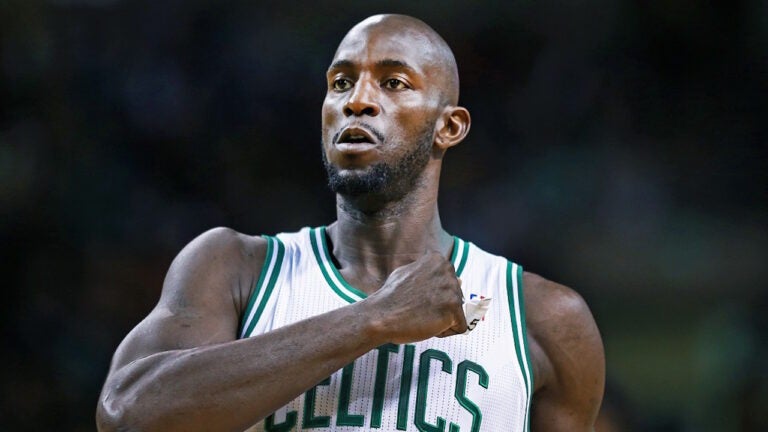
Ten years ago Monday, the Celtics pulled off a 7-for-1 blockbuster that ended up wildly lopsided in their favor, and not only from a who-won-the-trade perspective. It meant so much more than that.
On July 31, 2007, Danny Ainge and his old pal, Timberwolves general manager Kevin McHale, completed a deal that sent Al Jefferson, Ryan Gomes, Gerald Green, Sebastian Telfair, Theo Ratliff, and draft picks that became Wayne Ellington and Jonny Flynn from Boston to Minnesota for the one and only Kevin Maurice Garnett.
Acquiring Garnett, a lock for Springfield even before he arrived to become the screaming fulcrum of the Celtics’ 2007-08 championship team, was a heist of Auerbachian proportions by Ainge.
Perhaps history would view it as a more balanced deal had the promising Jefferson not blown out his knee or had McHale’s successor as GM, the hapless David Kahn, not foolishly taken Flynn over a sharpshooting wisp from Davidson College named Stephen Curry in the 2009 NBA Draft.
But that isn’t how it played out. And even an imagined best-case scenario of the deal for the Timberwolves is still a blowout win for the Celtics. Because Garnett wasn’t all they got in return.
When he came to Boston, something else came with him: The return of Celtics Pride, and the franchise’s identity.
Garnett changed everything, back to how it was in the good old days, back to how it was supposed to be. The Celtics had some mildly satisfying moments in the banner-free gap between the revered 1985-86 champions and the Garnett/Paul Pierce/Ray Allen title revival in ’08.
The 2001-02 team, which hustled and 3-point bombed its way to the Eastern Conference finals, was a fun overachiever, albeit one that played an aesthetically ugly brand of basketball. They were not a contender, but a charming pretender.
But the majority of those 21 years were pocked with lost hope and pure sadness. Len Bias died. Seven years later, unfathomably, so did Reggie Lewis. Injuries abbreviated Larry Bird’s run of greatness — it still staggers me that he was here for just 13 years. Time was cruel to McHale, too.
There were free agent signings of false hope — we got to find out what a parquet-bound Dominique Wilkins looked like, and it wasn’t pretty — and draft picks who fooled someone into thinking they were a chosen one (Jerome Moiso, anyone).
It is to Ainge’s eternal credit that he accumulated enough young talent during the mid-2000s to have the pieces to trade for a player of Garnett’s magnitude when one became available. But there was also incredible good fortune there, and not just because McHale preferred Jefferson to the Lakers’ Andrew Bynum.
It’s rare that a player of Garnett’s talent becomes available. It’s rarer still that one of his talent and on-court character does. The importance of this cannot be exaggerated. There are very few genuine, game-altering superstars in the history of the NBA who do not seem to care whatsoever about how many shots they get. Bill Russell is forever the prototype for this team-above-all approach, of course.
But it was Garnett’s way as well — he was a ferocious defender, a knock-down midrange shooter, a savvy passer, and an emotional leader. He was also something of a bully. I cannot see Zaza Pachulia nowadays without thinking of Garnett flattening him with a blindside screen in the first-round series with the Hawks in 2007.
What he was not was a ballhog, ever. The Celtics during his six years here would not have functioned as well if he were wired any other way. Paul Pierce had the best gig in the league when Garnett was here. Score, and score, and score some more, and maybe let Ray Allen get a few touches as well. The acquisition of Garnett changed nothing for Pierce, other than that his team won a heck of a lot more. Garnett was their best player, and yet also their most unselfish. He never seemed to care about anything other than winning that night’s game. Players with that mind-set are pure gold.
It’s why there should never be any debate regarding whether his number 5 should hang from the Garden rafters someday. Of course it belongs. Yeah, his run here was just six seasons, and he’s not in that tier with Bird and Russell, Celtics lifers and legends among legends who collected multiple championships. Among the 21 players whose numbers are already retired, only Lewis was a Celtic for an equally short span as Garnett, and that was due to tragedy.
Heck, I’ll acknowledge that Garnett belongs to the Timberwolves more. He began his career there, the lanky kid fresh out of high school, built his name and reputation there, even came back to Minnesota for the career coda.
But do not forget this: Garnett was a quintessential Celtic, a talented, fierce, selfless winner, the one player — the one person — beyond all others who restored what the Celtics stood for after a two-decade drought.
Celtics history changed 10 years ago Monday when Kevin Garnett came to Boston. He was the embodiment of what a Celtic was supposed to be.
So what if he was among us for just a half-dozen seasons? He’s still helping in the years beyond his departure. There’s a reason Brooklyn gave up all of those draft picks for Garnett and Pierce five years ago.
They wanted what the Celtics had. They wanted Garnett to bring to them what he brought back to Boston.